Denton's fleet services division not yet feeling impact of rising gas prices
Published: Mon, 03/14/22
Denton's fleet services division not yet feeling impact of rising gas prices
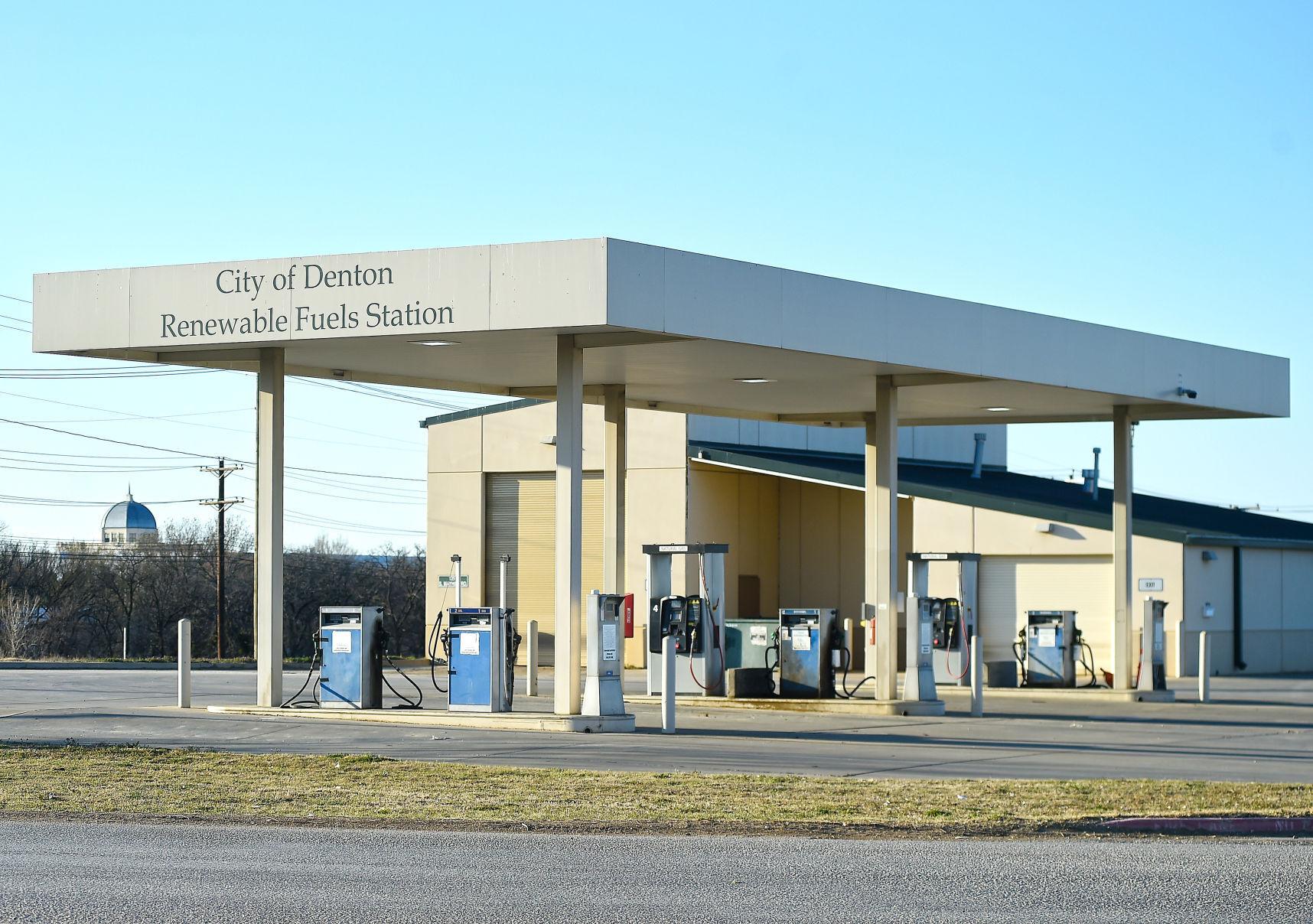
Denton’s Renewable Fuels Station is off Mayhill Road at the entrance to the city landfill, shown Saturday. The city has two fuel “islands” for its fleet of vehicles.
Denton hasn’t yet felt the impact of rising gasoline prices to fuel its fleet of city-owned cars, trucks and vans.
At the city’s two fuel “islands,” city employees can fuel up their work vehicles at a cost that goes to their respective departments. If you haven’t seen an EMT filling up an ambulance at a normal gas station, this is probably why, although they can fill up on fuel at ordinary gas stations if they need to.
“We have a mix of fuel types we provide to the fleet for a lot of your light-duty vehicles, and there’s a fuel card they can use,” Ethan Cox, Denton’s director of public works, said Thursday. “The fuel island tells us all that [fuel and mileage] information and the fuel cards have that as well. They can be used at any gas station if our staff needs to stop in. We know they don’t always have the ability to come to the fuel islands.”
Overall, the city has 1,061 vehicles and pieces of equipment in its fleet. Cox said they use a variety of fuel types. About 35% of the city’s vehicles use fuel other than traditional gasoline and diesel — instead, they may be powered by biodiesel or compressed natural gas. Some vehicles are electric or hybrid.
Cox said the city buys fuel in bulk several times a month, sometimes together with several government entities so they can get better purchasing power. Gas prices have started to rise internationally due to Russia’s invasion of Ukraine, but the city won’t feel that impact just yet.
Cox said the fleet services division spent $2.85 million on fuel last fiscal year, October 2020-September 2021, and is budgeting $3.83 million for the current fiscal year. For solid waste — which makes up 40% of fleet services customers — as well as the police and fire departments, Cox said they spent $1.275 million for all 715,000 gallons of fuel.
Cox said that since Russia’s invasion began several weeks ago, fuel prices have gone up — about 40% for diesel, 18% for gasoline.
“We do have some contracts, so we may be getting a better rate than the public,” he said. “We buy in bulk, but it will catch up to us.”
Cox said fleet services’ annual fuel budget is based on how much gas each department uses. Their fueling system runs an analysis and bills the proper departments, which he said each have their own fuel budgets.
“We were looking at the fleet budget a little earlier [Thursday],” Cox said. “With just three weeks of impacts so far, we’re really not seeing year-to-date any potential overrun when you look at just the first four months of the fiscal year. If this continues, we will anticipate overruns at the departmental level.”
That impact will vary by department, he said. The solid waste department uses a great deal of fuel compared to the other departments, so they would feel a greater impact than an administrative department such as finance. Any department with heavy equipment vehicles would see that cost hit them as well.
“If it looks like we’re going to expect a cost overrun, we’ll go to [City] Council when we know about it and say a budget amendment for additional expenditures for those,” Cox said. “Later in the year, we’ll have more data to evaluate trends.”