Quorum Questions: Killeen City Council broke quorum rules at community forum
Published: Sun, 04/03/22
Quorum Questions: Killeen City Council broke quorum rules at community forum

The Open Meetings Act Handbook for 2022 provides information for both the public and elected officials on how to remain compliant with the Texas Open Meetings Act of 1967.
The Killeen City Council appeared to violate the Texas Open Meetings Act of 1967 on Monday when Killeen City Council members Ken Wilkerson, Rick Williams and Mellisa Brown attended Councilman Michael Boyd’s District 4 update and community forum.
Texas law typically defines a meeting as a “deliberation between a quorum of a governmental body, or between a quorum of a governmental body and another person, during which public business or public policy over which the governmental body has supervision or control is discussed or considered or during which the governmental body takes formal action.”
However, a “meeting” may also be defined as a gathering at which “a quorum of members of the governing body is present” or one at which members of the governing body “receive information from, give information to, ask questions of, or receive questions from any third person, about the public business or public policy over which the governmental body has supervision or control.”
This last definition is especially important as Bill Aleshire, an attorney of 21 years, former Travis County judge and specialist in the field of transparency in government, said that the case appeared clear.
“It doesn’t matter; they could sit like potted plants, and have other people present them information, and it would still be a meeting under the Open Meetings Act if a quorum is present,” he said.
A quorum is defined by Texas law as “a majority of the governing body, unless otherwise defined by applicable law or the governing body’s charter.”
In the case of the Killeen City Council, a quorum is at least four City Council members or three City Council members and the presiding officer, who, in the case of Killeen, would be Mayor Debbie Nash-King. Nash-King was not present at the forum.
To his credit, Boyd informed the crowd of roughly 53 residents and city staff members that there was a quorum of City Council members present when Brown walked in; however, Boyd’s warning, though in good faith, does not constitute a proper notice.
According to Texas’ sunshine laws, proper notice must come 72 hours in advance of the meeting, include the specific items to be deliberated, and must be posted “in a place readily accessible to the public.”
Silence from city administrators
In this case, the city regularly posts City Council meeting notices on the city website and physically at City Hall. Notable exceptions to posting rules include disaster and emergency situations.
Aleshire explained that, although a notice was issued that the forum would take place, if it was not posted to the city website and physically at City Hall, and so long as it did not specify that a quorum of council members would be present, the meeting would certainly be in violation of the Open Meetings Act.
Killeen city administrators did not answer the Herald’s questions last week about the Monday night forum where a City Council quorum was reached without advanced public notice.
“Is this a violation of open meetings law? Does the city plan to do anything about this?,” the Herald asked city officials on Tuesday morning.
The email was not replied to until Thursday morning when Killeen spokeswoman Janell Ford said “Hi there, apologies ... I can work this.”
As of late Saturday, no further answers from the city have been sent to the Herald.
Top Killeen city staff was well aware of the meeting, and several of them attended, including Assistant City Manager Danielle Singh, Police Chief Charles Kimble and Joe Brown, the city’s executive director of Recreation Services,
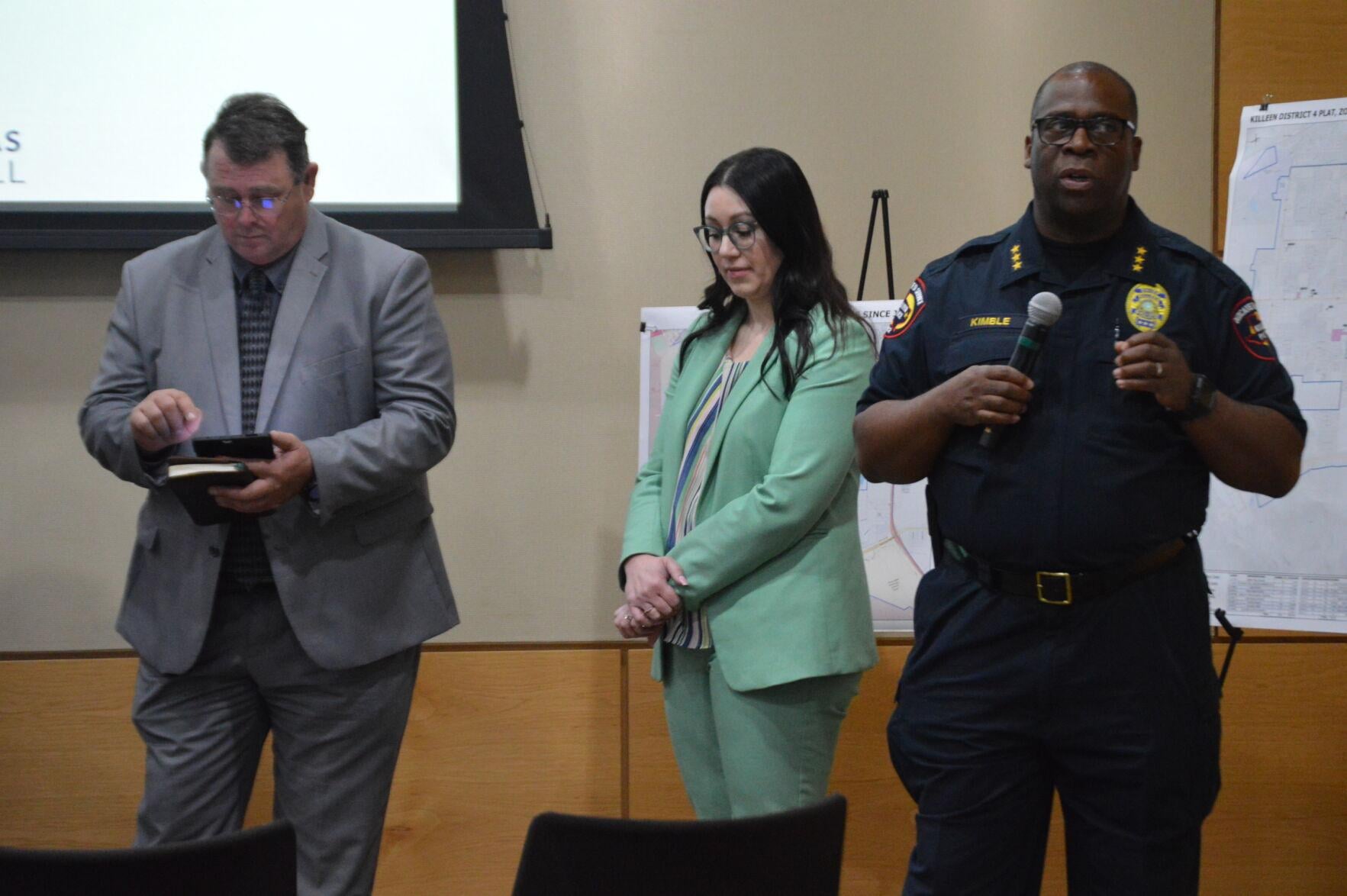
Killeen Police Chief Charles Kimble (right) speaks with a resident during Killeen City Councilman Michael Boyd's community forum Monday night. Other city staff shown are Assistant City Manager Danielle Singh (middle) and Kevin Watkins, the city’s director of code enforcement.
Residents of District 4
At Boyd’s forum on Monday night, held at Texas A&M University-Central Texas, the councilman described Wilkerson and Williams as attending members of the public and residents of District 4, which covers west Killeen. However, Stratta v. Roe, a 2020 case in which a board member of the Brazos Groundwater Conservation District was denied the opportunity to speak during citizens comments, established that an official’s public position supersedes his or her rights as a private citizen. The resulting court case from the United States Court of Appeals for the Fifth Circuit had the following to say:
“Whatever Stratta’s rights otherwise may be, they were overcome by his status as a Board member, and the Board correctly prevented Stratta from speaking at the meeting.”
Context is important, however. Both Wilkerson and Williams arrived before the forum and left once it had concluded. Mellisa Brown arrived after the meeting had begun and remained in attendance for the duration of the meeting, but did not take action to leave.
Councilwoman Jessica Gonzalez was also briefly present at the meeting, but said that she left once she realized she was not the only council member present. The Herald did not see her present at the meeting.
Brown, city respond
Mellisa Brown responded to a request for comment Thursday.
“Honestly I saw the event that was going on and I went so I could hear first hand from the residents what they had to say about what was going on,” she said. “I didn’t know, other than Michael of course, that any (other council members) were going to be in attendance.”
Brown said that her understanding of the Texas Open Meetings Act allowed council members to be in attendance at social functions, so long as less than a quorum of council members spoke about city business.
“My understanding is even if we all show up to the same public social event, at any place or any time, as long as we don’t all talk about city business that’s going on we’re still OK,” she said. “Like I said, the general rule that we were told is that as long as we’re not all talking about city business, or four of us are not talking about city business together and having the discussion.”
All public officials who fall under the Texas Open Meetings Act are required to undergo training at the start of their respective terms.
Further, Brown also claims that Boyd’s forum Monday constituted a social function, which Texas law allows for. However, this is only so long as discussion of public business is “incidental” to the event, not the focus.
Monday’s forum was directly tied to city business, and included presentations from nearly every major department head in Killeen, as well as from Wilkerson, who was given to opportunity to speak about the city’s new Crime Solutions Committee.
Liability
General liability under Texas law falls under two categories: criminal and civil. Criminal liabilities for violating the act often take the form of fines up to $500 or up to six months in the county jail. Civil liabilities may take the form of an formal injunction to stop the offending parties from engaging in the illicit activity — such as stopping a board from holding secret meetings — or may void actions taken by the group not sanctioned by the Open Meetings Act.
However, as far as the Herald is aware, no clandestine meeting took place Monday, and Killeen’s City Council did not attempt to take any official action; nor was there any deliberation amongst a majority of its members. Monday’s meeting, though certainly a violation of Texas law, was likely unintentional, and is a mistake which may be easily avoided in the future.
If the meeting — and quorum — is to be investigated further, it would have to go through the Bell County Attorney’s Office, which handles misdemeanor and other cases involving misconduct by elected officials.
As of early Friday, Bell County Attorney James Nichols said “to my knowledge” his office has not received any complaints about the Killeen City Council having a quorum last week when no public notice was given.
He said in order to call it a violation of the law, his office would first need to investigate it.
Nichols said anyone is welcomed to file a report about the situation, and “if it warrants a complaint, we’ll investigate.”
Nichols said there can be many examples of several council members meeting in public places — such as movie premiers or church events — but there would be no violation of the law.
“It depends of what is being discussed ... and the nature of the town hall meeting,” he said. “There are some things you can get away with.”
Herald writer Jacob Brooks contributed to this report.