With tree decision, League City made the best of a bad loss
Published: Thu, 04/07/22
With tree decision, League City made the best of a bad loss
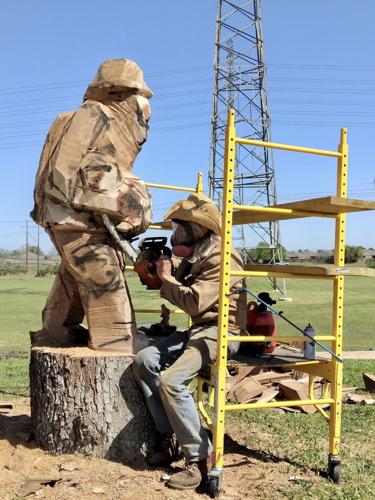
League City leaders deserve a Making Lemonade award for their decision to turn two dying oak trees into art, rather than landfill fodder.
As correspondent Richard Tew reported Wednesday, when two treasured oaks had to be removed because of fungi and beetles, the city called in wood sculptor Jimmy Phillips and his chainsaw.
Most trees are valuable and these were especially so because they were more than 100 years old and their roots intertwined with the city’s.
The oaks came from Louisiana on two railcars in 1907 and were planted by some of League City’s pioneers, including J.C. League, the city’s namesake, and George Washington Butler.
Two months ago, the city’s arborist found that two of the oak trees in League Park, 512 Second St., had a fungus known as hypoxylon canker and tree-killing beetles.
Because of the risk in two large, dying trees near heavily trafficked parts of the park, city officials initially decided to have them removed — a tough decision given the community’s appreciation for 100-plus-year-old trees.
Cutting down two of the city’s original oak trees — enjoyed by both area residents and visitors — was something the city wanted to consider very carefully, spokeswoman Sarah Greer Osborne said.
As the city mulled it over, an idea emerged that would address safety concerns and also allow the trees to live on, in a way.
Ultimately, the city decided to have Phillips assess whether parts of the trees could be salvaged and turned into pieces of art.
“We contacted him, and in a couple of days, he came out, and he’s like ‘yep, we can do something with these,’” Greer Osborne said.
Jimmy Phillips, 67, owner of Inshore Sculpture, began his art career after a 30-year career in industrial tool sales.
After Hurricane Ike ravaged Galveston County in September 2008, lots of large oak trees were marked for removal. Phillips was called in to try to convert some of them into sculptures.
“I like to take an interesting-looking piece of wood and make an abstract shape out of it,” Phillips said. “To me, it’s just beautiful.”
One tree still in the park was mostly cut down but enough was left over for Phillips to create a sculpture of a train conductor. Large pieces of the second tree will be used to make three more sculptures.
Phillips is carving a firefighter sculpture near the Dickinson Avenue entrance to Hometown Heroes Park, 2105 Dickinson Ave. in League City. It pays tribute to the city’s volunteer fire department, along with police and EMS services.
“It being Hometown Heroes Park, we thought what a great way to honor our hometown heroes, our police, our firefighters and our EMS,” Greer Osborne said. “The plan is to unveil the firefighter statue on May 22.”
The unveiling will coincide with the opening of the new 5K Loop also being constructed at Hometown Heroes Park, and will be a part of the “Red, White and Blue, Top Gun Fun Run.” The city plans to honor both local emergency services personnel and veterans at the event.
The name plays off of the “Top Gun: Maverick” movie set to be released the following weekend, Greer Osborne said. The city would like residents in attendance to vote on a theme for the remaining fourth piece of wood, also set for eventual placement at Hometown Heroes Park, she said.
A third block of wood, now sitting near the entrance of the Helen Hall Library, 100 W. Walker St., will be a sculpture of a dog with a child leaning on it while reading a book in honor of one of the library’s children’s reading programs called “Read to the Dogs.”
Funding for the train conductor, firefighter and yet-to-be-named sculpture comes from park dedication fee funds, while the library’s sculpture of a dog and child will be paid for via Hotel Occupancy Tax funds. League City council set aside $150,000 in park dedication fees that can be used for art projects.
The living trees are irreplaceable, but the city picked the best option available.
• Michael A. Smith