How the Peters Colony settled North Texas
Published: Sat, 04/16/22
How the Peters Colony settled North Texas
By Annetta Ramsay For the Denton Record-Chronicle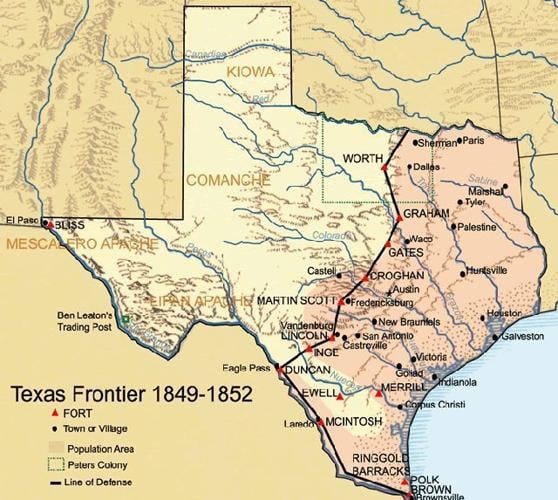
A map of frontier Texas shows the boundaries of the Peters Colony in 1849-1852.
- Courtesy image/University of Texas Libraries
The Peters Colony settled North Texas through four empresario, or entrepreneurial, land grants between the Republic of Texas and investors. According to the Texas State Historical Association, English businessman and musician William S. Peters envisioned the colony as a business and, perhaps, a new English middle-class opportunity.
His son William C. Peters’ successful music store in Louisville, Kentucky, served as colony headquarters. William S. Peters’ son and son-in-law Samuel Browning returned from London in July 1841 to report 10 investors signed on to the project. All but one or two investors were British or British-born.
A month later, Browning signed the first contract with the Republic of Texas establishing colony boundaries as the Red River at the mouth of Big Mineral Creek, south for 60 miles, west for 22 miles, north to the Red River and east to the river’s origin.
Organizers contracted to recruit 200 families in three years. A second contract extended boundaries 40 miles south and increased the required number of families to 800. Two more contracts added millions of acres to the colony.
Because Texas was a cash-poor republic, it used land as currency between 1836 and 1845. Single male colonists over age 17 received 320 acres; married men received 640 acres. Peters Colony land agents could retain up to half of the colonists’ land as payment; settlers may not have been informed of the payment plan, which became a tipping point. Organizers provided gunpowder, shot and seed.
Louisville investors reorganized as the Texas Agricultural, Commercial and Manufacturing Company, adding seven investors in November 1841 to compensate for the lack of London backing. The new company began sending settlers to the Cross Timbers area of North Texas via steamboat in December 1841. The Cross Timbers region encompassed 26,000 square miles of North and Central Texas. The land was heavily timbered with oak and walnut trees, making travel difficult.
Peters Colony organizers had difficulty attracting and keeping people in the colony. Colonists envisioning cornfields and well-manicured farms found rough, uncivilized land. North Texas was the Wild West in 1841.
Although England abolished slavery in 1807, settlers were allowed to bring enslaved Africans. The Republic of Texas legalized slavery in 1836. By 1845, 30,000 enslaved Africans lived in Texas. Many arrived through the Peters Colony.
North Texas was also “Indian territory.” Tensions mounted between poorly treated Native Americans and land-hungry settlers. Texas didn’t address conflicts between colonists who claimed land and Native Americans who viewed it as a communal resource. Widely publicized stories of Indian raids created a fearful atmosphere.
Not all settlers were British. The Northern Standard announced that 300 German families settled in the Cross Timbers area. German settlements likely became towns such as Muenster.
The biggest problem colonists faced was the Peters Colony disorganization and strife. In 1842, English investors transferred interests to three other Englishmen and three Americans who were scheming for control: Daniel J. Carroll, Sherman Converse and Charles Fenton Mercer. Believing Converse had deceived them, the Louisville group reclaimed colony ownership as the Texas Emigration and Land Company in 1844, hiring Englishman Henry Hedgcoxe as their agent.
Hedgcoxe irritated colonists who believed organizers were just land speculators. Squatters further complicated colony administration. Settlers became angry about inaccurate surveys, boundary disputes and deeds that never arrived.
Colonists demanded justice when the Peters Colony contract ended in July 1848, allowing new settlers to obtain 640-acre certificates. Two non-colonists, John H. Reagan and doctor-turned-lawyer James W. Throckmorton, obtained compromise legislation in 1850, giving colonists four months to establish claims and colony organizers 2½ years to produce deeds. Wary colonists opposed the compromise.
On July 12, 1852, an estimated 100 colonists stormed Hedgcoxe’s Collin County office, seized his files and took them to Dallas County. Hedgcoxe was ordered to leave the colony after receiving an unfavorable report. In a nonviolent incident known as the Hedgcoxe War, colonists chased Hedgcoxe to Austin. It took many years for Texas to settle land disputes.
Although the Peters Colony helped settle North Texas, the failed business angered colonists and brought little profit to English investors.
Source: Texas State Historical Association
ANNETTA RAMSAY, Ph.D., has lived and worked in Denton for many years. She can be reached at annetta.ramsay@gmail.com.