The administrative law judges recommended Texas' environmental regulator grant the desalination permit so long as additional salinity limits, monitoring are implemented
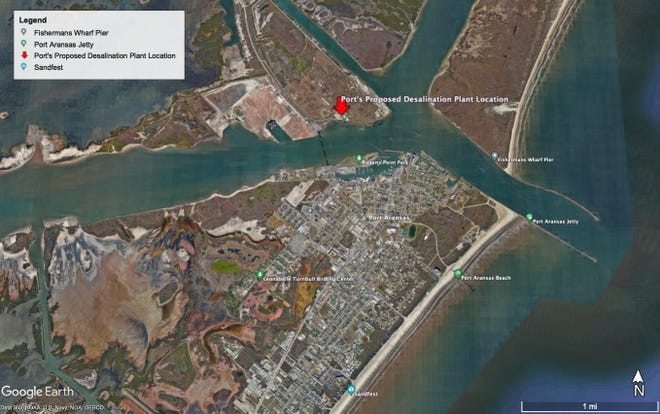
The Port of Corpus Christi Authority cleared a regulatory hurdle this week in its multimillion-dollar effort to obtain a permit for a seawater desalination plant on Port Aransas' Harbor Island.
Administrative law judges on Monday recommended the Texas Commission on Environmental Quality grant the port's water quality permit, contingent on a few tweaks to the plans.
A port spokesperson on Thursday said staff is still reviewing the 130-page recommendation from the state judges, which asks the port to include additional monitoring measures and adhere to additional salinity and mixing limits.
“While still evaluating the recommendations by the administrative law judges, the Port of Corpus Christi is pleased with this ruling," according to the port's statement. "But there is still much more to be done in moving toward a drought-proof water supply. The port authority will continue to work closely with the TCEQ and other compulsory agencies throughout this process."
It is not guaranteed the wastewater permit will be granted, as the port must amend its plans to adhere to the judges' recommendations.
Federal regulators — who could potentially require additional measures, or nix the proposal entirely — have yet to weigh in on the project.
The final decision would be decided by state commissioners during a TCEQ hearing.
The port has gone through this process before with this project, though it ended with a different result.
In February 2021, judges with the State Office of Administrative Hearings recommended the port's original application be denied based on potential impacts of discharging brine into the bay system. A few months later, TCEQ board members remanded the case back to the state office.
The port submitted a revised application, which included a change of location of the discharge point, revisions to its proposed diffuser design and additional modeling and data.
A remand hearing held in March included expert testimony from the port and environmentalist groups protesting the project. The parties submitted written closing arguments in April, leading to the Monday ruling.
At a port commission meeting, Nueces County-appointed commissioner Bryan Gulley estimated the port has spent at least $4 million pursuing the Harbor Island permit over the last five years.
Local opposition to continue
Many of those opposing the project have focused on potential environmental impacts to the area's sensitive habitat, known to foster both resident and migratory marine and avian life.
The ecology’s fragility calls for increased vigilance of its care — an effort that could be threatened by nearby wastewater discharge, some critics have said.
James King, president of the Port Aransas Conservancy, said the judges' recommendation favoring the port was "unfortunate" but vowed to continue fighting the project, saying the process "largely favors the permittee."
"This is what happens in this arena," King said. "(The application) gets remanded back, they make changes and then it is approved. ... It is rigged against the people and in favor of industry."
He added that PAC — the lead opponent in the case — has spent more than $4.5 million in legal fees to oppose the port's plans.
"We did the best we could," King said.
King said his only objection is the location of the proposed facility and its discharge's effects on the bay system — not to desalination itself. The facility, he suggested, should discharge offshore into the gulf to avoid impacting the bay's sensitive habitat.
King said he was happy, in part, to see the changes in the port's revised application and those recommended by the state judges, which will lessen the environmental impact.
"This ruling is not a gold stamp on the project," King said. "(The judges) basically agree with all of our science, 100%, and rather than approving it, they put some recommendations that are going to make TCEQ think hard about what this permit is going to look like."
Environmental Protection Agency involvement
The Environmental Protection Agency, which indicated it would review the port's application, has yet to weigh in on the project and could be a determining factor in whether TCEQ grants the permit.
The EPA entered the picture in December, expressing concerns that TCEQ had improperly characterized the port's proposed seawater desalination plant as a minor facility — for which the federal agency would waive review — as opposed to a major facility.
In a March 1 letter, the EPA regulators wrote that more information would be needed "to determine whether the proposed permit meets the guidelines and requirements of the Clean Water Act."
EPA officials said that TCEQ issuing a discharge permit without responding to its objections would violate an agreement between the federal and state agencies and would not have been "validly issued."
The judges in the Monday recommendation did not address TCEQ's classification of the proposed facility or the effects of any "potential dispute between EPA and TCEQ on the validity of any permit."
King characterized the disagreement as "the classic state vs. the feds" scenario, voicing hopes the EPA will exercise strict oversight over the project.
City officials weigh in
The judges' recommendation comes on the heels of multiple public disputes between the city of Corpus Christi and the port.
Disagreements reached a boiling point earlier this month when three city-appointed port commissioners were scrutinized during a City Council meeting. The mayor and multiple council members voiced grievances about the port's efforts to obtain a desalination permit and purported communication shortcomings with city officials.
City and port leaders agree seawater desalination facilities are needed to address concerns with droughts and to better accommodate the Coastal Bend's projected population and industrial growth, which could strain the region's limited water supplies.
However, city leaders have accused the port of hindering the city's efforts to obtain desalination permits. They worry the port or a third party opening a desalination plant would hurt the city's business model as the sole water provider for nearly 500,000 customers in the region and raise the cost of water for ratepayers.
On Thursday, City Manager Peter Zanoni said the city still opposes the Harbor Island location for a desalination plant, saying the city would not seek to establish a plant there nor purchase water from the port or a third party operating there.
Mayor Paulette Guajardo said the city would request the Harbor Island permit be transferred to the city, as port officials and city officials once agreed to do. (Emails show this agreement with the port's chief executive, Sean Strawbridge, but it does not appear a memorandum of understanding between the two entities was ever signed.)
"The City of Corpus Christi affirms our rights to these desalination water permits. The entire Port Commission and their Executive Director, Sean Strawbridge, (have) agreed to turn the permits over to the city and we agree this is the best pathway forward. ... We will accept and consider these permits exclusively, as a part of all efforts we currently are undertaking to build desalination," Guajardo said in an email. "We are committed to providing the lowest cost water to our residents."
In a statement to the Caller-Times, At-large Councilman John Martinez said it was "vital that the City of Corpus Christi and the Port of Corpus Christi work together to ensure that our residents have an affordable, plentiful, and drought-proof source of fresh water for generations to come."
Chase Rogers covers local government and industry in South Texas. Contact him at chase.rogers@caller.com or on Twitter @chasedrogers. You can support local journalism with a subscription to the Caller-Times.