Brazoria County: Local cities prep grant requests for millions in federal funding
Published: Sat, 08/27/22
Local cities prep grant requests for millions in federal funding
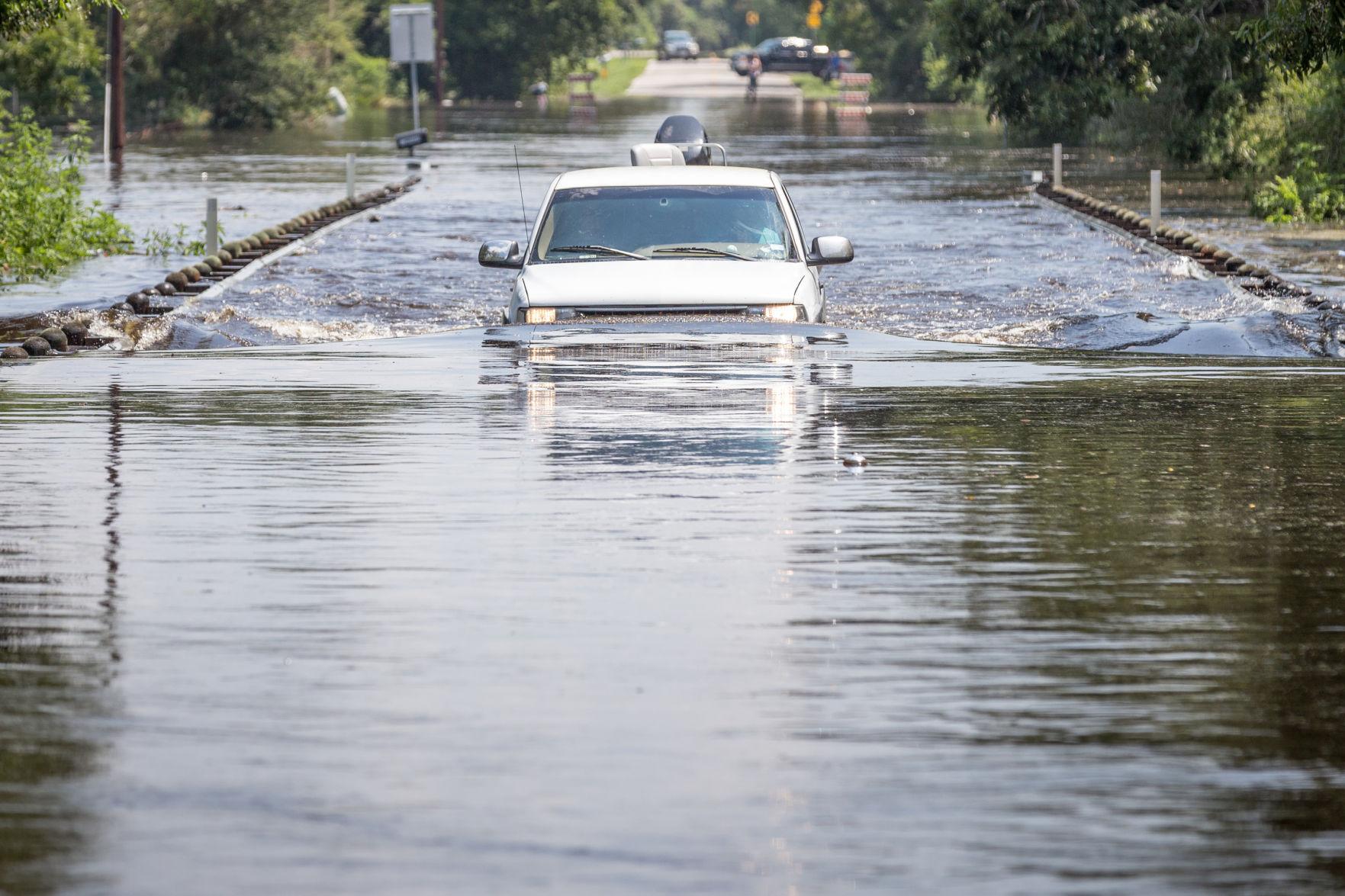
A truck attempts to cross a bridge Sept. 2, 2017 on FM 522 in Wild Peach. Five years after Hurricane Harvey, Brazoria County communities expect to receive millions in federal funding to better protect against potential floods.
The Houston-Galveston area will see an infusion of nearly a half-billion dollars proposed to support resiliency improvement projects to protect communities from future disasters across the region.
How Brazoria County and its eligible communities plan to spend their shares of the windfall has yet to be decided.
The Department of Housing and Urban Development and the Texas General Land Office allocated $1.2 billion in mitigation funds to the region with $750 million given to Harris County, the remainder of $489 million will be distributed to other areas of the region, according to the Houston-Galveston Area Council, which created the distribution formula.
With $43 million expected to come its way, Brazoria County plans to bring in a third party to put together its program, Brazoria County Judge Matt Sebesta said.
“We plan on hiring a grant administrator and once we get one working with us, they will make sure we follow all of the guidelines as we identify projects throughout the county that quality as a mitigation project,” Sebesta said.
The county’s share can be used in unincorporated areas as well as communities with insufficient populations to qualify for their own allocation, he said.
“All of the money will be going toward hazard mitigation, but there are no specific projects identified at this time,” Sebesta said. “We just in the last month have been allocated those dollars, and we put it out for grant companies bid qualifications, so hopefully in the next month or two will be hiring a grant administrator to help us work through all of the red tape on the grant.”
Half of the allocation must be used to benefit low- to moderate-income residents under the stipulations of the funding, he said.
“We’re going to be looking at any projects that are characterized by hazard mitigation and we will be going through all of the checks on it to see if each area that utilizes these dollars, whether they are low- to moderate-income areas they are affecting,” Sebesta said.
Flood mitigation projects are the most likely use for the money, which could include water or sewer systems affected by flooding among preventive measures, Sebesta said.
“We will be looking at different projects, but it’s too early to say we’re going to spend a certain amount on a certain project,” Sebesta said.
ANGLETON
Angleton is scheduled to receive $1.7 million and there are a multitude of the city could consider for it.
“In the final steps of the process, then we’ll be allocated the funds, and they’re geared toward mitigation, so hurricanes, winter storms,” City Manager Chris Whittaker said. “Some of the projects include, like if we apply for a grant for a generator at the Rec, we could use it as a shelter. It could also be things like upgraded radios for emergency services.”
The city has a whole bunch of projects but is still working on the list before taking it to council, Whittaker said.
“We’ll take that to city council when we know if we’re getting the funding for sure,” Whittaker said. “I think we’ve known about it for a couple of months. We were waiting on the rules and timelines to come out for the validation.”
With the list of projects that Angleton wants to address, the money helps take to burden off local taxpayers, he said.
“We’re in a very vulnerable part of the state and have things happen on a random basis,” Whittaker said. “Our budget is pretty slim, so this helps us get at things we normally can’t.”
CLUTE
City Manager CJ Snipes said the plan with its expected $1.22 million in resiliency funds is to improve drainage systems in east Clute.
“We’re looking and getting ready to start trying to figure out which systems on the east side get the most improvement and then utilize that money to improve the drainage,” he said.
This comes off the heels of getting $9.6 million in funds during the first tranche, after collaborating with the City of Lake Jackson and Freeport for a drainage study back in 2018.
Snipes isn’t sure what areas of the city will allow the city to satisfy the low- to moderate-income requirement, but wherever it is, that section of Clute will get a project to alleviate drainage and flooding issues in the future.
“The faster we get the water out of here, the better off it’s going to be for everybody,’’ Snipes said.
FREEPORT
City Manager Tim Kelty says officials in Freeport have s not looked at their plans for the $1.8 million in its designated funding, but they should not have to wait long.
“The city of Freeport has not yet prioritized our list yet for the use of that funding, but we’re very excited about the fact that that money has been made available for us,” he said. “We will look at that very, very closely to see how best it can be exercised and used.”
The city previously partnered with H-GAC and the GLO on the rehabilitation of the Sienna Villa apartments to the tune of $13.2 million, with the designation that at least half of the rental units be utilized by low- to moderate-income residents.
“I’m going to look at that over the next week and a half or so and I’ll be making some recommendations to the council at the next council meeting,” Kelty said.
LAKE JACKSON
The city doesn’t know how it will use the $2.14 million it has been allocated from the H-GAC funds, City Manager Modesto Mundo said.
First, they will have to see if any of the places they’d like to work on will qualify as low- to moderate-income area since half of the money has to be put toward that use, he said.
“We have one designated area that we believe is the LMI. We’re trying to find out if we have more,” Modesto said. “Usually our low to moderate area is around the downtown area in the homes there. But there’s one particular project that we would like to do, which is for drainage in our East Side drainage, but we’re not sure if it will meet the LMI.”
The city only has one possible area where it can spend about $1.1 million and the rest is free to be spent in the community, Mundo said.
The East Side drainage corridor includes Dixie Drive in the Garland Drive area and some parts of Plantation Drive. The city has $25 million to $30 million worth of drainage projects in that area shared with Clute. There are some minor improvements, including improving ditch capacities and storm drainage projects, the city would like to tackle if that area meets the criteria for funding. Those projects would cost about $2 million, he said.
Another option is in the downtown area where the homes abut the businesses, Mundo said.
“That is historically been our CBDG area where we’ve done projects, but we’ve done a lot of projects there,” he said. “So if we’re running out of projects, we’ve redone all the streets and the drainage. So it may not be a drainage project, it may be a sewer project or improvements to the lift station. That’s why we’re still waiting on the final guidance from the GLO.”
The city will have to submit its project plans for the grants and hope the funds will be approved. It could take six months to a year for the whole process to be finalized and the projects completed, but the city would be excited to receive the funds, Mundo said.
RICHWOOD
City Manager Eric Foerster said the city has several projects outlined based on the allocation to use for the city.
The city was given $2.4 million in funds for HUDMID, while using $1.2 million in low- to moderate-income areas.