Appeals court rules against city, affirms $2.7 million award to two former Denton Municipal Electric employees
Published: Fri, 09/02/22
Appeals court rules against city, affirms $2.7 million award to two former DME employees
A proposal before the Denton City Council regarding expanded protections for locals in possession of marijuana is dead after failing to reach consensus Tuesday evening.
Five years ago, two longtime Denton Municipal Electric employees were terminated, allegedly for breaching their supervisor’s trust. They filed a lawsuit alleging the city had violated the Texas Open Meetings Act and the Texas Whistleblower Act, according to a July 14, 2017, Denton Record-Chronicle report.
Mike Grim, DME’s former executive manager of power supply and legislative and regulatory affairs, and Jim Maynard, former energy project development manager, claimed the city had violated the whistleblower act when they were terminated “on the basis of deliberately falsified accusations, and defaming them after the fact, in retaliation for their prior reports to City Attorney Anita Burgess about a leak of certain confidential information regarding the proposed Denton Energy Center, information that was provided by then-current city council member Keely Briggs to the Denton Record-Chronicle, the local daily newspaper, and was then published online,” Texas’ 5th District Court of Appeals Judge Ken Molberg wrote in an opinion Monday.
“Grim and Maynard claim Briggs’s disclosure to DRC violated the Texas Open Meetings Act,” Molberg wrote in his Monday opinion.
In February 2020, a Dallas County jury ruled against the city and awarded Grim and Maynard $2,759,195.49, plus post-judgment interest at a 5% per annum rate, according to Molberg’s opinion.
The city appealed the jury’s decision to the Court of Appeals’ 5th District of Texas in Dallas, arguing four issues it claimed did not apply as a matter of law and evidence and were legally and factually insufficient.
On Monday, the appellate court disagreed and upheld the jury’s decision in a 2-1 ruling and reaffirmed the jury’s decision to award Grim and Maynard more than $2.7 million, plus the post-judgment interest.
“We were expecting it,” said Robert Goodman, a Dallas-based attorney from the Kilgore & Kilgore law firm who represented Grim and Maynard. “It was a fairly run trial, and the jury was able to assess the credibility of the city’s witnesses and didn’t believe the important witnesses. We think it’s time to pay the piper and get this case over with.”
Stuart Birdseye, a city spokesperson, shared a quote from Mayor Gerard Hudspeth about the appellate court’s decision.
“I am aware of the court’s ruling on this matter,” Hudspeth said. “I am committed to fiscal responsibility, and we will work with the City Attorney’s Office and City Council to determine what the next steps might be.”
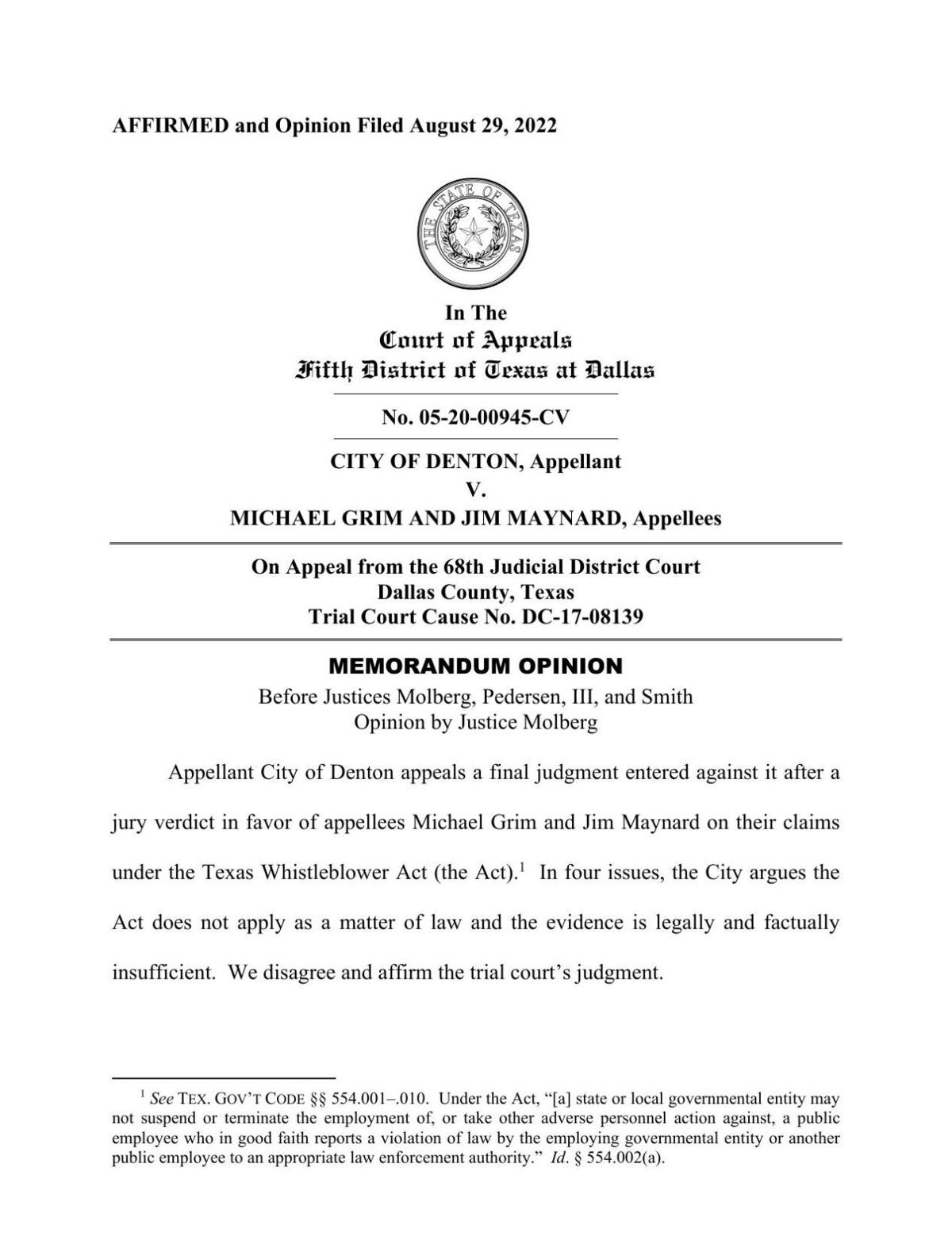
In Monday’s opinion, Molberg offered a breakdown of the four issues the city argued:
- Did the district court err in holding that, as a matter of law, an individual member of the unpaid Denton City Council acting without the council’s knowledge or sanction was either the “employing governmental entity” or “another public employee” within the meaning of the Whistleblower Act, thus rendering the Whistleblower Act applicable to this case?
- Did the district court err in concluding there was legally and factually sufficient evidence to sustain the jury’s finding that [appellees’] report of an alleged violation of law by an individual member of the Denton City Council caused them to be fired, when such firing — not by the City Council but by the city manager — occurred almost a year after the report and following an unrelated investigation of staff conduct with vendors?
- Did the district court err in concluding there was legally and factually sufficient evidence to sustain the jury’s finding that [appellees] had a good-faith belief that the conduct of the council member they reported constituted a violation of law?
- Did the district court err in holding that, as a matter of law, the then-city attorney constituted an “appropriate law enforcement agency” to whom to make a report within the meaning of the Whistleblower Act?
According to the Texas Whistleblower Act, “a state or local governmental entity may not suspend or terminate the employment of, or take other adverse personnel action against, a public employee who in good faith reports a violation of law by the employing governmental entity or another public employee to an appropriate law enforcement authority.”
Molberg went on to explain the act’s underlying purposes, “to enhance open government by protecting public employees from retaliation by their employers when an employee reports a violation of the law in good faith, and to secure lawful conduct by those who direct and conduct the affairs of government.”
Since the city never raised an issue about immunity from liability, Molberg wrote that the court instead focused on the four issues the city did raise.
For the first issue, the majority overruled it and found “Briggs’ alleged misconduct in providing information to DRC about the DEC could fall within her official duties of a city council member, at least insofar as it related to her votes regarding the DEC contracts. Moreover, her disclosure of confidential information about the DEC to DRC would be the type of conduct the public would be concerned about if committed by an appointed city council member, as it could jeopardize pending or future contracts with the City or possibly expose the City to further liability.”
They also overruled the fourth issue, that Burgess wasn’t an appropriate law enforcement official. “We need not decide the City’s fourth issue because the City failed to preserve error, as the City did not request or receive any ruling on this element, based on the record before us,” according to Monday’s opinion.
As for the third issue, they overruled it and claimed Grim and Maynard were right to suspect that Briggs had violated the Texas Open Meetings Act (TOMA), given that the city had trained City Council and city employees about the requirements of TOMA and warned that violations by them “could constitute official misconduct and were punishable as misdemeanors.”
“Thus, based on appellees’ experience and training that they received from the City, some evidence supports the finding that their belief Briggs violated the law was reasonable,” Molberg wrote. “Former City Attorney Burgess reminded city council members about the confidentiality of some of the items they were reviewing and the penalty for violating such confidentiality just a few days before Briggs provided the documents to the newspaper. …
“As a result of appellees’ report, Burgess contacted the newspaper, and it removed the confidential documents from its website.”
Molberg said the majority viewed the evidence in the “light most favorable to the verdict” and concluded that a “reasonable and fair-minded juror” could find Grim and Maynard had acted in good faith that they believed Briggs had violated the Open Meetings Act when she disclosed confidential information to the newspaper.
The majority then looked at the city’s second issue, that there was “no elaborate termination scheme.” They spent several paragraphs explaining why a jury could believe there was “a reasonable inference the city council was involved, at least to some extent, in the terminations.”
They quoted two people who had testified that former Assistant City Attorney Larry Collister had said “the council got the heads on pikes that they wanted” and “the council has the heads on the pikes they were looking for.”
While the terminations took place 10 months after Briggs’ report, the majority argued that the timeline revealed that once the makeup of the council was aligned with Briggs, they began investigating Grim and Maynard for improper contacts even though it had already been reviewed and discussed before the previous council approved the gas-powered plant.
They agreed that the jury’s evidence was legally and factually sufficient.

In his dissenting opinion, Judge Bill Pederson III argued the Whistleblower Act didn’t apply because, despite being a council member, Briggs didn’t act “as a part of the City” but instead “acted apart from the City” since she kept her plan to share information with the reporter a secret.
“Briggs testified her purpose was purely personal,” Pederson III wrote in his dissenting opinion Monday. “She made a personal statement, not a statement as a part of the City or on behalf of the City or in her official capacity: ‘I just wanted to share the knowledge that I had and let everybody come from the same place, know where I was coming from.’”
It’s unclear if the city plans to appeal.
Goodman estimated the city has already spent more than the verdict appealing the case and is probably reaching the $6 million mark.
“I hope the Denton City Council is keen enough to think about this in a fair-minded rational way rather than continue to try to defend themselves after they lost a nearly $4 million verdict,” he said. “If the Denton City Council is in a better place than what has happened in the last six years, they’ll vote to end this madness.”