Borderlands: Texas-Mexico trade expected to top $1.5 trillion by 2050
Published: Mon, 09/05/22
Borderlands: Texas-Mexico trade expected to top $1.5 trillion by 2050

The Texas Department of Transportation projects that by 2050 high technology will be the top cross-border supply chain between Texas and Mexico by value at $651 billion. (Photo: FreightWaves staff)
International trade between the Lone Star State and Mexico could reach $1.5 trillion in value by 2050, with tractor-trailers representing the primary mode of freight transport, according to the Texas Department of Transportation (TxDOT).
“Today, we are at 3.9 million tons of freight annually between Texas and Mexico, and we’re looking at pretty much doubling that by 2050 to 7.2 billion tons. That’s an 80% rate of growth,” said Caroline Mays, TxDOT’s director of freight, trade and connectivity. “Trucks dominate the movement of freight around the state of Texas, but we also have rail, water and air that plays a big part of that movement.”
Mays gave a presentation on the future of Texas-Mexico trade at the U.S.-Mexico Border Environmental Forum hosted by the North American Development Bank on Aug. 18 in San Antonio.
Last year, TxDOT released its Texas-Mexico Border Transportation Master Plan, which forecasts as many as 12 million tractor-trailers and 2.5 million rail containers are forecast to flow between the countries by 2050. In 2021, about 6 million trucks and over 420,000 loaded rail containers crossed the border.
Texas and Mexico are connected by 28 international bridges and border crossings, as well as six rail-only bridges.
“We are looking at staggering numbers of truck and rail goods moving into our borders, and certainly it’s going to require investments,” Mays said.
TxDOT projects that by 2050, high technology will be the top cross-border supply chain between Texas and Mexico by value at $651 billion. High-technology exports include products in aerospace, computers, pharmaceuticals, scientific instruments and electrical machinery. In 2019, the high-technology supply chain between the countries was valued at $135 billion, according to TxDOT.
Other projected top Texas-Mexico supply chains in 2050 include assembled motor vehicles ($187 billion, up from $88 billion in 2019), industrial machinery ($170 billion, up from $56 billion), fresh produce and grains ($93 billion, up from $14 billion) and manufactured goods ($61 billion, up from $15 billion).
Mays said the greatest challenge for the trade community is making sure both countries have enough bridges, railways and roads to facilitate the increased commerce.
“This is why we need to invest in our infrastructure, the cross-border infrastructure in both countries,” she said.
TxDOT estimates that U.S.-Mexico border crossing delays in 2019 resulted in $68 million in economic productivity losses, reducing GDP in both countries by $2.3 billion.
If no significant improvements are made to the infrastructure connecting Texas and Mexico by 2050, productivity losses from border delays could reach $4.4 billion, reducing gross domestic product by $116 billion in both countries, TxDOT said.
According to the FreightWaves SONAR platform, north-bound truck wait times at Laredo’s World Trade Bridge (WAIT.LRD) and other U.S.-Mexico border ports of entry are averaging about 2.7 hours over the last week.
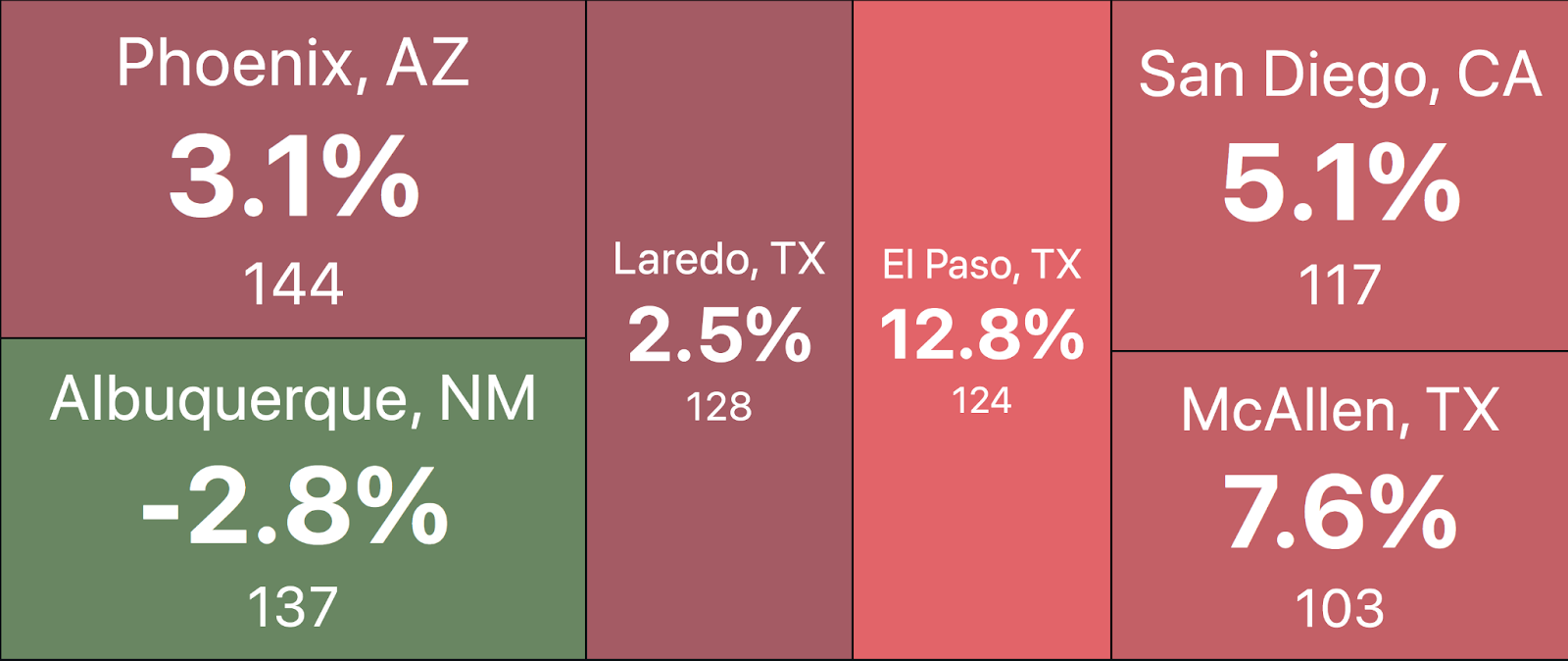
The FreightWaves SONAR platform shows wait times are sitting at about 162 minutes on average across markets near U.S.-Mexico ports of entry. To learn more about FreightWaves SONAR, click here.
TxDOT has identified 661 projects at a cost of $37.4 billion along the border that could help alleviate wait times for goods moving between the two countries. The plans — which include 559 projects in Texas and 102 in Mexico — include bridges, rail, highways and roads.
Some of the projects TxDOT discussed in its master plan include the construction of a new commercial truck bridge in Laredo, Texas. The so-called 4/5 bridge would be the addition of a fifth international bridge in Laredo connecting it to Nuevo Laredo, Mexico.
“Transportation is where the rubber meets the road,” Mays said. “We can’t compete as the North American trading bloc if we don’t address the infrastructure needs that are facing us today.”