Body-camera footage doesn’t jibe with Arredondo’s claims about Uvalde shooting response
Published: Fri, 09/09/22
Body-camera footage doesn’t jibe with Arredondo’s claims about Uvalde shooting response
Guillermo Contreras, Staff writer
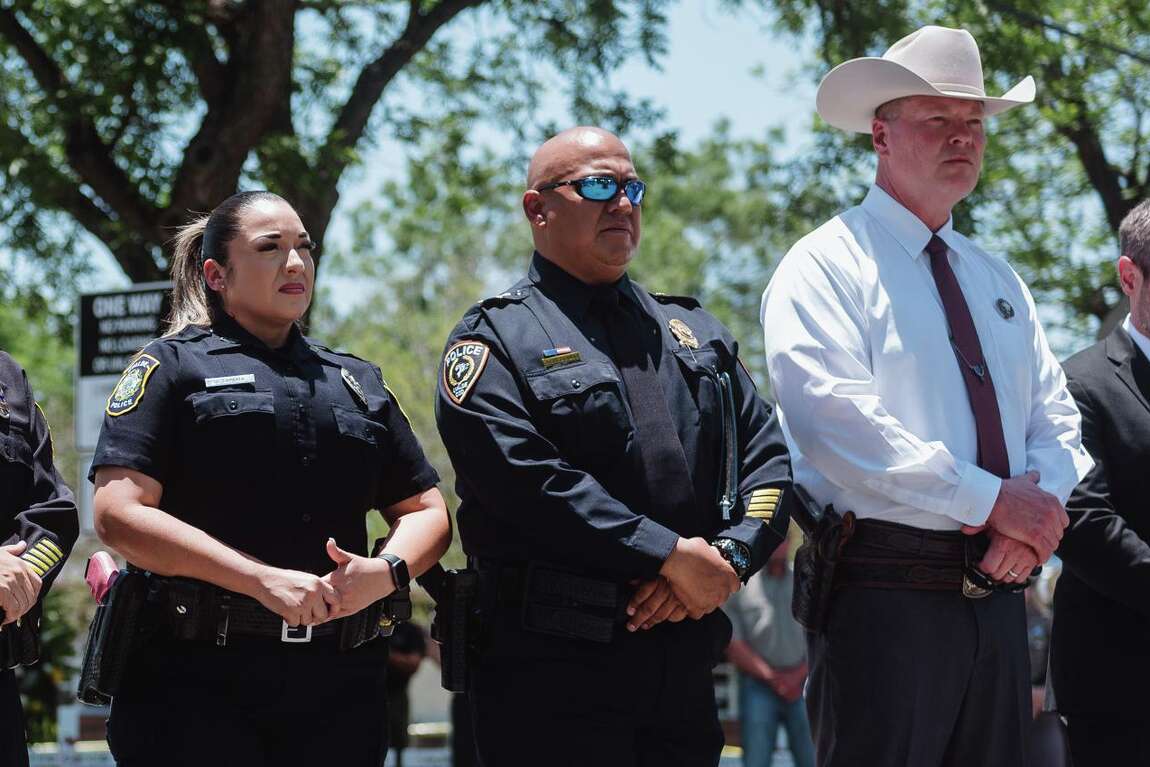
Pete Arredondo, center, the Uvalde school district police chief, at a news conference in Uvalde, Texas, on May 26, 2022. Facing intense pressure from parents, the school board in Uvalde on Wednesday, Aug. 24, 2022, terminated Arredondo, who directed the district’s police response to a mass shooting at an elementary school in which the gunman was allowed to remain in a pair of classrooms for more than 75 minutes. (Christopher Lee/The New York Times)
A 17-page statement written by his attorney — and released before his firing — laid out Arredondo’s rationale for skipping the meeting. In it, Arredondo also asked to return to work from unpaid administrative leave, with back pay, and defended his role in the disastrous police response to the May 24 mass shooting at Robb Elementary School, which left
19 students and two teachers dead.
Law enforcement experts have condemned officers’ decision to wait more than an hour to confront and kill the gunman.
The Texas Department of Public Safety has identified Arredondo as the incident commander that day because he was the most senior first responder and had jurisdiction over the district’s campuses. But Arredondo said in his statement that he wasn’t in charge — that he was “a responding officer, intent on finding and apprehending and/or shooting an unknown number of suspects.”
That and several of Arredondo’s other claims don’t appear to jibe with police body-camera recordings of Uvalde police officers that have been released so far, investigators say.
Who was in charge?
Publicly released police body-camera video, however, shows Arredondo giving instructions to officers, including someone he was talking with on his cellphone.
It also shows him telling officers not to move in as he tries keys on what appears to be classroom 109, near where the shooter was, according to body-cam recordings and a schematic of the building released by DPS in May.
“Tell them to (expletive) wait,” Arredondo said. “No one comes in.”
He said he wanted to make sure no students or teachers in classrooms across the hall where the shooter was — classrooms 111 and 112 — would be hit in a potential gun battle between the gunman and police.
“Chief Arredondo did the right thing,” his statement said.
The shooter had entered two adjoining classrooms through the apparently unlocked door of room 111, investigators have said. Inside Rooms 111 and 112, he fired a burst of shots in the first several minutes of his rampage and fired sporadically over the next hour. Two Uvalde police officers were hit by shrapnel in the hallway within the first several minutes.
“The obvious question is: When he and the other officers were shot at (active shooter) why did they stop knowing there were children inside?” said one law enforcement source familiar with the investigation. “He didn’t do the right thing.”
It’s not clear from the available footage — from Uvalde police body cameras — what actions Arredondo took within the first 40 minutes of the incident. School district officers do not have body cameras, but school surveillance video shows other officers rushing into the same building the gunman had entered three minutes earlier, at 11:30 a.m.
Arredondo does not first appear on body-cam video until 12:10 p.m.
He said it appeared to him that the shooter had “barricaded” himself in classrooms. He shifted his focus to “finding a means to get to the shooter while simultaneously directing other officers to remove the children and school employees that were in the ‘line of fire,’” according to his statement.
Who ordered evacuation?
Arredondo’s statement said he made the call to evacuate students after the shooter, 18-year-old Salvador Ramos of Uvalde, fired at officers who initially responded, including himself.
Arredondo’s statement said he feared “children and employees in the rooms across the hall were in imminent danger of serious bodily injury or death, so he felt it imperative to evacuate those rooms in a safe way to save those people from the shooter, while they developed a means to get to the shooter.”
“Chief Arredondo noticed that the bullets that missed the officers (and) went through the walls on the other side of the hallway,” his statement said. “He immediately realized that should another burst of high velocity bullets come through the doors or walls from where the shooter was, children and employees in the rooms across the hall were in imminent danger of serious bodily injury or death.”
But the body-cam video appears to show that other officers, positioned outside the building, made an initial call to evacuate students, not Arredondo. At about 11:58 a.m., Uvalde Police Sgt. Daniel “Corny” Coronado directed officers to go inside the building to check a classroom for students.
At about 11:59 a.m., the officers emerged and raced to a classroom window outside. The window, which had been hit by bullets, was open and children were climbing out, the footage shows.
Three officers helped more students and a teacher out of the room, Room 102.
“Kids coming out! Kids coming out! Kids coming out!” Coronado yelled into his police radio as children were told to run away from the building.
As more officers arrived to help, they moved to classrooms 103 to 106. The officers broke classroom windows to get students and teachers out.
The evacuation took about eight minutes. Coronado then left the area and went back into the building.
At about 12:17 p.m., Arredondo tried the keys on the door to classroom 109. Unsuccessful, Arredondo peeked through a window in the door and said that there were kids inside.
Other officers tried more keys as well as a knife to pry open the door classroom 109, which was adjacent to where the shooter was — without success.
The Associated Press reported Monday that 16 fourth graders waited an hour inside with their wounded teacher in that classroom, Elisa Avila, who was shot in the abdomen.
Did he know about victims?
Arredondo’s statement also said “it is important to note that Chief Arredondo, along with several other officers in the hallway, were completely unaware of any occupants in the room with the shooter until entry was made, the shooter was engaged, and the officers stopped him.”
But the camera footage shows other officers knew the classrooms the shooter was in had students in it at various times.
“The classroom should be in session, right now,” an officer said on police radio at 11:43 a.m. “The class should be in session. Mrs. (Eva) Mireles.”
Mireles was among those killed.
The body-cam video of Uvalde police officer Justin Mendoza also shows police were alerted by a dispatcher at 12:11 p.m. that a boy inside one of the classrooms where the shooter was holed up had called 911.
“Child called...and said he is in a room full of victims at this moment,” the dispatcher said.
Mendoza’s camera shows officers who were gathered nearby spreading the word at an entrance and section of hallway that was opposite Arredondo’s location.
About 12:19 p.m., Mendoza’s body camera caught the sound of three or four gunshots. At 12:21 p.m., a dispatcher tells officers about another 911 call from the classrooms where the shooter was.
“Be advised we do have a student on the line saying they just took three shots,” the dispatcher said.
The body-cam videos do not make it clear if any of that information was provided to Arredondo. He did not have a police radio.
At about 12:34 p.m., an unidentified officer asked: “We don’t know if he has anybody in the room with him, do we?”
Coronado responded: “Yeah, he does.”
And Arredondo — who was standing near Coronado — said, “If he does, there are probably some casualties.”
guillermo.contreras@express-news.net | Twitter: @gmaninfedland