Council approves changes to short term rental requirements
Published: Wed, 09/14/22
Council approves changes to short term rental requirements
Roger Mathews

Councilman Roman Garcia, left, discusses the issue of buffer zones around short
term rentals in the R-1A residential zone, joined by several members of the
council in opposition to the use of it, including councilwoman Kim Clarkson, right.
Roger Mathews
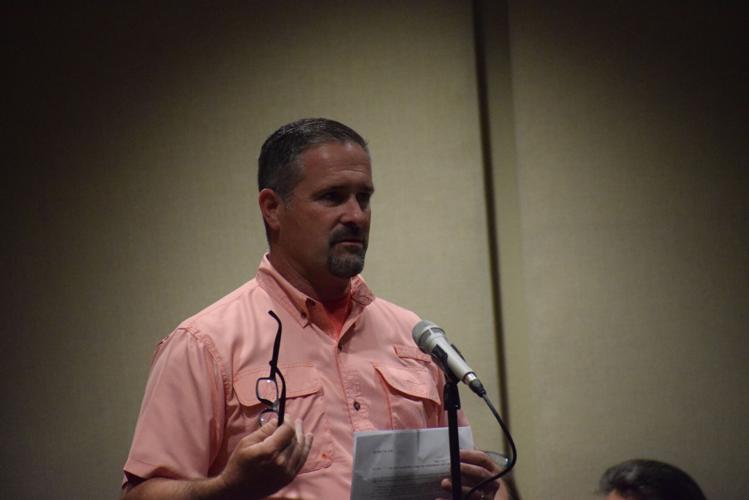
John Caren, an owner of short term rentals, addresses the city council, requesting
that they reinstate short term rentals for any residential zone, in direct contrast
to what the changes to the zoning code were changed to. He also opposed the
use of the 250 foot buffer zone in R-1A.
Roger Mathews
The Kerrville city council Tuesday, after months of debates, public meetings, town halls and lots of advice from the Planning and Zoning Commission, approved changes to the land use tables, effectively restricting short term rentals to five zones, not to include R-1 residential and R-2 multi-family zones.
Many of the opponents of the short term rental in Kerrville, namely the Kerrville chapter of the Texas Neighborhood Coalition, were in agreement with the council about the changes proposed dealing with short term rentals, saying that they felt it was a good compromise.
“The new rules don’t go far enough in our opinion, but we can live with them,” said Karen Sides with the Coalition.
The heart of the matter is the change to the land us table, according to Drew Paxton. Short Term Rentals will only be allowed in the following zones as a right, including, R-1A, residence with additional structures, R-3 multi-family, R-T residential transitional, the DAC downtown arts and MUD multi-use districts. No conditional use permits will be required for these zones, just approval of the application and adherence to supporting regulations regarding short term rentals.
These changes are to Chapter 60 of the Zoning Code for the City of Kerrville and were under review by the council Tuesday at the council’s regular meeting. What was not approved, however, was the suggested 250 foot buffer zone around existing short term rentals in the R-1A zone. City staff presented several options for the council to consider, but several members of the council, and nearly all of the public speakers who own short term rentals, were not sure about the use of those exclusion zones.
Councilman Roman Garcia spoke out at the beginning of the session on the changes to the zoning code.
“Because Planning and Zoning had reservations on it, I have reservations on it,” Garcia said. “It’s a complicated restriction to apply that and I think that overall, when I was looking at the conditional use permit we have in place for short term rentals, and trying to put those conditions and codify them into the zoning code, we’ve added a lot from my perspective up here on the dais, that I wasn’t expecting to be implemented into what we have now. If there’s another way, either reduce it (the zone) or get rid of it. That’s a policy decision that we’ll have to make.”
Other members were not comfortable about using the 250 foot zone to limit short term rentals in a zone that supposedly allows them by right. Councilwoman Brenda Hughes commented that she didn’t think that it was right to limit one person in an approved zone to have a short term rental, and the next person over not be able to have one.
“That’s just not right, and we need to look at that,” Hughes said.
Other public comments involved the process of approving short term rentals in any way. One man, John Caren, requested that the council go back to allowing short term rentals in all residential zones, due to the fact that a short term rental is a residential building, but he also spoke out against the buffer zones in R-1A.
“Short term rentals represent 1% of the homes here,” Caren said. “It’s not like we’re taking over. We’re not vermin spreading everywhere. We’re trying to make a living for our families. “I request that since R-1A is a by rights zone, that we do away with the 250 foot rules, as councilman Garcia said. Obviously, the Planning and Zoning people had a problem with that as well.”
Councilman Garcia, after discussions with city attorney Mike Hayes, made the recommendation to approve the ordinance changing the land use tables to exclude short term rentals from Residential Zones, but to strike section two of the resolution, which dealt with the buffer zone. The measure passed unanimously with a 5-0 vote. By statute, the law will go into effect on April 1 of next year.
The followup ordinance, dealing with licensing and permits for short term rentals was an entirely different subject, and after discussion and consultations with attorney Hayes, the resolution was tabled for further study and perhaps the creation of an ad hoc committee, appointed by city council members, to study the issue.
Fourteen lots on about 3,500 acres in the Comfort area and 13 lots on 408 acres southwest of Hunt were among several proposed neighborhoods presented to the Kerr County Commissioners Court on Monday.
Coltam Ridge and the adjacent Amani Hills will offer a total of 14 estate-style lots, ranging from about 99 to 413 acres off Lane Valley Road southwest of Comfort. The acreage includes creeks that flow more during less-dry periods and springs that also have been affected by the drought, but they’re still flowing.
“That’s why we went in and took so many of those cedar trees out around the pond and around the creeks and everything,” said Jensen Fry, associate at Boerne-based Texas Ranch Sales LLC.
Removing the Ashe juniper — AKA cedar — trees, has made a visible difference, Jensen Fry said. A mature Ashe juniper tree is able to transpire about 33 gallons of water per day, while a mature oak tree of similar dimensions can transpire about 19 gallons per day, according to a Texas A&M University article.
Amani Hills will be accessible from Turkey Knob Road and Coltom Ridge will be accessible off of a new designed Lane Valley Road entrance. The developer paid “a substantial” amount of money to have Bandera Electric Cooperative construct infrastructure to bring three-phase power down Turkey Knob Road, as the estate lots under development would likely want access to 200-800 amps for amenities such as horse barns, workshops and guest homes, according to Todd Fry, one of the project’s investors. Residential homes are usually served by a single-phase power, while commercial and industrial facilities usually use a three-phase supply. This additional power capacity can benefit existing property owners in the area, he said.
“A lot of the homeowners were real happy — it benefits homeowners along the way at no expense to them,” Todd Fry said.
There also will be three phase down Lane Valley Road, Todd Fry said.
Todd Fry, father of Jensen Fry, also is the general contractor and developer for the project under T. Fry Companies LLC and Teton JT LLC.
The project also will involve some reconstruction of Lane Valley Road to make it straighter and safer, and provide a turnaround for semis that happen to travel down the road, Todd Fry said. Currently, semis get trapped on the road and have to be assisted by a county commissioner who lives in the area. The official helps them out by opening his gate.
Both sections of the development have wooded and grassy areas, but more clearing has been undertaken at Amani Hills, which features large hills, Jensen Fry said.
“The views at Amani Hills are unbelievable,” Jensen Fry said.
There also are nice views at Coltam Ridge, but it’s a little more flat and open than Amani Hills, Jensen Fry said. There’s a four-bed, five-bath lodge at Coltam Ridge, which also includes a fully stocked pond and gated entrance, fenced and irrigated yard and water well. It’s the only place with a well on the 3,500 acres, and how many wells end up being drilled depends on how many buyers there are, Jensen Fry said. For example, if someone buys two adjacent lots, they could serve both with a single well, he noted.
The county is allowing each of the 14 lots to be served by a well and septic system. A portion of the project is in a floodplain. The project involves extending Lan Valley Road about 3.1 miles and two cul de sacs are proposed.
The developer is legally allowed to put hundreds of lots on the property, according to a county engineering report.
The commissioners court was updated Monday about this project, and a final plat has yet to be filed with the county.
Another proposed neighborhood presented to the court for informational purposes on Monday was Yellow Rose Estates, which calls for 13 lots on 408.15 acres near the 4500 block of Texas 39. Lots range in size from 19.16 to 50.03 acres, and each could be served by a private well and septic system. Two cul de sacs and three new roads totaling 1.15 miles are proposed off Texas 39 as part of the project, which is being developed by Rancho Viejo Cattle Company Ltd. Portions of the property are in the floodplain, and the developer is legally allowed to develop 78 lots on the property, according to a county engineering report.
In another matter, the court approved a final plat Monday for a 799.29-acre site subdivided into three lots ranging from 62.16 to 504 acres off Hasenwinkel Road and Guilanshah Road. Guilanshah Road is to officially bear that name as of Sept. 26, when the court is expected to vote on the naming after a public hearing. Each lot will be served by private wells and septic systems, and the development is known as Hall Ranch, developed by WWBRS Investments LLC.
The court also approved a final plat for The Rez, just west of Harper, developed by Lafe Munal, which calls for four lots ranging from 7.3 to 7.5 acres each, served by private wells and septic systems, in a 30.53-acre area fronting Lower Reservation Road. The developer is dedicating land to allow Lower Reservation Road to be widened, according to County Engineer Charlie Hastings.