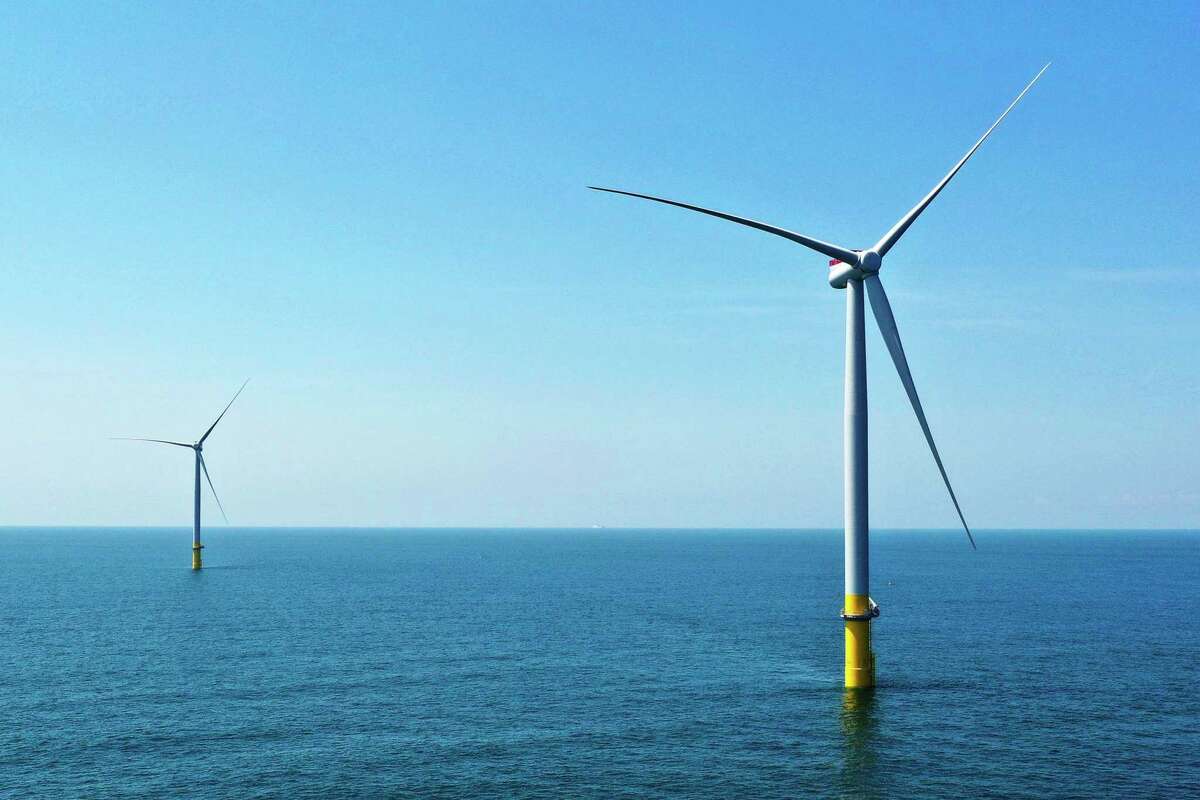
Federal officials said Wednesday they are looking into leasing a massive amount of offshore land for wind projects about 24 nautical miles off the coast of Galveston.
If developed, the Wind Energy Area would cover 546,645 acres — a larger area than the City of Houston — which officials with the Bureau of Ocean Energy Management say could produce enough electricity to power about 2.3 million homes.
A second project was also proposed about 56 nautical miles off the coast of Lake Charles, which would cover 188,023 acres. Bureau of Ocean Energy Management officials said that second project could produce enough power 799,000 homes.
Bureau of Ocean Energy Management, or BOEM, officials said this was still early on in the process, and the wind energy area proposed is still a draft. They are asking for public comments on the proposed area and leases on their website. They will hold two townhalls on the proposals virtually on Aug. 9 and 11, and more information and registration details can be found here.
"We are in the early planning stages for offshore wind leasing in the Gulf of Mexico. Once the final wind energy area or areas have been identified, the next step is to propose a lease sale for public comment either later this year or early next year," said John Filostrat, a spokesman for BOEM's Gulf of Mexico office.
It would likely be up to states, the wind developers and intergovernmental agencies to determine whether the electricity generated would be interconnected with ERCOT or the neighboring East Coast interconnection. It would be up to the Coast Guard to determine whether commercial or recreational boats -- including commercial fishing and shrimping operations -- could enter the waters near the wind turbines, BOEM officials said, adding they have already held several meetings with fishing groups and associations this year as they've planned the leases.
As a result, they said they have already carved out parcels from the lease area to leave bare for shrimping operations to continue.
READ MORE: The Biden Administration wants to open the Gulf for offshore wind power. Is Texas ready?
The announcement is part of a Biden Administration initiative to help develop 30,000 megawatts of offshore wind generation by 2030, a jaw-dropping increase from the 42 megawatts of electricity produced by the only two offshore wind farms currently in operation nationwide. Those two projects are in state waters -- and there are no projects currently operating in federal waters.
Another 15 projects are in the permitting phase, and eight states have set goals to procure a combined 39,298 megawatts by 2040, according to the U.S. Department of Energy. One megawatt is enough to power about 200 homes on a hot summer day.
Wind energy along the Gulf Coast tends to be strongest closer to Corpus Christi and Brownsville, but tapers off by the time it reaches Florida, according to a study by the Bureau of Ocean Energy Management.
Gulf Coast winds still aren't as forceful or as consistent as those off the East Coast, where existing offshore wind farms are located, said Michael Matthews, U.S. representative for the World Forum Offshore Wind, which promotes wind energy around the globe.
“It isn’t fantastic,” Matthews said of the wind in the Gulf in an October 2021 interview. “It’s okay, it’s good for offshore wind, but it’s nothing like the North Sea in Europe or the Northeast (United States).”
The Gulf, however, is attractive to wind developers because of its existing offshore infrastructure, Matthews said.
Requesting comment for draft leases is part of the first of four stages of developing offshore wind. The second stage is selling the leases and doing more detailed environmental impact studies; the third is site assessments; and the fourth is construction and operation. It can take about 10 years from the initial stage of offshore wind development before wind turbines are operational.
Plans for offshore wind developments in the Gulf lag behind plans along the East Coast. Leases for offshore wind have already gone up for sale in North Carolina, New Jersey, New York and Massachusetts.
If the offshore wind power flows into ERCOT, it could help the grid meet the record-breaking and growing demand the nonprofit grid operator has seen in recent months. For a moment Wednesday afternoon, demand reached above 80,000 megawatts, an all-time system record.
Some state officials, including ERCOT interim CEO Brad Jones and Gov. Greg Abbott, have blamed low-out put from the state's onshore wind fleet for tight grid conditions this summer, although it has long been known that wind blows less on hot summer days and is primarily at its best during winters and in the evenings. Off-shore wind, however, performs much better during the middle of hot days.
Ed Hirs, an energy fellow with the University of Houston, said having more power generation close to large population centers helps decrease congestion on transmission lines and can help lower the price of electricity locally. However, he said, the region will still need dispatchable, thermal generation to keep up with demand when wind output is low.
"This doesn’t negate the need for backup generators," he said. "Is it a great thing to build? Absolutely, it adds a resource we desperately need. But if the weather doesn’t cooperate all the time, ERCOT or the host grid is going to have to have some sort of standby generation capacity."
This is a developing story, check back for updates.