New Braunfels City Council approves impact fee items during meeting
Published: Wed, 11/16/22
New Braunfels City Council approves impact fee items during meeting
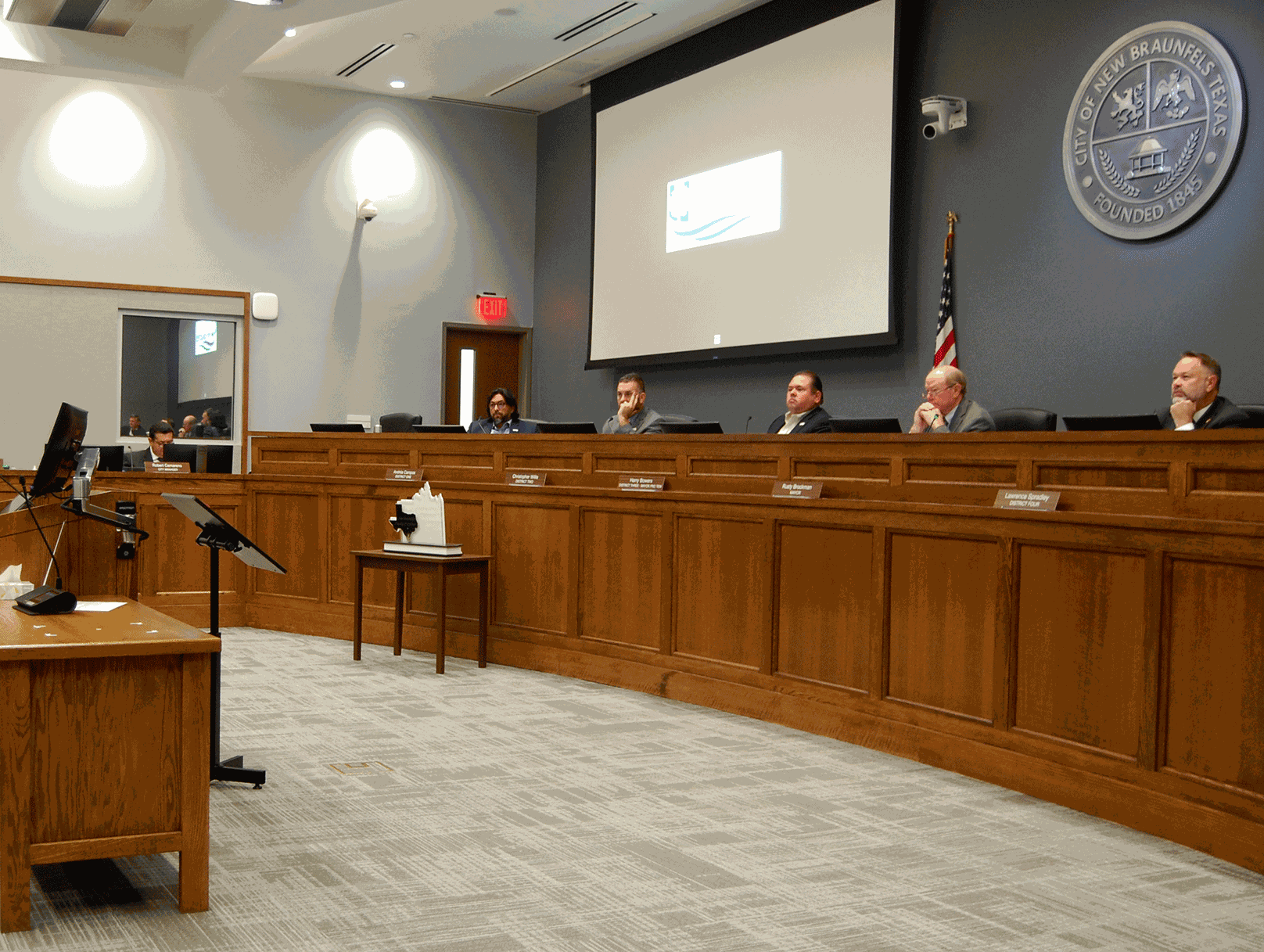
FILE PHOTO: Members of the New Braunfels City Council listen to comments during the meeting held at City Hall on Monday, Oct. 10, 2022.
STEVE KNIGHT | Herald-Zeitung
By Steve Knight The Herald-Zeitung
November 15, 2022
New Braunfels City Council members on Monday approved two impact fee items that officials say will shift the burden of paying for capital projects away from local taxpayers and utility ratepayers.
Members gave initial approval to a measure raising maximum collected roadway impact fees, which would generate additional funds needed for roadway projects prompted by new development.
The item would increase collected impact fees to 100% of the maximum assessable fee to address transportation needs and place more of the burden on developers — and likely passed on to future home and commercial building owners — to pay for the impact of new residential and non-residential construction in the city.
Current collected fees, adopted in 2020, are 50% of the maximum assessable fee for residential land uses and 25% for non-residential land uses. Other funding sources are then required to complete transportation capital improvements attributable to new development.
“Very similar to water and wastewater, we look at the roadways similar capacity — this many vehicles and a certain level of service — and what is needed to maintain that level of service and that capacity, based on new growth, new development and making sure that the impact of new development is paid by new development,” Garry Ford, the city’s transportation and capital improvements director, told council members.
Roadway impact fees are based on a five-year update to land use assumptions, growth projections and a capital improvements plan. The city is divided into six service areas within its boundaries, Ford said, with some service areas requiring more needs than others.
According to Ford, the cost of the city’s 10-year capital improvement plan necessitated by and attributable to new development is about $242.3 million. Adopting the collected fee at 100% of the maximum assessable impact fee would recover about $90.6 million of that cost.
Ford also added that the plan would provide credits for developments benefiting the city and exempt developments that qualify as affordable housing from roadway impact fees.
“If a development is coming in and providing a clear economic benefit… (or) constructing improvements that are needed, then obviously we would want and encourage to provide them credits for doing so,” he said. “Affordable housing is in our current ordinance that they would qualify. We’re sensitive to that, but we want to make sure there is criteria specifically for affordable housing. We feel that standard housing is market driven. However, if you do want a credit, there has to be some parameters and criteria for affordable housing.”
New Braunfels established the Roadway Impact Fee Ordinance in 2007, authorizing the city to impose impact fees on new development within its corporate boundaries to generate revenue for funding or recouping the costs of transportation capital improvements or facility expansions necessitated by new construction.
According to Ford, current projects utilizing impact fee funding include around $800,000 for intersection improvements at Barbarosa Road and Farm-to-Market Road 1101, $75,356 for the design of a traffic signal project at FM 1044 and Schmidt Avenue and County Line Road, and about $435,000 for a traffic signal and turn lanes at Common Street and Old FM 306.
If council members decide to amend the maximum collected fee schedule in a second reading later this month, the new fees will apply to new developments with final plat approval on and after March 1 or for which platting is not required.
The Roadway Impact Fee Advisory Committee recommended updating the roadway impact collected fees to the maximum assessable fees during its Nov. 1 meeting.
In other action, members approved the second and final reading of a New Braunfels Utilities request to increase water and wastewater impact fees.
The NBU proposal increases the maximum impact fee that could be assessed and collected for water from $7,989 to $19,448 per living unit equivalent and for wastewater from $3,251 to $6,244 per living unit equivalent.
A living unit equivalent, or LUE, is defined as the typical flow that would be produced by a single family residence located in a typical subdivision.
According to NBU, the maximum impact fee increase would assist in recovering the cost of about $314.25 million in infrastructure projects needed to serve new development in the next ten years.
Impact fees are charged to new or expanded water and wastewater service within corporate limits, the city’s extraterritorial jurisdiction, and other new customers served by contract with NBU.
The impact fees will not apply to existing NBU customers who do not request an expansion of service through larger meters or extended or larger diameter lines or to properties that do not receive water or sewer service.