Harker Heights council recalls new marijuana ordinance
Published: Wed, 11/23/22
Harker Heights council recalls new marijuana ordinance
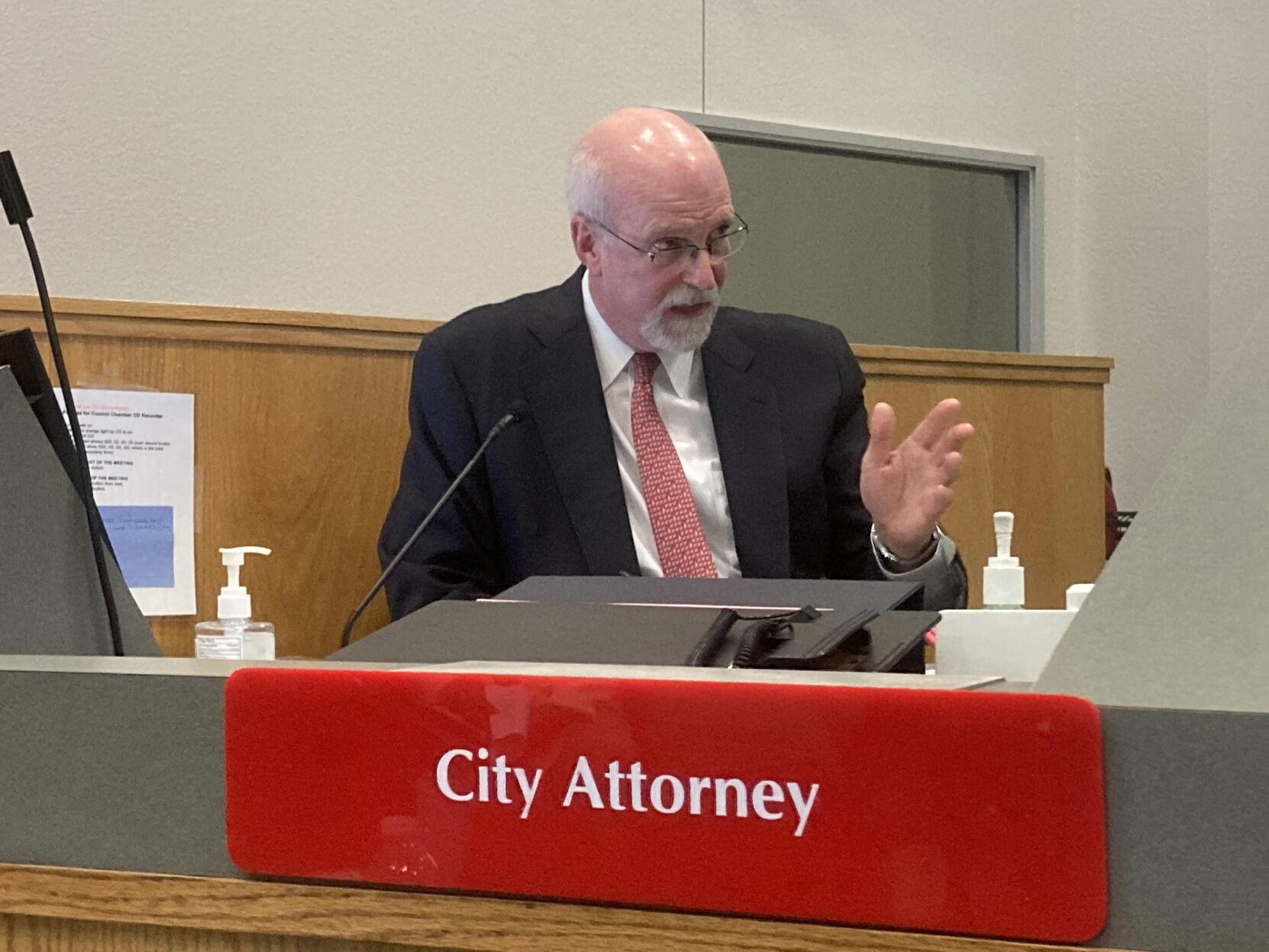
Harker Heights City Attorney Charlie Olson presented his legal opinion to council Tuesday night on why he was advising council members to repeal the city's new marijuana decriminalization ordinance passed by voters Nov. 8.
Clay Thorp | Herald
Killen Daily Herald
By Clay Thorp Herald correspondent
November 22, 2022
HARKER HEIGHTS — The Harker Heights City Council relegated its new marijuana decriminalization ordinance to the ashtray Tuesday night, repealing a measure passed by a solid majority of the voters in the city’s Nov. 8 election.
Mayor Pro Tem Jennifer McCann, Councilmen Michael Blomquist, Tony Canterino, and Sam Halabi voted for repeal while Councilwoman Lynda Nash was the only dissenting vote to keep the ordinance in a 4-1 vote.
At least nine individuals spoke at Tuesday night’s meeting for and against repealing the ordinance.
Vitalis Dubininkas, a veteran who said he uses cannabis for health reasons, compared the council’s impending repeal vote to the prohibition era and said the council should keep the ordinance.
“I use cannabis for PTSD,” he told council members. “…You guys should be on the right side of history.”
Julie Oliver, an Austin attorney whose progressive group Ground Game Texas helped get the measure on the ballot, also spoke for keeping the ordinance passed by voters.
She said Texas legalized hemp in 2019, so the marijuana decriminalization ordinance should stand to protect those who use legal hemp.
“Legal hemp is indistinguishable from illegal marijuana,” Oliver said. “... Please let the voice of the people stand.”
Shirley Fleming, a former Killeen city councilwoman, said repealing the ordinance could make voters feel like their vote doesn’t matter.
“If you stomp on this, a lot of people will say ‘my vote doesn’t count,’” Fleming said. “…Let’s respect their vote.”
Ashley Smith, a precinct chair in Killeen who helped young voters register before the election, said many young people told her they felt like their vote already doesn’t matter.
“A lot of people came to me and said ‘I don’t think my vote will matter.’ I was able to get a lot of people my age to vote,” Smith said. “…They will remember if they voted and their vote didn’t count.”
Robert Johnson of Harker Heights said there were plenty of state and local laws that are rarely enforced, so the ordinance should stand.
“There’s a whole slew of them,” Roberts said of unenforceable laws. “There’s a whole slew of laws in the state of Texas they can’t enforce.”
Roberts said the cost of convicting and jailing citizens on low level marijuana offenses would be more expensive to taxpayers.
“Not only is it silly to prosecute someone for a minor marijuana offense, it’s very expensive for taxpayers to send them to jail,” Roberts said.
But others, including Howard Arey and his daughter, Julia, disagreed. Howard Arey said the council should follow state law.
“Know that citizens expect the council to make decisions based on law and I believe the state law on this is very clear,” he said.
Various provisions of state law require police officers to enforce drug possession laws, so legal officials in Bell County have signaled to local police departments that voters’ new marijuana ordinance is essentially void.
Julia Arey, a graduate of Harker Heights High School who said she’s attending Baylor University, recalled drug deals inside her high school and an environment that was already not prime for learning.
“Every single bathroom reeked of weed,” Julia said of her high school. “…I’ve witnessed drug deals in my classroom.”
Gerald F. Dreher, a retired Army surgeon, said the area’s military readiness might be compromised by the marijuana ordinance.
“In a military community, we should have higher standards,” Dreher said. “…It’s just wrong in every way.”
Terry Delano said the ordinance would have an effect on crime.
“I don’t believe this will do anything to improve crime in Harker Heights,” Delano said. “I think it will make it worse.”
Once the public comment period was over, City Attorney Charlie Olson gave council his legal opinion on why the ordinance should be repealed: it was inconsistent with existing state law and targets the law enforcement community.
“It places limitations and burdens on their conduct,” Olson said. “It essentially targets police officers.”
Olson also outlined how the ordinance was light on definitions, like what constitutes a ‘high-priority narcotics investigation’ exception in the ordinance for probable cause searches and that the ordinance violated the separation of powers between the judicial and legislative branches.
“The courts decide what is probable cause depending on a given situation,” Olson said.
Olson could find no precedent for a city disciplining a police officer, as is dictated by the new ordinance if officers decide to uphold state marijuana law instead of a local marijuana law.
“I know of no city anywhere who punishes police officers for upholding state law,” Olson said.
Nash was the only council member to ask Olson questions about their options of amending the ordinance, whether the city or council could be punished by the state for upholding the ordinance, or if officers currently already have discretion to cite and release those suspected of possessing small amounts of marijuana.
Some cities in Texas allow for officers to cite and release marijuana possession suspects.
Other cities such as Elgin, San Marcos and Austin have fully enforced the will of voters on decriminalizing marijuana in recent elections, with no apparent action to stop them by state officials.
Nash asked Olson what the state of Texas could really do if Harker Heights chose not to repeal the marijuana ordinance.
“Would the state come back on us?” Nash asked Olson.
“They could, but I don’t think they would,” Olson answered.
Nash said she wasn’t in favor of punishing police officers, but nonetheless was the only vote to keep the ordinance.