Harker Heights City Council adopts impact fees
Published: Wed, 11/23/22
Harker Heights City Council adopts impact fees
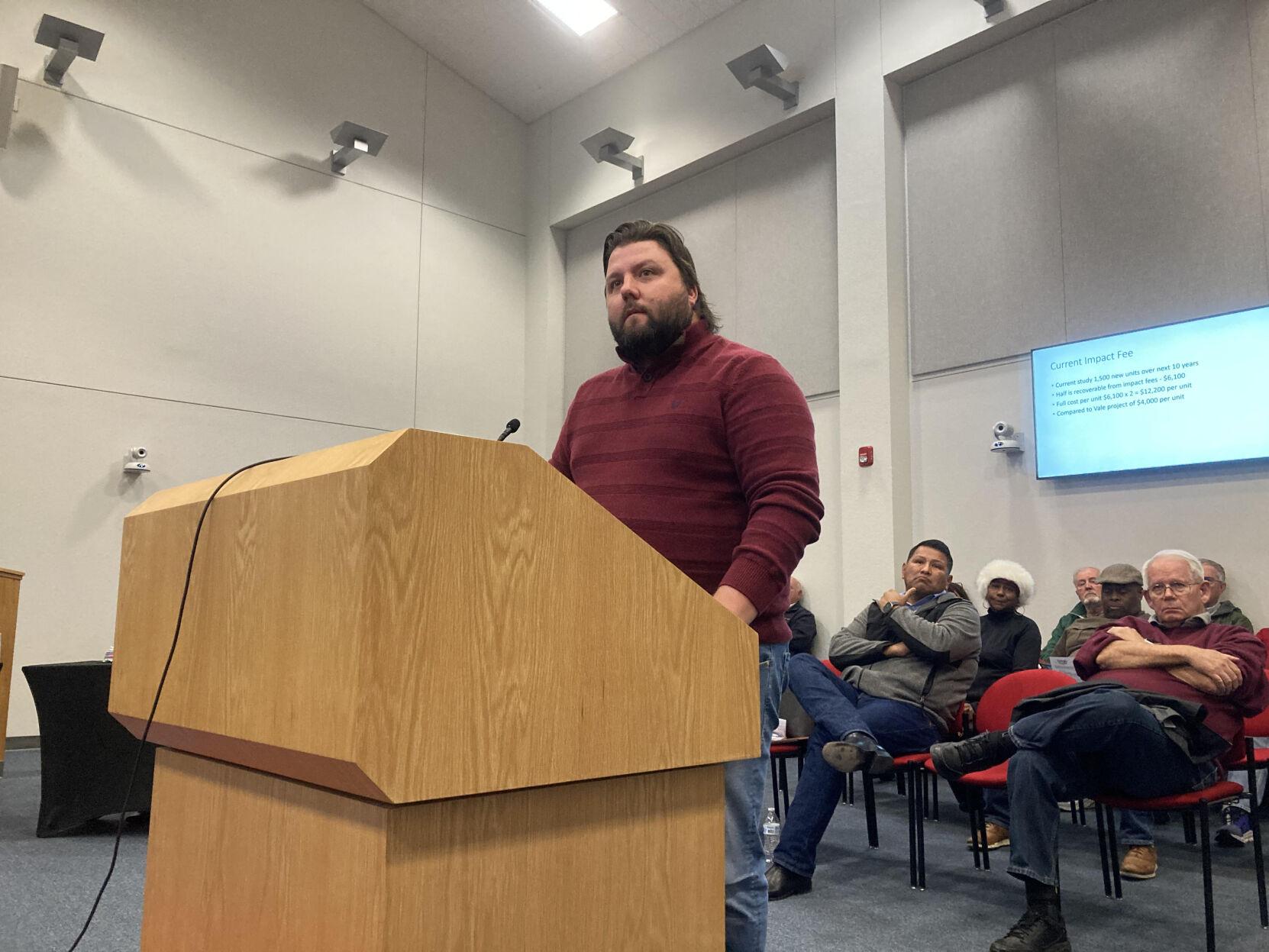
Josh Welch with the Central Texas Home Builders Association asks the Harker Heights City Council on Tuesday to consider lowering any impact fees for future home development.
Clay Thorp | Herald
Harker Heights Herald
By Clay - Thorp Herald Correspondent
November 22, 2022
In a 3-2 vote Tuesday, the Harker Heights City Council approved charging wastewater impact fees to developers, a first for the city.
The move is designed to get developers to pay their fair share of increased water infrastructure costs associated with the booming housing development industry as new construction inevitably replaces the cedar, scrub and grazing land between Heights and Nolanville.
Heights wants to use the additional impact fee revenue to build new water and wastewater facilities to help feed thirsty developments that are sure to come along the city’s eastern growth corridors.
President of the Central Texas Homebuilders Association Joshua Welch spoke against the measure Tuesday night.
Welch is also a developer who has met with Heights city staff multiple times in regard to the impact fees, citing plans to build more than 1,000 new homes in the Heights area.
“We’re planning for potentially another 1,500 units (homes) of growth over the next 10 years,” Welch said Tuesday.
Welch presented the Heights board with a detailed outline of how the new impact fees were burdensome to their industry, especially considering the cost of an upcoming water treatment plant to feed the new developments.
“We are going to build a new treatment plant from scratch,” Welch said. “We already got our permit from TCEQ.”
Heights Assistant City Manager Jerry Bark on Tuesday told the Herald their consultant based the city’s new $6,133 impact fee on 1,379 new homes. The city says they’ll need about $53.7 million to fund capital improvements to support their coming needs. Some $15.7 million of that would come from the city’s new impact fees, according to the city’s planning department.
“We can only recoup 50% of the cost on impact fees,” Bark said of the coming developments.
After Welch’s presentation, in which he recommended the council consider an impact fee around the $4,000 mark, there was plenty of public discourse about the ordinance between council, culminating in a 3-2 vote with Mayor Pro-tem Jennifer McCann and Councilwoman Lynda Nash voting no. Councilmen Tony Canterino, Michael Blomquist and Sam Halabi voted yes.
Before the vote, Nash and McCann seemed to lean toward lowering the $6,133 impact fee down closer to $4,000 after Welch’s presentation. Nash asked city staff their options on lowering the fee now or later down the road. Nash later asked council to consider the $5,000 mark. The city’s consultant on the impact fee study, Jessica Vassar of Freese and Nichols in Austin, was asked by Nash how they might come up with any additional impact fee revenues later if they lowered the impact fees now. Vassar said they could reevaluate their calculations at the two- and five-year marks, but any money needed for capital improvements would have to come from somewhere.
“If it’s not funded through the impact fee, it will have to be funded some way else,” Vassar said.
Despite Nash and McCann’s probe into lower impact fees, Canterino and Blomquist solidly refused to amend their motions to pass the new $6,133 impact fee.
Canterino and Blomquist viewed any lowering of impact fees as taxpayers getting a raw deal from developers, calling it a burden especially to lower-income Heights residents.
“We aren’t trying to run you out of business,” Blomquist said of developers. “We are trying to make sure this is fair for everybody.”
As for Welch’s presentation and the data it contained, Blomquist told Welch it was too little too late.
“It’s kind of too late,” Blomquist said. “You should have addressed this up front so it could be vetted.”
Blomquist pointed out builders would be made whole rain or shine.
“Ultimately the builder is going to get their money back no matter what,” he said.
Canterino said he was “trying to defer some of that cost back to builders” and didn’t want taxpayers subsidizing the housing development industry.
“I’m not going to lower rates to subsidize private industry,” he said.
Canterino signaled the $6,133 impact fee might not be high enough.
“I think even at the higher impact fee, I still think we are coming up short,” Canterino said.
After the impact fee ordinance passed, Welch told the Herald home building will be affected.
“It will have an effect — yes,” he said. “To what extent, we’ll see.”
The council could have structured the impact fees to be more affordable, Welch said.
“I think there’s a lot more affordable ways to do it than they have planned,” he said.
Welch said the housing market is cooling down some in Texas and across the country as interest rates rise, but he was nonetheless confident development will continue unabated despite the new impact fees.
“It’s not gonna stop,” Welch said.