Legal implications, ‘practical’ issues dominate Proposition A discussions in Killeen
Published: Sun, 11/27/22
Legal implications, ‘practical’ issues dominate Proposition A discussions in Killeen
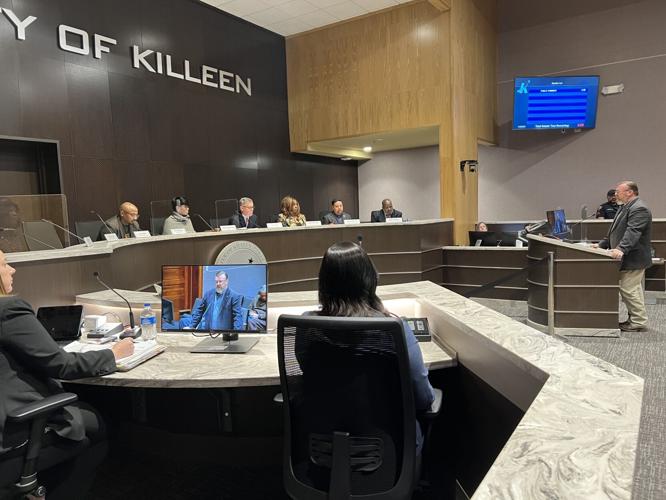
Bell County Precinct 4 Commissioner Bobby Whitson addresses Killeen City Council members on Tuesday before they voted to place a moratorium on Proposition A until Dec. 6
Ricky Green | Herald
Killeen Daily Herald
By Paul Bryant | Herald Staff Writer
November 27, 2022
Months after Ground Game Texas activists began circulating an initiative petition to decriminalize possession of misdemeanor amounts of marijuana here, Killeen City Council members on Tuesday said they need more time to consider the legal implications of Proposition A.
“I hope that citizens will have a better understanding as to why Council has not acted yet,” Councilman Jose Segarra said. “Our charter states that any petitions brought before council must be voted on by council and if not approved by council, then it must be put on the ballot for citizens to vote on it.”
Council members ordered the special election in August — necessary under the city charter because council members did not adopt the initiative ordinance on July 26 that requires “Killeen police officers shall not issue citations or make arrests for Class A or Class B misdemeanor possession of marijuana offenses, except in the limited circumstances.”
On Nov. 8, Killeen voters approved the measure by nearly 70%
The ordinance
On Tuesday, council members and Killeen Police Chief Charles Kimble, City Attorney Holli Clements and City Manager Kent Cagle discussed how — and whether — Proposition A should be implemented.
“We did have an election on Nov. 8,” Clements said. “State law requires the election be canvassed, which is what you’ve just done. It is an ordinance of the city of Killeen. I do have an opinion that disciplining an officer while complying with state law would be problematic and subject the city to legal action.”
Citing Section 370.003 of the Texas Government Code, Clements said that she believes “the initiative ordinance would likely be found in violation of this statute. There are a number of other federal and state laws implicated. This is perhaps the most direct.”
Although no city in Texas — Austin, Harker Heights, Denton, San Marcos and Elgin — where voters have decriminalized misdemeanor possession of marijuana has been sued, Clements repeated her assertion that Killeen faces that possibility.
“There could be legal challenges ... and they could come from all sides,” she said. “And there are also practical concerns. The police department may be more qualified to discuss those practical concerns.”
Central to such concerns is that Proposition A prohibits Killeen police officers from using the smell of marijuana as probable cause to begin investigations into possible criminal activity.
‘Responsibility to the voters’
“The U.S. Constitution ... (grants) law enforcement officers the ability to search and seize illegal substances based on probable cause — probable cause being the odor of burnt marijuana,” Kimble said. “To take that away from us and try to comply with the ordinance would be very difficult, at best. Also, as Mr. Cagle has talked about, we do have a responsibility to the voters of the city of Killeen.”
But invoking concerns about not being able to use the Fourth Amendment while following what was a short-lived directive by Cagle to enforce Proposition A is a contradiction.
On Nov. 10, Kimble issued “special order 22-07” to officers, essentially putting the new ordinance in effect before election results were canvassed.
“No arrests will be made for misdemeanor possession of marijuana,” according to Kimble’s order. “In lieu of a marijuana arrest, officers will not arrest for possession of drug paraphernalia or drug residue.”
Furthermore, consistent with the initiative ordinance that led to the approval of Proposition A on Nov. 8, “city funds and city employees are prohibited from requesting, conducting or obtaining testing for THC. The order of marijuana or hemp shall not be considered for probable cause for any search or seizure.”
Four days later, Bell County District Attorney Henry Garza sent a letter to Kimble asking him to rescind the order.
“You instruct your employees, among other things, not to make arrests for the possession of misdemeanor amounts of marijuana nor to consider the odor of marijuana or hemp as probable cause for any search and seizure,” Garza wrote. “I am writing to respectfully request that you rescind this order.”
A day later, Garza confirmed he sent the letter to Kimble.
“Myself and the county attorney Jim Nichols have both signed a letter to Chief Kimble requesting him to reconsider a general order that he has signed,” Garza said in an email. “We expect to visit with the chief once he has had an opportunity to review the information that has been provided to him.”
It’s not clear whether that meeting happened. But during the special council meeting on Nov. 22, Kimble acknowledged that he cleared his “special order” with Cagle before circulating it.
“We discussed this,” Cagle said. “To clarify one more time, the council did not pass an ordinance (on Tuesday). The voters passed it. Now, this problem has been laid in your laps and our lap, in the chief’s lap and in the officers’ laps.”
‘Confusion from officers’
Kimble agreed.
“When the voters approved the ordinance as it was written at almost 70 percent, there was some confusion from officers,” the police chief said. “I said, ‘Well, listen, I’m going to put out a memo as a stop-gap measure to eliminate enforcing low-level marijuana. Special orders come out ... to temporarily deal with an issue until they become a general order.”
And while Mayor Debbie Nash-King reminded council members several times they may repeal or amend Proposition A, Cagle told them the voters passed the ordinance into law and that they “did everything you were supposed to do.”
“You follow the charter,” Cagle said. “That’s our constitution. The state of Texas didn’t write that constitution. It was approved by Killeen voters, and you did exactly what you were supposed to do. You did not adopt the law. The voters adopted the law. You followed the constitution, and we need to decide what to do from here.”
Meanwhile, Kimble continued to explain his position. Last December, when organizers were starting the petition to decriminalize marijuana in Killeen, the police chief opposed such an ordinance that would prohibit police from enforcing low-level marijuana offenses.
“We want the community to know that the department does not support to decriminalize marijuana and we will continue to follow the statute, Texas Health and Safety Code 481.121 - Possession of Marijuana, which is the Texas State Law,” the Killeen Police Department released in statement last December.
Earlier this month, Kimble issued “special order 22-07.” And on Tuesday night, Kimble questioned not only the probable-cause clause in Proposition A but the one that allows the city to discipline officers who violate Proposition A.
‘Not a high priority’
“Given that direction from you as council ... to potentially discipline an officer and have he or she lose their livelihood is not fair,” Kimble said. But “as you look throughout the country — places like the state of Washington, Colorado, city of Chicago, city of Seattle, city of New York City and even places here in Texas — enforcing marijuana is not a high priority. But taking away that discretion ... would hamper police work.”
However, Kimble said, his police force would “adjust.”
“There was a little bit of confusion (after Proposition A was approved), so we halted our enforcement” through “special order 22-07.”
Clements offered no recommendation to the council on whether to amend or repeal Proposition A.
‘Definitely need guidance’
“Staff would definitely need guidance on what you wanted to be amended, what your goal there would be,” she said. “As I stated, i believe that it would be difficult to say you are fully enforcing the statute while also eliminating enforcement of misdemeanor marijuana.”
And “removing that section” on probable cause “is frustrating the will of the voters,” Clements said.
“That is clearly the main point. If you take that out, you are kind of gutting the ordinance. Repealing the ordinance would be direction from council. Staff would bring back an ordinance to repeal this ordinance. And then your third option (is) you would not need to take any action.”
‘Leery of repealing it’
Mayor Pro Tem Ken Wilkerson said he was not prepared to make a decision and asked the council to consider revisiting Proposition A in three months to coincide with language in Proposition A that requires the governing body to review how the ordinance has been implemented.
“I don’t think that this is something we’re going to be able to determine tonight,” said Wilkerson, who signed the petition last spring. “I would be leery of repealing it. As far as Garza and all the opinions we have out there, they’re not judges.”
Wilkerson said on Wednesday he hadn’t changed his mind after council members voted 5-1 to place a moratorium on Proposition A, at least until Dec. 6.
“I voted against it,” he said. “Originally, it was just (about taking) time to digest the information and do what’s best for us. I’m fine with Dec. 6. That’s fine. I just came up with that date because it was already in the ordinance.”
Wilkerson was referring to that part of Proposition A that requires Cagle to present to the City Council his findings on implementation of the ordinance.
Segarra joined Tuesday’s meeting remotely. He and council members Jessica Gonzalez, Ramon Alvarez, Nina Cobb and Riakos Adams voted on the moratorium. Councilman Michael Boyd did not attend the meeting, but he emailed a statement to the Herald that day.
‘Respect the will of the people’
”In unity, citizens across Killeen followed the course illustrated in the city charter to place Proposition A on the ballot. On (Nov. 8), an election was held and the majority of voters chose to approve Proposition A. While I may have differing opinions on the ordinance, I absolutely respect the will of the people in this regard. As District 4 council member, I represent the residents of west Killeen — many of whom voted to approve Proposition A.”
He also referenced “potential conflicts with existing law.”
“However, these could be more clearly codified outside of the myriad of opinions,” Boyd wrote. “Notably, the ordinance may need to be amended to eliminate any broadly determined conflicts. At the end of the day, the City Council has the option to adopt the ordinance with existing language, make necessary amendments or engage the process of repeal. I trust the will of the people will prevail.”
Still, some of the council members appeared surprised by how Proposition A might impact the way Killeen police officers do their jobs, and the opinions of 10 residents who spoke during public comments on Tuesday.
“We’re already not enforcing at certain levels,” Gonzalez said to Kimble. “Can you tell what the difference is between this ordinance versus an internal policy?”
Kimble responded.
“Words like ‘shall’ and ‘may;’ our officers are going to try their best to abide by that,” he said. “The law under certain misdemeanors ... gives the officer a bit of discretion in their work. Killeen police officers do a very good job now in enforcing Class C violations.”
‘Scale of criminality’
To magnify his point, Kimble used speeding as an example of how officers use discretion in writing citations.
“If you are going absolutely 52 miles per hour in a 50-mile-per-hour zone, will we write you a ticket? No.”
But then Kimble began talking about “scale of criminality.”
“(It’s) taking away options from us because we know that there’s a scale of people you deal with (such as) a first- time offender who may need some discretion on them, or a person who is constantly in the drug trade. There’s a scale of criminality we deal with. Taking that ability away will hamper those operations.”
On Tuesday, Segarra was one council member who supported removing the probable-cause clause from Proposition A.
“It’s hard to pull this back once it’s out there,” he said. “If we do table it, all that basically means is that we are approving it as is. My big issue hasn’t even been the marijuana part. It’s Section 22-83, which is what we’ve already talked about — police using odor of marijuana for probable cause. I think the No. 1 concern for our citizens has always been crime. I’m more in favor, if we have to do this, as amending it and removing that one section. That is my big concern. I don’t want to remove that tool from our police officers.”
Cobb acknowledged voters’ will but said she opposes Proposition A.
“The vote is the most powerful tool that a citizen ... would ever have,” she said. “It helps us when we’re right. It helps us when we’re wrong. I have to still say, ‘No.’ But I want you to listen to what i have to tell you. You voted your desires and your wishes on how you see the city of Killeen with Proposition A. We’re faced tonight with the law. I took an oath of office and said I would be fair and I would be honest. To do those things, that means that I could not break the law.”
‘People passed it’
Wilkerson sided with Cagle.
“I agree 100 percent with what the city manager said. I’ve been saying that. I know we’re an easy target as we sit up here. If you spent more than one city council meeting here, you understand we all unanimously sat here and our city attorney said we cannot pass this. And we didn’t. The people passed it. No one up here is an attorney — except one. I think we’re doing our due diligence now to go back and make it a practical application.”
Proposition A does not involve jurisdictions beyond the Killeen Police Department. Yet, Gonzalez asked Kimble on Tuesday to talk more about that.
“When it comes to the prohibition from making arrests on the local level, it was mentioned by someone in the audience that it could still be a challenge on the county side,” she said.
Kimble said that is accurate.
“Based on the ordinance as written ... that does not prohibit other law enforcement agencies from conducting operations in Killeen.”
That includes, for example, Bell County deputies and constables and Texas Department of Public Safety troopers.
“In my opinion, Prop A should have been voted on (by the council) Tuesday night,” Nash-King said on Wednesday. “The council was briefed by the city’s attorney and police chief, and we heard from the residents — not to mention, the citizens who have already voted. The council only has three options. It’s just that simple. However, I do respect the council members‘ decision to postpone it until Dec. 6 for members who need more time to research the ordinance.”
Louie Minor, the Bell County Precinct 4 Commissioner-elect and Ground Game activist, called the handling of Proposition A in Killeen a “charlie foxtrot.”
‘Everyone’s confused’
“In the military, we use the term and a lot of your readers will get it,” he said. “That’s what happened (on Tuesday night) So everyone’s confused. I’m confused, and I’m one of the ones spearheading everything.”
While another activist, Shirley Fleming, a former Killeen City Council member, has threatened to organize recalls, Minor said they’re taking a wait-and-see approach.
“I think we have a plan of action for Harker Heights and Killeen,” he said. “In Killeen, we’re going to wait and see what they’re going to do.”
In Harker Heights, where the city council repealed the voter-approved marijuana decriminalization law last week, Ground Game is planning a referendum.
“We have a very short period, though,” Minor said. “It would repeal the city’s repeal. So, the citizens would vote on repealing the ordinance that City Council voted on repealing. I was really disappointed in everything.”
Fleming expressed the same sentiment.
“I am very disappointed in some of the council members,” she said. “They did something stupid. I don’t care whether they like it or not. When you canvass the votes, it became law. We worked too hard for them to just throw this in the garbage can. It’s not against the law.”
Following Tuesday’s meeting, Alvarez called implementing Proposition A “a multifaceted issue.”
“I think it’s going to take a multifaceted response to get there,” he said. “I think we needed more time to obviously do our due diligence and come up with the best response for the city and, hopefully, between now and Dec. 6, we can do just that. It’s a tough position. I think this is where we’ve got to kind of get in there with our experts, with our city attorney, and kind of find out the best way to navigate this thing.”
Public comments
John Miller was one of three residents to speak in favor of Proposition A on Tuesday night.
“The people voted ... for Proposition A,” he said. “And they voted for it with a clear conscience — almost 2 or 3-1. Before we alter it or change it, let’s start off by doing what the people asked for. Let’s do that first, then we can ... make changes later.”
On Nov. 8, Proposition A was approved in Killeen by nearly 70% of the vote, 16,886-7,424.
“This whole Proposition A is nothing but cheap political theater for low-information voters,” resident Michael Fornino said. “With regard to Proposition A, once again I’ll say it: You folks have a lack of command in civics in application of law. There’s a way and a legal process to change the law. This is not it.”
Another resident, Jack Ralston, said that “smoking marijuana is against state law.”
“It’s against federal law. If you swore an oath to uphold the law and you support this ordinance, you have decided that you would rather disobey the law. This is the Marijuana Smokers Protection act. This is a country of laws. We are not hamstringing our police by telling them you can’t enforce this law.”
Killeen resident Chris Bray, a Republican defeated by Minor, a Democrat, on Nov. 8, said Proposition A is about state law.
“We could be here all night debating the pros and cons, but this issue is not really about Proposition A,” he said at Tuesday’s meeting. “This issue is about Texas law, and I want to remind all the City Council members of their sworn oath to uphold state and federal law. No amount of amendments made to this ordinance is going to make it legal.”
The City Council meeting on Dec. 6 is scheduled for 5 p.m. at City Hall, 101 N. College St.