10 Years Later, a Return Trip to ‘Walkable City’
Published: Tue, 12/06/22
10 Years Later, a Return Trip to ‘Walkable City’
In an excerpt from the book’s new 10th anniversary edition, author and urban planner Jeff Speck looks at how the streets of US cities have changed.
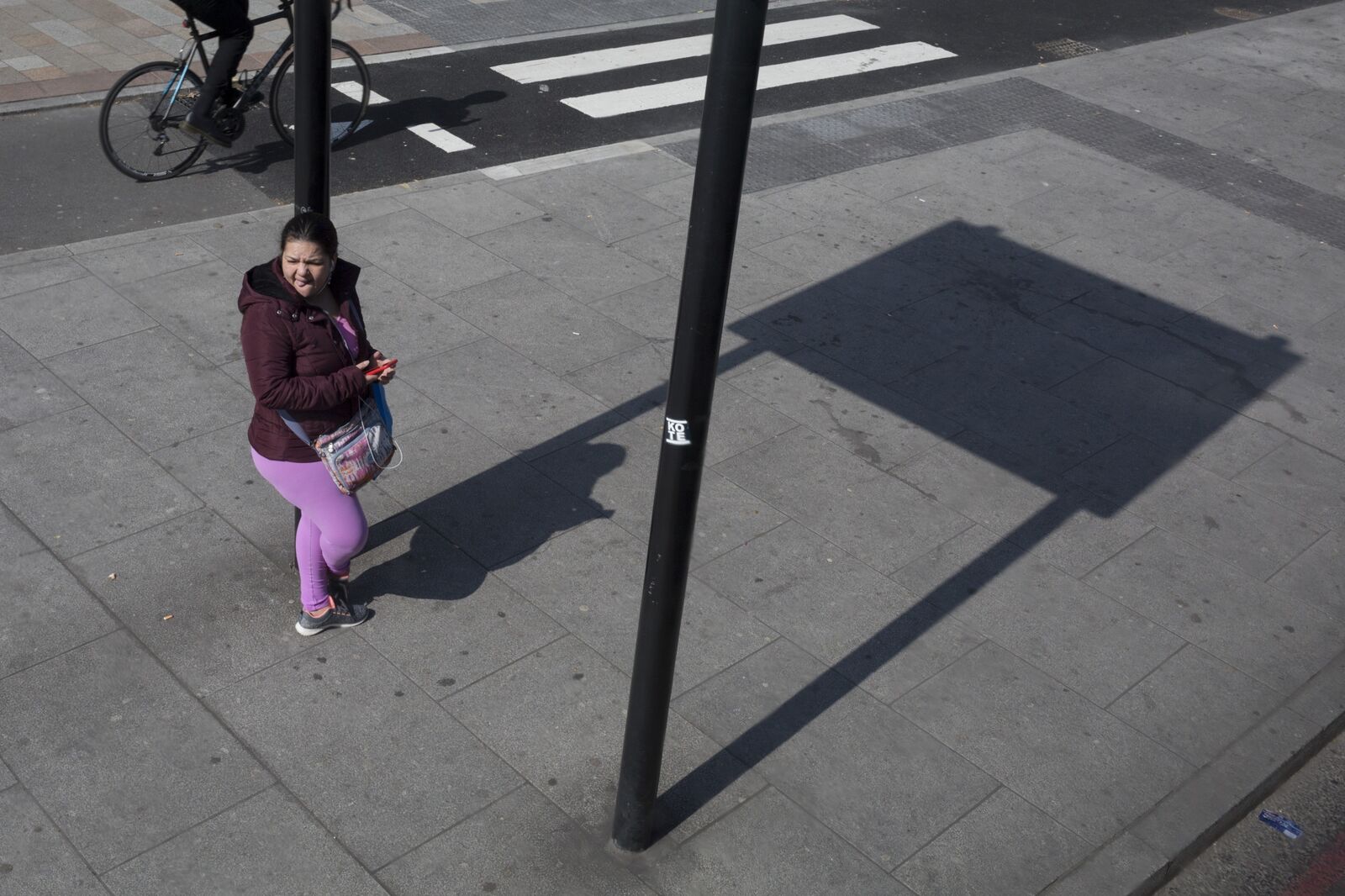
Many US cities have made improvements to their pedestrian and bike infrastructure since 2012; others are still waiting.
Photo: Richard Baker/In Pictures via Getty Images
Bloomberg
By Jeff Speck
Since it was published in 2012, Jeff Speck’s book Walkable City: How Downtown Can Save America, One Step at a Time has become one of the most popular titles in urban planning. Speck’s blunt assessment of the state of the planning profession and 10 steps for improving street design have influenced the last decade of efforts to improve safety and livability across US cities.
The book’s 10th anniversary edition is now being released, with a 100-page update by the author and a forward by former New York City transportation commissioner Janette Sadik-Khan. This week, CityLab begins sharing the first of three excerpts from Speck’s new text.
Ten years ago, before lecturing cities on how they could become more walkable, I was often asked to explain why it was so important.
Most lecture clients now tell me I can skip that bit. “We’re already sold.”
Still, the evidence keeps piling in. I recently reviewed a deeply researched technical report from the engineering giant Arup. It documented how walkability improves, among other things, traffic safety, community identity, tourism, stormwater management, transit effectiveness, urban competitiveness and connection to cultural heritage; it reduces obesity, other chronic diseases, health-care costs, crime, traffic congestion, maintenance costs, fossil fuel dependence, air pollution, ambient noise and microclimates; and it increases life spans, neighborhood vitality, worker creativity, social interaction, intergenerational connectedness, community inclusivity, employment rates, economic productivity, local investment, property values, efficiency of land use, public engagement, civic responsibility, urban resiliency, beauty, and happiness.
Anything missing?
I have found that it is still useful to organize these benefits under the tripartite headings of wealth, health and sustainability, except that I missed one: equity. Bringing this book up to date means correcting both for 10 years of history and for a lifetime of insufficient awareness of how car culture disproportionately punishes people of color and other marginalized populations.
Urban Fundamentals
The Covid-19 pandemic caused a lot of city dwellers to head for the hills. Many are now coming back, and the long-term outlook is strong. But even before Covid, it became clear that the millennial urban invasion was losing steam. Young adults kept moving into cities, but millennials stopped being young adults. The average member of that generation is now — brace yourself — 36 years old. That puts them in that small window of life when their housing location is going to be driven mostly by school choice. Urban schools may be getting better, but they are not the best, so the parents who are able will continue to relocate to the suburbs.
Ignoring the immorality of this situation, we can still say that downtown and other walkable urban neighborhoods, post-Covid, will remain popular, thanks to the law of supply and demand. Demographers and real estate economists will continue to grab headlines with stories about one group or another “swarming into” cities or “flocking out” of them, but the fundamental American mismatch between the desire for and the availability of walkable places is not about to change.
Depending on who you listen to and when they conduct their polls, somewhere between 45% and 55% of the US public would prefer a home in a walkable neighborhood to one with a big yard. Meanwhile, the number of Americans who live in walkable communities has been estimated at one in 10. That means that most of the half of us who want walkable places aren’t getting them, so we can be confident that the “urban advantage” persists.
By goosing telework, Covid and Zoom have allowed many Americans to decamp for greener pastures. For some, that has meant the country or the suburbs. But many others have moved to smaller cities and towns with less overblown real estate markets. These relocations — from New York City to Hudson, or from San Francisco to Truckee — will help bring walkability faster to a lot of places that were lagging.
What will a dispersing workforce mean for the American economy? There are reasons to be worried. A three-year University of Pennsylvania study of 3,445 inventors commuting to 1,180 different firms found that “for every [6.2 miles] of added travel distance, the firm employing those inventors registered 5% fewer patents. The quality of the patents took an even bigger dive, dropping 7% with every 6.2 miles added to the inventors’ commute.”
In other words, for every additional mile your inventors commute, they are likely to produce 1% fewer inventions of 1% worse quality. Acknowledging how lengthy commutes hurt productivity, Facebook offered $10,000 bonuses to workers who moved closer to their Menlo Park campus.
Is it the lack of proximity that enfeebles suburban inventors, or the time wasted driving? Likely both. Whether the solution is urbanism or Zoom, we can be confident that more suburbanization is not a path to success.
Even the Mafia is struggling from sprawl. An October 2021 Wall Street Journal article noted how “bumbling suburban-bred mobsters kneecap a storied New York clan”:
Older members complain that the millennials — who grew up in the suburbs instead of city streets — are softer, dumber, and not as loyal as mobsters of the past. Plus, they’re always texting. “Everything is on the phones with them,” said a former made member of the Colombo family.
Soft Targets
What our gangster meant by “soft” could be interpreted several ways, but suburbanization contributes to a number of public health concerns. The percentage of obese Americans rose a solid 24% from 2008 to 2018, and our driving lifestyle deserves much of the blame. How do we know? Evidence comes from many sources, but my favorite is an accidentally randomized experiment conducted in China. I know of no other study that has been able to isolate the impacts of car ownership while holding all other variables constant.
Beijing is like the Soviet Union used to be: If you want to own a car, you have to win a lottery. Fewer than one in 50 applicants are allowed to buy cars. Researchers tracked 937 “winners” and “losers” over five years. They found that the winners walked 24 minutes less each day than the losers, and that, for people over 50, winning the car lottery meant gaining an average of 22.7 pounds.
While the clear causality can’t be mistaken, it is difficult to know exactly how much of our current obesity crisis can be pinned on the automobile. Not so for another epidemic: the roughly 40,000 of our fellow citizens killed each year by traffic violence — up to 42,915 in 2021. That’s like a 737 crashing every day.
The most shocking thing about this number is how we continue to take it for granted. If some communities’ response to the Covid crisis conveyed the impression that life is cheap in America, we need look no further to understand why.
And the injuries! Two million Americans are “permanently injured” in car crashes each year. That’s 228 life-changing injuries per hour, every hour. Every day. Every year. It is a strange collective psychosis indeed that blinds us to this rolling disaster.
I guess this is old news, and, thanks to evolving technologies, the risks of driving a car have been falling. Also on a steady decline were pedestrian fatalities — until 2009. What has happened since then is news, and is expertly covered in Angie Schmitt’s important book Right of Way: Pedestrian fatalities have been rising on average almost 5% a year, every year. Pedestrian fatalities were 6,700 in 2020, up 63% from 2009.
Why the sudden rise? There appear to be two main causes, and they do not include cell phones, which have proliferated in Europe without causing similar bloodshed. The first is that more Americans have been forced to live in suburbia, especially low-income Americans. As cities become less affordable, more car-less citizens find themselves living and working in places never intended for walking. With bus stops located on seven-lane arterials and crosswalks a half mile apart, it’s a killing zone out there, and one that discriminates ruthlessly.
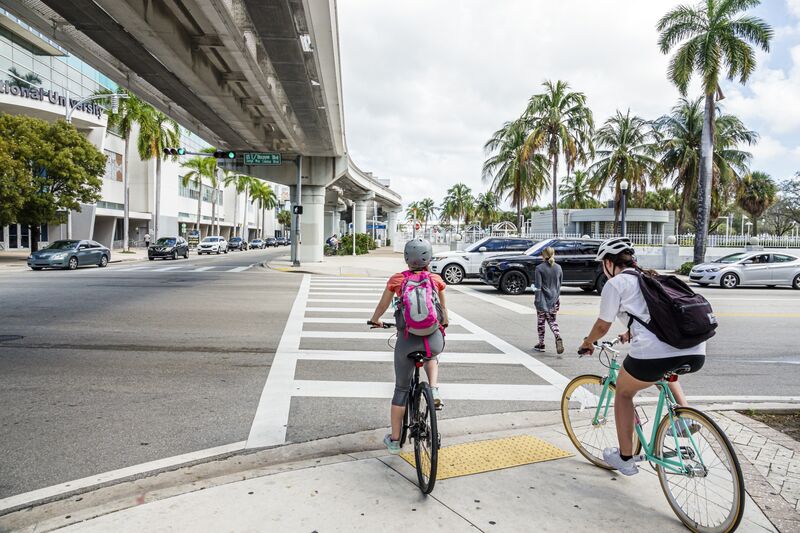
Pedestrians and bicyclists trying to cross Biscayne Boulevard in Miami.
Photographer: Jeff Greenberg/Universal Images Group Editorial via Getty Images
The second factor affects all Americans: the rise of the sport utility vehicle.
SUVs have been around for decades, but through the course of the 2010s they took over. By 2018, they captured 48% of the US new car market, as sedans dropped below 30%. According to the National Highway Traffic Safety Administration (NHTSA), SUVs are two to three times more likely than sedans to kill pedestrians when they hit them, and four times more likely to kill children.
SUVs are much heavier than cars, so they take longer to stop, and hit harder. Just as important is their high stance, which causes people struck by SUVs to fall under the vehicle, where they are crushed. When hit straight on by a sedan, adult pedestrians end up on the hood, with mostly lower- body injuries; SUVs aim for the chest — or the head, if it’s a child. A study of crashes in Michigan found that 100% of pedestrians struck by SUVs traveling more than 40 miles per hour died, compared to 54% of pedestrians struck by cars.
Why are so many Americans buying SUVs? One reason is fear of SUVs. That fear is justified: When a sedan and an SUV hit head-on, the passengers in the sedan are four to 10 times as likely to die as those in the SUV. The result has been an arms race the likes of which our roads have never seen.
The NHTSA could reverse this trend, but don’t hold your breath.
Infrastructural Racism
In February 2019, when I arrived to give a lecture in Houston, I was met by protesters holding signs. This had never happened to me before. Happily, it turns out we were on the same side: They had come to the theater for the same reason I had, to stop the ill-conceived $7 billion expansion of US Interstate 45 through their city. Their motivation was mostly personal: a desire not to have their homes destroyed, their air polluted, and their tax dollars wasted. Mine was more professional: the hope of bringing to a major metropolis some basic concepts about city-building that, so far, had seemed to elude it. The Texas Department of Transportation (TxDOT) was trying to sell the I-45 expansion to Houston with the usual false promises: reduced traffic congestion, improved driver safety and cleaner air quality. These are three promises that no highway expansion in America has ever delivered on.
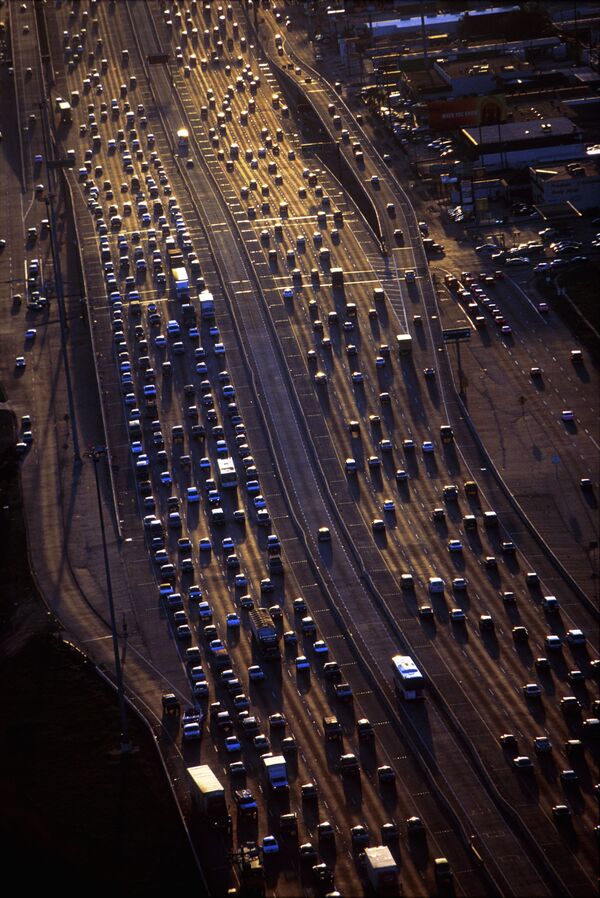
Widening Interstate 45 in Houston has long been a priority for local transportation officials.
Photographer: Paul S. Howell/Hulton Archive via Getty Images
I was prepared to attack the expansion on these terms, but what I learned during my visit was even more compelling. By TxDOT’s own admission, the plan to widen I-45 was on track to destroy no fewer than 1,235 units of housing. It would also plow through 331 existing businesses that provide almost 25,000 permanent jobs. Together, these residential and business losses were predicted to cost the city of Houston about $135 million in forgone property and sales taxes each year.
But these financial deficits paled next to the human cost of breaking communities apart. If the plan proceeds, 40% of the students at Bruce Elementary are set to lose their homes and end up at different schools. The historic Mount Olive Baptist Church, the heart of Independence Heights, is set to be demolished, along with 43 other properties there. Remarkably, the first town incorporated by African Americans in Texas was completely omitted from TxDOT’s Historical Resources Survey for this project.
And let’s talk air quality. Black families with children suffer from asthma at roughly twice the average rate, and most of that comes from living within five hundred meters of highways. Currently, a dozen daycare facilities and two dozen schools sit within a mere 150 meters of the highway. More cars and trucks on I-45 will mean more particulate matter, more asthma, and more environmental inequity for Houston.
Three years later, this project hangs in the balance, wisely tied up with an environmental lawsuit. If it moves forward — which still seems likely— it will be just one of many similar efforts nationwide. According to the Los Angeles Times, more than 200,000 people have lost their homes to federal highway projects since 1990. These include 750 families in Tampa, 850 in Los Angeles and Orange Counties, and thousands more in between. These families have been mostly Black and Latino. This is what the planner Destiny Thomas calls “infra-structural racism.”
Walking While Black
Communities destroyed by highways and children sickened by asthma are only two ways in which minority and other marginalized communities have disproportionally borne the brunt of American car culture. A recent study of 24 years of data found that lower-income neighborhoods experienced road fatality rates more than 3.6 times higher than wealthier places. Research also shows that Blacks and Latinos are at considerably higher risk on the road — especially as pedestrians and bicyclists — than white populations. African Americans and Native Americans make up 12.9% of the population but they represent 22% of pedestrian deaths. In all, people of color are 54% more likely to be struck and killed while walking in the US.
Meanwhile, an analysis of jaywalking tickets in Jacksonville, Florida, which typically result in a $65 fine, found that ticketing did not correlate with the most dangerous walking areas. Rather, they were focused in communities of color, with African Americans nearly three times as likely as whites to be ticketed. Just as with driving violations, police are targeting minority populations with jaywalking tickets as a way to troll for other offenses. For this reason, the Commonwealth of Virginia has decriminalized jaywalking throughout the state.
One state over, Maryland Representative Robbyn Lewis is one of a new breed of legislators who make a point of recognizing walking as a fundamental American freedom in need of protection, whether it be from police harassment or from the threat of traffic violence:
Walkability is a human right, like any other — the right to self-determination, bodily autonomy or privacy. And as an elected official who swore to defend the Constitution and protect human rights, it is my duty to ensure that every person — no matter where they were born, what color they are, or what language they speak at home — has the right to walk, to get where they want or need to go, in comfort and safety.
As this sort of advocacy implies, public investments in walkability disproportionally benefit the most disadvantaged Americans. Blacks are three times as likely as whites to take transit. Latinos are twice as likely as whites to have no access to a car. People who earn less than $25,000 annually are three times as likely to walk to work as people who earn three times that much. Every single investment in walkability also makes a community safer and more accessible to people in wheelchairs, as it benefits the young, the old, and the rest of the 103 million Americans who can’t drive.
One of the reasons it has been so hard to knock driving off its pedestal in the United States is that, despite its populist image, driving trends rich and therefore powerful. Walking trends poor. Cities that hope to improve social equity should start there.
Excerpted from Walkable City: How Downtown Can Save America, One Step at a Time by Jeff Speck. 10th Anniversary Picador paperback edition, 2022. Published by MCD, Picador. Copyright 2012 by Jeff Speck. Introduction copyright 2022 by Janette Sadik-Khan. Part III copyright 2022 by Jeff Speck. All rights reserved.