Killeen City Council removes probable-cause provision from Proposition A
Published: Wed, 12/07/22
Killeen City Council removes probable-cause provision from Proposition A
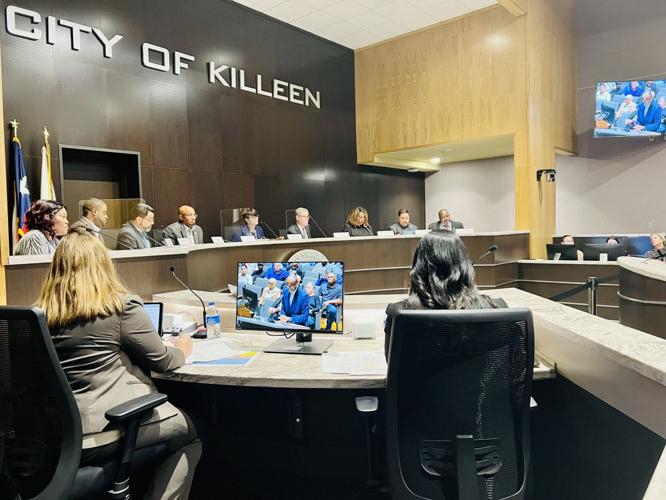
Killeen City Council members listen during Tuesday's council meeting. After an extended debate, the council voted 4-3 to remove a portion of the ordinance that decriminalizes misdemeanor possession of marijuana.
Ricky Green - Herald
kdhnews.com
By Paul Bryant | Herald Staff Writer
December 6, 2022
A central component to Proposition A — the ordinance that decriminalizes misdemeanor possession of marijuana — was removed on Tuesday after some Killeen City Council members tried to find a compromise between upholding the will of voters and appeasing police officers.
The portion removed, in a 4-3 vote, was Section 22-83, which prevents Killeen police from using the odor of marijuana or hemp as probable cause for search or seizure. That effort to amend Proposition A was the third of the meeting, and Mayor Pro Tem Ken Wilkerson voted against each attempt, insisting that the council should do nothing and allow the ordinance to become law.
“You’re just getting more restrictive,” he said. “You just had a vote that was against two of the items that we just voted not to amend. You’re putting them back again and adding something else to it.”
That was a reference to a previous motion by Councilman Ramon Alvarez, who asked for a vote to remove Section 22-83 as well as Section 22-85, the provision that disciplines Killeen officers who violate Proposition A, and to remove non-enforcement of Class A misdemeanors involving possession of marijuana.
That motion was defeated, 5-2, with Nina Cobb, Michael Boyd, Wilkerson, Jessica Gonzalez and Riakos Adams voting against it. Alvarez and Jose Segarra voted for it.
“My concern is in alignment with council member Wilkerson,” Boyd said. “I don’t believe that we should be going in and gutting it too much. I’m not in favor of piling on top of that. In my opinion, we’re gutting this ordinance.”
But Boyd did vote with Segarra on an effort to amend Proposition A to remove Section 22-83 and Section 22-85.
“I’ve been against this from the get-go, and I’m still against this,” Segarra said. “The big thing I have with it is Section 22-83, which is the probable-cause (provision). The other part I would like (is) at least amend Section 22-85, which disciplines our officers. I don’t want to see any of our officers disciplined for doing their job.”
That amendment also failed, with Adams, Gonzalez, Alvarez, Cobb and Wilkerson voting against it. Boyd and Segarra voted for it.
“If we do nothing, this is in effect,” Wilkerson said. “I understand what it is to follow an oath, and that’s why we didn’t pass it the first time. But as a republic, as a representative, I answer to the people. I just ... can’t go back and effectively gut this by talking out Section 22-83 because I know that was a concern, and that is in the spirit of the proposition.”
Instead, Wilkerson asked the council to wait until March 6 to revisit Proposition A. But his motion died.
“I just want to justify why I can’t support amending (it),” Wilkerson said. “I wish that we would let it stay in place. We effectively have a mechanism in place that we can review this in March. That’s just where I stand on this. I have to vote “no” on this today to amend it.”
But Gonzalez offered another alternative in an effort to “find some balance.”
“I make a motion that we remove Section 22-83 and request bringing it back in three months,” she said.
Adams, Gonzalez, Alvarez and Segarra voted for that. Cobb, Boyd and Wilkerson voted against it.
“We’re put up here to represent what the people want but also exercise some due diligence on everything else that’s going on,” Adams said. “This situation ... has been made bigger than what it is. I do have hang-ups with (disciplining police). Killeen has a history of a low voter turnout, and I think we send the wrong message if we amend this to the point it doesn’t exist. We need to be careful with that.”
Before the council finally amended Proposition A to remove Section 22-83, Boyd said he doesn’t believe “this is about snatching away or stripping the ordinance.”
“I think it’s about being responsible and not reckless in the approach,” he said. “This is a very signfiicant vote, right? I understand the interest of just letting it ride until March. If it did ride into March ... do you foresee significant legal challenges or issues within that time period?”
City Attorney Holli Clements said that she didn’t “think I can answer it,” but clarified that no city where voters have approved decriminalization — Austin, Harker Heights, Killeen, Elgin and San Marcos — has been litigated. In Harker Heights, however, that City Council has repealed Proposition A, citing conflicts with state law.
On Nov. 22, Killeen City Council members placed a moratorium on the ordinance until Tuesday.
“You don’t have to amend it,” Clements said before council members debated amending Proposition A. “The electors voted it into ordinance. You can amend the ordinance as presented. You can approve additional or different amendments, or you can do nothing at this time and the ordinance is still an ordinance of the city of Killeen.”
Although one of the council’s options was to repeal the ordinance on Tuesday, no effort was made to that end.
Thirteen people spoke in favor of or in opposition to Proposition A on Tuesday. About 100 people attended the meeting in Killeen City Council chambers.
Proposition A prohibits Killeen officers from issuing citations or making arrests for Class A or Class B misdemeanor possession of marijuana except in “limited circumstances,” including the investigation of a “felony-level narcotics case that has been designated as a high priority.”
The ordinance also includes a prohibition against using city funds or personnel to conduct THC testing, issuing citations for possession of drug residue or drug paraphernalia in lie of a marijuana possession charge.
Killeen Police Chief Charles Kimble told the council that after he “kicked it around administratively,” officers will seize marijuana during searches and destroy it “so no one will be charged with it.”
But on Nov. 22, Clements told council members that Section 22-83 is “clearly the main point” of Proposition A and that “if you take that out, you are kind of gutting the ordinance.”
Still, Clements has said, “the initiative ordinance would likely be found in violation of this statute. There are a number of other federal and state laws implicated. This is perhaps the most direct.”
Recreational marijuana is legal in California, Alaska, Nevada, Oregon, Maine, Montana, Vermont, Rhode Island, New Mexico, Michigan, Arizona, New Jersey, Connecticut, Massachusetts, Illinois, Maryland, Missouri, Virginia and Washington, D.C.
He did not address the legal implications of Proposition A on Tuesday, but City Manager Kent Cagle in a Nov. 13 email to council members said that “staff has no choice but to try and follow the proposition and state law. State law does not REQUIRE that officers make an arrest for low level amounts of marijuana. Proposition A does require that officers NOT arrest for low level amounts of marijuana. The two laws are not necessarily in conflict, but state law does ALLOW an officer to make an arrest. Proposition A takes away that discretion.”
Proposition A requires the City Council to evaluate the effectiveness of the ordinance 90 days after its adoption. That is March 6.
On Nov. 8, Proposition A was approved in Killeen by 69% of the vote, 16,886 to 7,424. That made Proposition A the law until council members issued the moratorium two weeks later.