
San Antonio City Council voted Thursday to send $1.5 million of its federal pandemic relief to groups that help immigrants seeking a pathway to citizenship.
While the decision received nearly unanimous support from the council, it later sparked a tense discussion of spending priorities that drew a response from Mayor Ron Nirenberg.
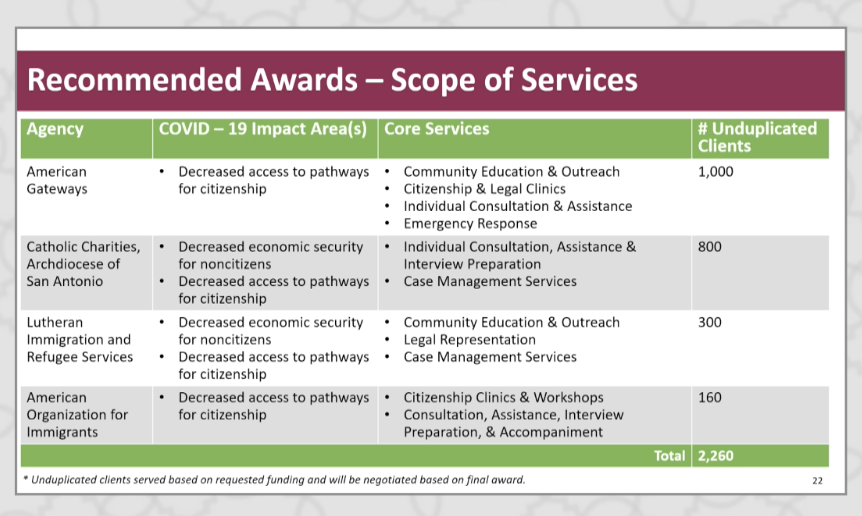
A presentation by Jessica Dovalina, assistant director for the Department of Human Services, said the money going to immigration nonprofits will be used to fund citizenship workshops, legal services for immigrants and community outreach programs to spread awareness about the resources available to immigrants.
“I am proud that our city is making sure that federal funds can serve our residents without regard to citizenship status,” said Councilwoman Ana Sandoval (D7), who led the effort from her role as chair of the Community, Health, Environment and Culture Committee. “These funds will support job training, legal services and housing for immigrants and refugees.“
The $1.5 million for immigration nonprofits comes from the roughly $327 million San Antonio received under the American Rescue Plan Act (ARPA).
Catholic Charities of San Antonio, which is taking over operation of the city’s migrant resource center, will receive $580,000.
American Gateways will receive $460,000, Lutheran Immigration and Refugee Services will receive $290,000 and American Organization for Immigrants will receive roughly $160,000.
Council voted 9-1 in favor of approving the city’s selections.
Councilman Clayton Perry (D10), who cast the lone no vote, said the nonprofits should have had to compete with other businesses for the city’s pandemic relief. He said he was concerned that unlike the grants the city is issuing to small businesses, there are no restrictions on how much of the money the nonprofits can use for administrative costs and supplies.
“I’m going to really be looking at the metrics to make sure that this money is being spent wisely,” said Perry.
That assessment irritated some members of the council who took aim at Perry’s approach later in the meeting.
During a discussion about renewing fees for the city’s downtown public improvement district, Perry pointed to a letter from the business community requesting help cleaning up downtown. He asked how the city planned to address the issue, suggesting it underscored bigger problems with San Antonio’s approach to cleanliness and the homeless population.
While many colleagues agreed with the concerns about downtown tourism, Councilwoman Phyllis Viagran (D3) accused Perry of having just voted against an effort to help some of the problems he wants solved.
“We are going to see many ARPA dollars come up [for a vote on] this council, and when you vote no against these agencies that are helping people like immigrants … you’re contributing to this problem,” Viagran said.
“We need to look at this in a holistic way, and if we’re not going to vote to spend money, or vote to approve to spend money on organizations that are addressing this issue, we’re going to keep having this conversation,” she added.
The exchange ultimately drew a response from Nirenberg, who weighed in on both perspectives as the council concluded its discussion on the downtown business district.
“What people think about our city is largely formed by the impression that they get when they come to places downtown … so it matters to me that we improve on some of these issues,” said Nirenberg of the business community’s concerns.
In a nod to the federal pandemic relief Viagran mentioned, however, he said every major city is experiencing problems with mental health and homelessness right now, and San Antonio has made addressing those problems a major priority.
“Those upstream challenges make their way to downtown in spades, and left unaddressed create enormous challenges,” said Nirenberg. But “for the first time since I’ve been around, we see federal dollars now pouring into local communities to address that issue.”
Council voted in favor of renewing the collection of Public Improvement District fees, including an $8,000 increase to the budget for pressure washing for sidewalks.