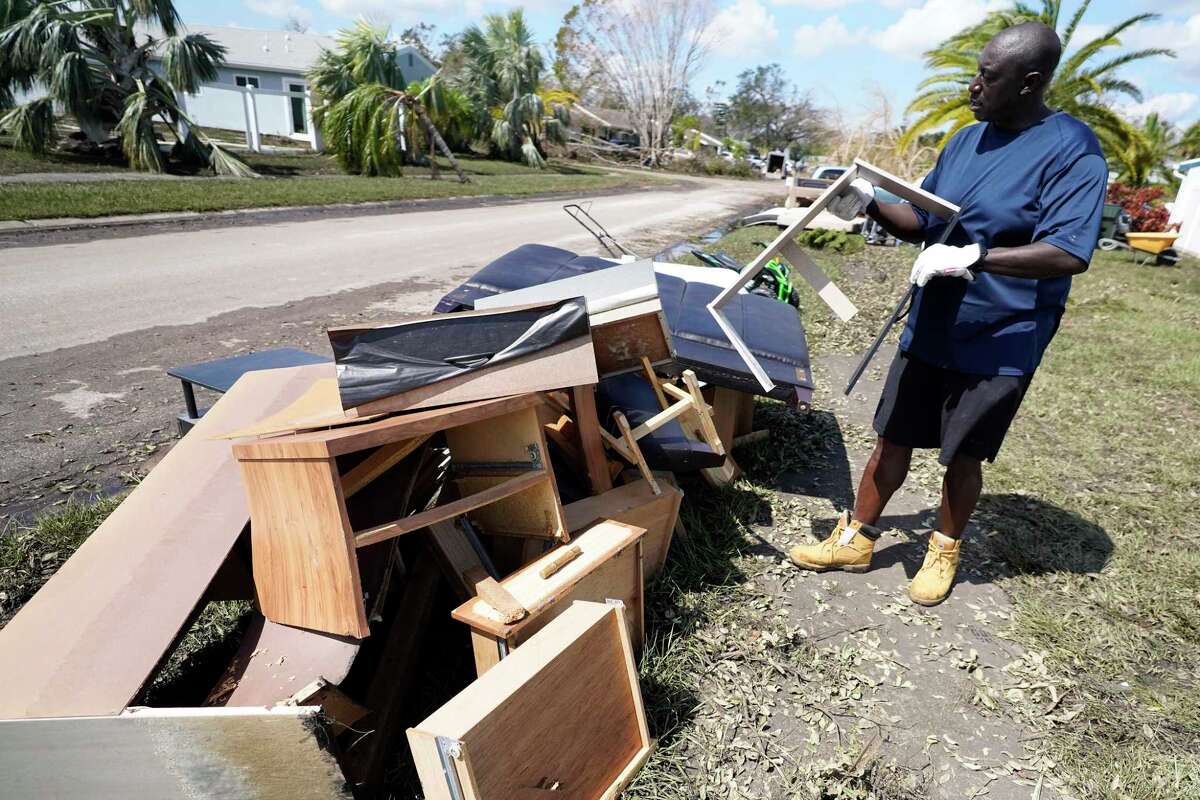
Andre McCourt throws away water logged furniture from his home on Oct. 4 in North Port, Fla., where residents were cleaning up flood damage after Hurricane Ian came ashore.
Chris O'Meara, STF / Associated Press
San Antonio Express-News
Michael Taylor, The Smart Money S.A.
As millions of Floridians and South Carolinians rebuild their lives in the wake of Hurricane Ian, we have a chance to reflect on lessons learned and research done in the five years since Hurricane Harvey slammed Houston and the surrounding Texas Gulf Coast.
Will we be better at meeting the new challenge of helping people recover from Hurricane Ian? And what is the best way to deploy scarce resources to millions of people in a time of extreme need?
A robust body of literature has emerged for studying financial and economic recoveries after hurricanes. In a paper published in November 2021 with the provocative title “Let the Rich Be Flooded: The Distribution of Financial Aid and Distress after Hurricane Harvey,” researchers found something very interesting about the allocation of federal disaster relief in Houston following Hurricane Harvey.
The short version of their findings is that because the most dollars and financial subsidy came in the form of SBA loans — for which decent credit was needed to qualify — overall federal disaster relief for Harvey was regressive.
In economic terms, regressive means that better-off people — on average — received more relief than poorer people. So federal disaster relief still has a way to go just to get to a baseline of progressive.
We would expect at least a progressive distribution of emergency funds, similar to tax policy, in which the most money goes toward helping the most vulnerable, and less money aids the most comfortable.
Just like there are no atheists in foxholes, I would have assumed there are no red and blue political teams after a hurricane — just Americans in need. But in our polarized society, not even disaster relief is apolitical. Mentioning an equity lens in emergency management policy — as Vice President Kamala Harris did last week — of course unleashed a backlash.
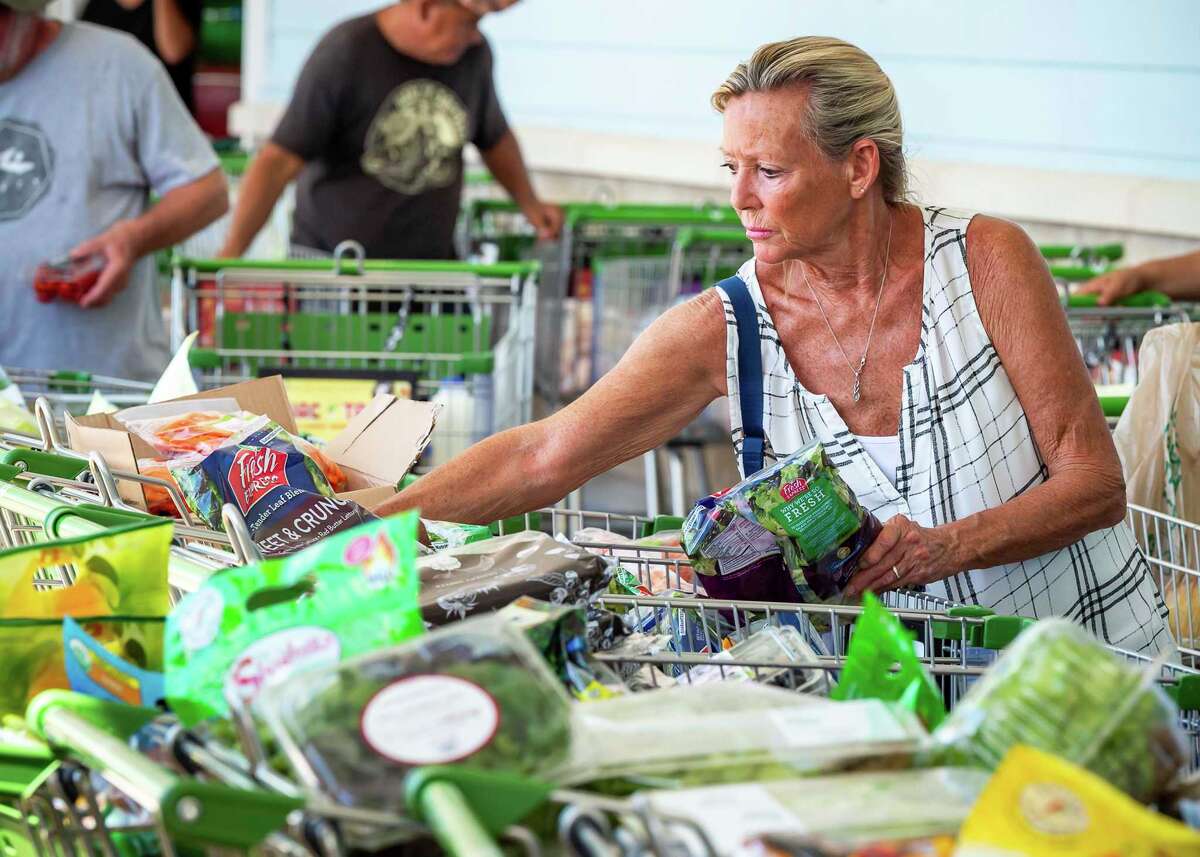
A woman looks for perishable food items donated by a Publix grocery story in Pine Island, Fla., on Oct. 4. Nearly a week after Hurricane Ian smashed into Florida and carved a path of destruction that reached into the Carolinas, hundreds of thousands of Florida residents faced another day without electricity.
Scott Clause, MBR / Associated Press
During an interview discussing global climate challenges, Harris said, “It is our lowest-income communities and communities of color that are most impacted by these extreme conditions and impacted by issues that are not of their own making. And so we have to address this in a way that is about giving resources based on equity, understanding that we fight for equality, but we also need to fight for equity,” Harris said.
This equity rhetoric, and specifically the mention of “communities of color,” provided the opening for Florida Rapid Response Director Christina Pushawa to push back on Harris’ taken-out-of-context statement. Pushawa retweeted Harris’ statement and said, “This is False. @VP ’s rhetoric is causing undue panic and must be clarified. FEMA Individual Assistance is already available to all Floridians
impacted by Hurricane Ian, regardless of race or background.”
That is obvious if one is not looking to score political points and to cause panic on purpose. Harris’ statement wouldn’t have been noted, elevated or “causing undue panic” were it not for the megaphone of the twitter account called “End Wokeness,” which Pushawa used to, well, cause panic.
In stating her case around equity as an emergency response strategy, Harris made explicit something that is already Federal Emergency Management Agency policy.
In its published strategic plan 2022 to 2025, FEMA declared that its No. 1 goal is to “instill equity as a foundation of emergency management.” Equity in this context goes beyond the goals of being progressive rather than regressive.
It specifically says that disadvantaged populations will suffer more during a natural disaster and therefore may need additional resources.
“Underserved communities, as well as specific identity groups, often suffer disproportionately from disasters. As a result, disasters worsen inequities already present in society.”
Intuitively, an equity lens in emergency response makes sense to me. If I were made temporarily homeless or suffered property damage from a natural disaster, a combination of insurance, savings and a prosperous family network would likely keep me and my family from being totally derailed from our lives. I would like to think we would bounce back quickly.
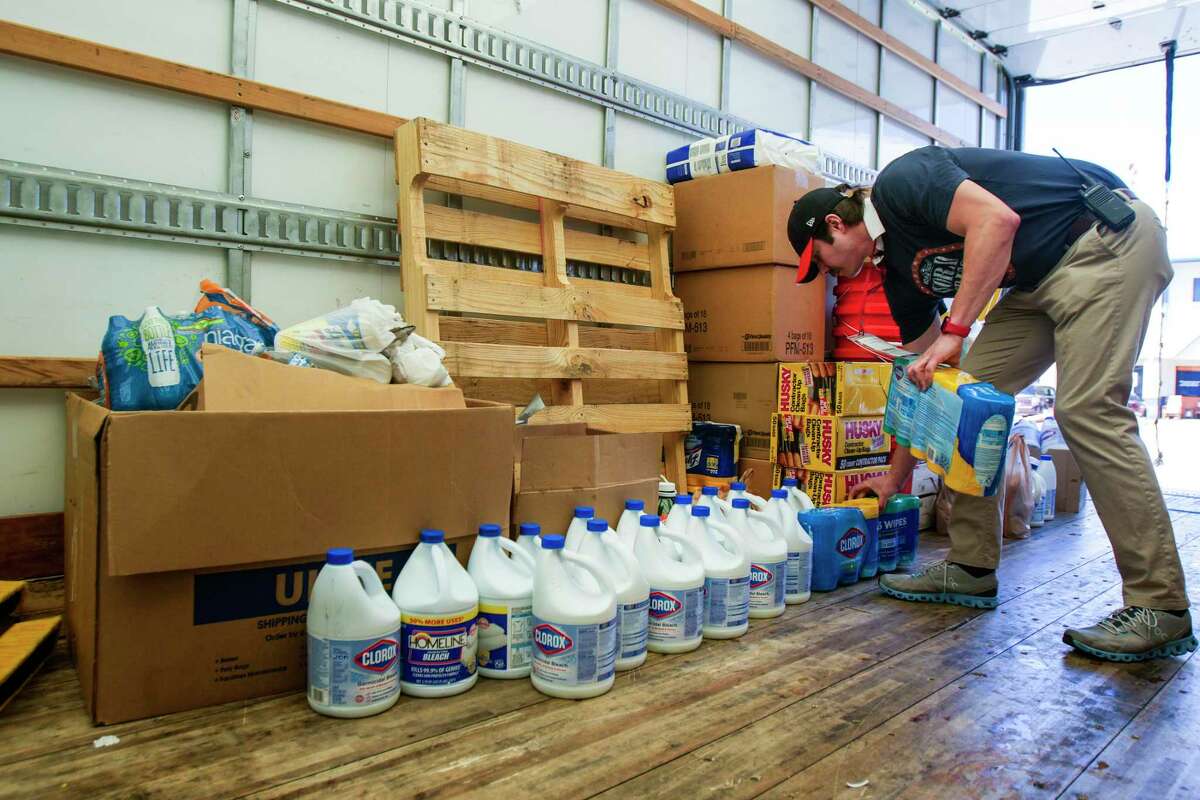
Sehiy Gavchak loads donated supplies into a truck bound for Florida on Sept. 30 at Gallery Furniture in Houston in response to Hurricane Ian.
Brett Coomer, Houston Chronicle / Staff photographer
Considering half of American households have no savings, however, property damage or homelessness from hurricane flooding would be life-changing for such more vulnerable populations. We watched this happen after Hurricane Katrina, which had a disproportionate effect on poorer neighborhoods in low-lying areas of New Orleans prone to catastrophic flooding.
The most effective deployment of life-saving resources for FEMA is going to be in communities and neighborhoods that will not naturally bounce back quickly. This seems normal, correct and noncontroversial to me. But of course, it is controversial.
The financial and economic impact of Hurricane Ian on Florida and South Carolina will not be known for a while, but the lessons of Houston’s Harvey experience five years ago are instructive.
Combining the current political rhetoric in Florida and the more sober academic study of Hurricane Harvey, what should we make of all this?
First, an equity lens is appropriate for FEMA. Second, the way disaster relief really works is that even with the best of intentions, the money flows in Houston were regressive. Better-off households on average received more money than the poorer households in Houston.
This is still America, and poor people are still getting less help than rich people, on average, following a natural disaster.
Equity remains far off in the future and aspirational.
Michael Taylor is a columnist for the San Antonio Express-News, author of “The Financial Rules for New College Graduates” and host of the podcast “No Hill For A Climber.”
michael@michaelthesmartmoney.com| twitter.com/michael_taylor