OIG: Data increases efficiency in the detection of fraud, waste and abuse
Published: Wed, 10/12/22
Data increases efficiency in the detection of fraud, waste and abuse
Inspector General
Texas Health and Human Services
The OIG has focused the evolution of fraud, waste and abuse (FWA) detection on a foundation of data analytics. Capitalizing on the power of data drives the agency to more efficient and comprehensive investigations, reviews, audits and inspections. Each year, the OIG team masters emerging technology used for data analytics to assess the billing trends and patterns of providers, clients and retailers participating in HHS programs. This information enables investigators to increase the recognition
of potential problems and move quickly against possible misuse of taxpayer funds.
Fraud Detection Operations
To support fraud detection operations (FDOs), the OIG's data team created more than 25 new algorithms throughout fiscal year 2022. OIG Investigations and Reviews used these tools to detect potential waste or wrongdoing by identifying providers with unusual billing patterns compared to their peers.
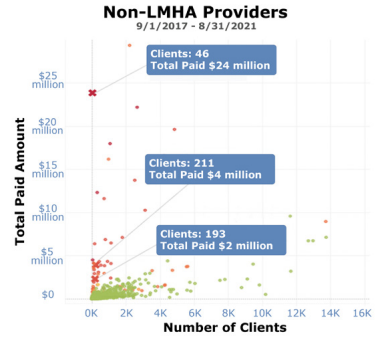
The creation of the new algorithms helped identify potential policy violations and suspicious billing behaviors for Non-Local Mental Health Authorities and durable medical equipment providers. The graphic below highlights providers billing for significantly higher amounts when seeing fewer clients than their peers. Outlier status is not an automatic indicator of wrongdoing; it only identifies providers who may warrant a closer look due to unusual billing activity. The initiatives are in various stages of review and investigation.
 In the span of a few years, the OIG's provider investigation inventory has evolved from approximately 95 percent referral cases with a few self-initiated projects to approximately 60 percent self-initiated, almost all of which are data initiative cases. By harnessing the power of data analytics, the OIG can handle cases more efficiently from the moment they begin
until each investigation reaches its final resolution.
In the span of a few years, the OIG's provider investigation inventory has evolved from approximately 95 percent referral cases with a few self-initiated projects to approximately 60 percent self-initiated, almost all of which are data initiative cases. By harnessing the power of data analytics, the OIG can handle cases more efficiently from the moment they begin
until each investigation reaches its final resolution.
Data Initiatives Project Team
Fiscal year 2022 has seen the OIG broaden the use of data analytics to uncover widespread trends in Medicaid delivery through the OIG's Data Initiatives Project Team. This team specializes in expanding previously developed algorithms from reviewing one provider – whether it comes from data analytics or a referral from an MCO or the public – to examining statewide data to locate Medicaid providers with similar issues in need of review.
This process identified a repeated issue with emergency room injection and infusion reimbursements. The data indicated outpatient hospital facilities were billing for administering injections or infusions in the emergency department when the E-R evaluation and management reimbursement already covered those services.
The team has settled 21 ER injection/infusion cases for more than $30 million in overpayments. This analysis has led to the OIG exploring the potential of millions more in overpayments associated with reimbursing providers for administering injections and infusions. The OIG is also working to develop education and outreach to help providers and MCOs prevent future overpayments. Chart 1 lists DIPT case settlements since the program's inception in 2015.
 Advancing analysis
To further develop the OIG analytics-based review methods, the agency contracted with SAS, a vendor that works with the government and private sectors. The contract focuses on creating more advanced analytical tools to help identify FWA's potential indicators throughout state health and human services. The work performed over the past fiscal year with SAS will enhance the agency's ability to perform highly complex data analysis, increase operational efficiencies, and advance its analytical capabilities. Additional work orders are planned for fiscal year 2023 and will continue to build upon the completed enhancements.
Sharing data and information
The OIG's data team facilitates a cross-divisional data analytics information-sharing session with data analysis staff throughout HHS. The quarterly meetings include OIG and HHS Medicaid/CHIP Services representatives, Actuarial Analysis, and the Office of Data, Analytics, and Performance.
During these meetings, staff share data anomalies, utilization trends, and program and financial updates that may impact Medicaid services. The information exchanged during these collaborative meetings is considered by the OIG when performing any data analysis on topics of interest and can lead to recommendations for reviews by OIG staff in the future.
Going forward
The OIG has found data analytics to be the most effective use of state resources. While referrals to the OIG identify potential risks in specific circumstances, a data-driven approach can identify risks program-wide. In addition, leveraging the latest technology with talented team members helps uncover the latest threats to program integrity as they begin to emerge.
In fiscal year 2023, the agency looks to widen its data capabilities by expanding the team of skilled personnel behind the technology. By hiring additional data analysts, investigators and attorneys, the state can fully realize the benefit of the OIG's data initiatives through increased detection of HHS program misuse and increased tax dollar recoveries.