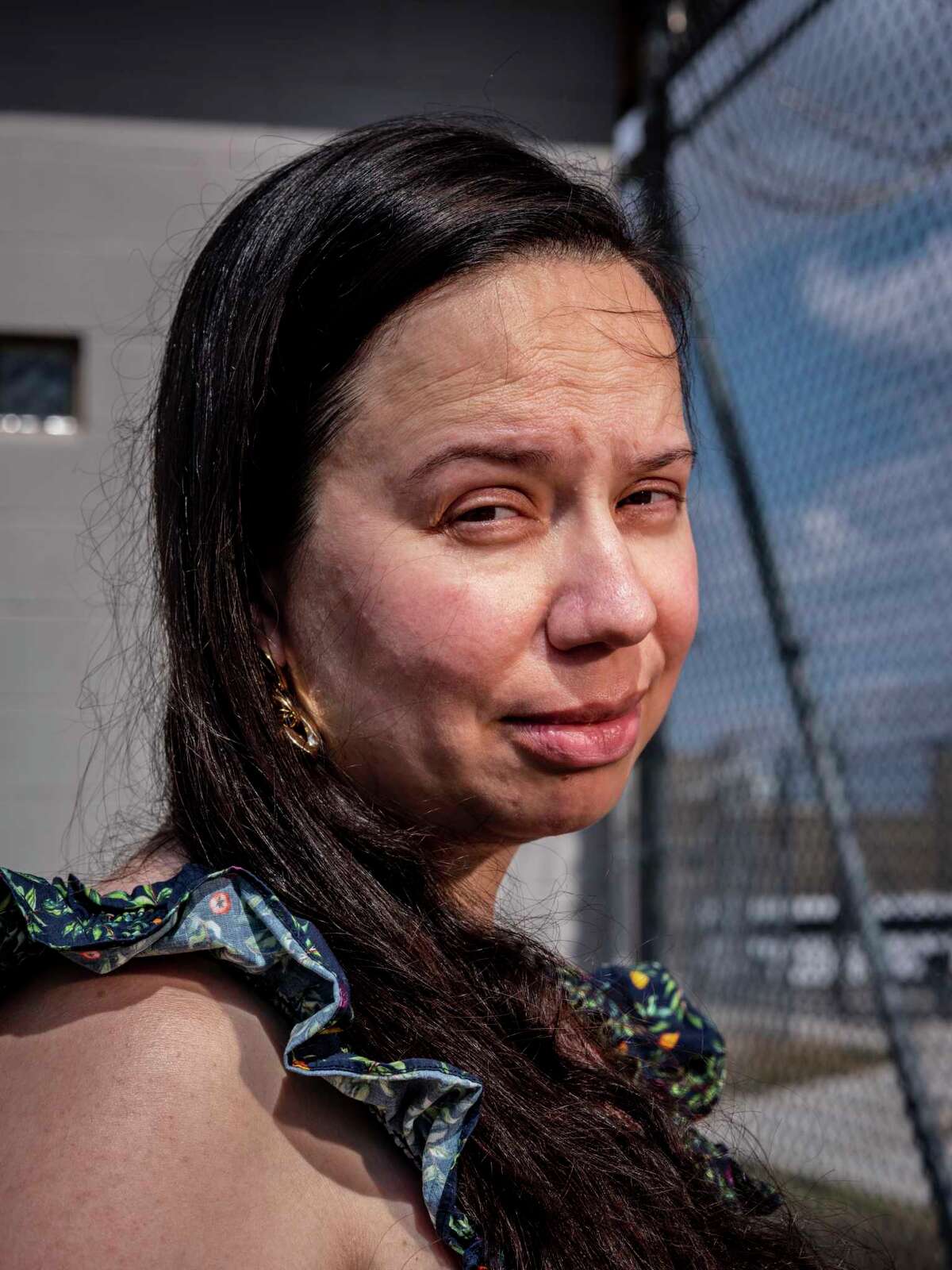
Amy Kamp, who has been advocating for inmates at the Hays County Jail who remain incarcerated for extended periods of time without having been convicted of a crime, poses for a portrait outside the jail Friday, Oct. 14, 2022, in San Marcos.
Matthew Busch, Contributor / For The San Antonio Express-News
Annie Blanks
San Antonio Express-News
SAN MARCOS — Cyrus Gray has been incarcerated at the Hays County Jail for more than four years without a conviction.
Charged in a 2018 slaying he maintains he didn’t commit, the 28-year-old San Marcos resident had been waiting for his day in court from March 2018 until July 2022, when a two-week trial resulted in a hung jury. Gray remains incarcerated, awaiting a retrial scheduled for the end of this month.
Gray is one of more than 518 inmates in Hays County who haven’t been convicted of a crime. That’s 84 percent of the entire county jail population — individuals who have been arrested and charged, but either can’t make bail or haven’t been offered bond by a judge.
It’s been a “mentally traumatizing experience,” Gray said in a phone interview from the Hays County Jail. “It’s very helpless being in a situation like this.”
Hays County is grappling with an inmate population that’s growing proportionately to the the rest of the county, and Gray and hundreds of other inmates are caught in the crosshairs as local lawmakers and law enforcement officials try to figure out just what to do with the ballooning numbers.
Most recently, the county entered into a $17.5 million private prison contract with LaSalle Corrections, a private prison operator, and Haskell County, one of the counties in which LaSalle operates, to house up to 100 inmates for the next fiscal year and 200 inmates in the 2024 fiscal year. That’s on top of approximately $4 million a year Hays County already spends to outsource inmates to eight other counties in Texas — Atascosa, Blanco, Burnett, Comal, Fort Bend, Lee, Maverick and Red River.
In total, Hays County spent $128,778 last week alone to house 205 men and 24 women in jails other than the one on Uhland Road in San Marcos.
And the outsourcing is happening at record numbers despite the fact that Hays County’s jail is only at about 60 percent capacity. In fact, construction is about 90 percent complete on a brand-new, $60 million expansion that voters approved in 2016. The new wing has 192 new beds and is operationally ready to go.
But the jail can’t fill its empty beds due to critical staffing shortages of corrections officers, said Hays County Judge Ruben Becerra. The sheriff’s office hasn’t been able to fill as many as 70 positions needed in its jail, so inmates have to go to other facilities that have appropriate staffing levels.
“The sheriff’s department can’t staff or keep corrections officers,” Becerra said.
The Hays County Sheriff’s Office did not return multiple messages seeking comment for this story.
Becerra, who was the lone “no” vote for the $17.5 million contract, called the $128,778 the county spent on outsourcing inmates last week “throwaway money.”
“I think we have fallen terribly short” with the multimillion-dollar jail expansion that the county asked taxpayers to approve six years ago, he said, along with the millions spent on outsourcing inmates to other counties.
“With $20 million, I could build an entire mental health hospital for the county,” he said.
Case backlog
The Hays County Jail had a population of 620 inmates as of Oct. 9, according to the county jail dashboard, which posts weekly breakdowns of its inmate statistics.
The plurality of those inmates — 43 percent — have been there for one to six months, according to the dashboard. Nearly 4 percent have been there for more than three years.
Gray, who has been there for four years and seven months, is one of the jail’s longest-tenured residents. He’s emblematic of the county’s sluggish judicial system, which has been called one of the slowest in the state and leads to a backlog of inmates the county is holding pre-trial.
“There’s no reason for him to be in jail, in my opinion,” said Amy Kamp, the lead jail advocacy organizer for San Marcos social justice group Mano Amiga. Kamp has been one of Gray’s strongest advocates on the outside.
Kamp said that the fact that so many people remain at the jail for years before their trials flies in the face of the “innocent until proven guilty” mantra on which the U.S. justice system hinges.
“If you’re charged with something and held in jail for seven years, as some people have been, that is not innocent until proven guilty,” she said. “We need to figure out why it’s taking so long for people to go to trial.”
Hays County’s District Attorney Wes Mau said in an email that most jails in the state of Texas “primarily house pretrial inmates as a matter of routine,” and Hays County’s proportion of pretrial detainees is “similar to most jurisdictions.”
But the big issue, Mau said, is that even with the new jail expansion, the facility still isn’t big enough to house the inmates of the fastest-growing county in Texas.
“The jail should be bigger for a county our size, and we should have more courts to deal with the increased number of cases resulting from that population explosion,” he said.
Empty cells
Calls for a bigger jail facility notwithstanding, the existing facility has entire pods sitting empty.
Gray said that several holding pods are shut down entirely, while many are only halfway full. His particular “tank,” or section of the jail that houses inmates, has 28 to 30 people in it at any given time, although it can hold 40. The tank next door to his has just 20 people in it.
“The reason or excuse is that they’re short on staff, but they’re getting all this money to transport people … when they could be using all the millions of dollars just to fix the problem that’s here,” he said.
Even if the jail facility does continue to expand, it will be useless if the Hays County Sheriff’s Office can’t staff it.
Chief Deputy Mike Davenport told the Commissioners Court at an Aug. 16 meeting that they had 12 unfilled positions solely for the brand-new wing.
He added that he “hates outsourcing as much as anybody,” but it’s currently the only way to handle the load of inmates that the jail is experiencing.
“It’s very problematic for us,” he said of the outsourcing. “We’re not designed to function like we are, so it’s very inefficient.”
Davenport said at the meeting that the county is undergoing collective bargaining agreement negotiations to look at wage increases for correctional officer positions.
But Kamp, the Hays jail advocate, said many people don’t want to work at the jail due to stressful work conditions and an unsupportive environment.
She said officers will “come into the jail, and the conditions are so bad that they’re experiencing burnout and are worried about their own mental health.” Understaffing can be dangerous and can also mean more mandatory overtime, which can be physically and mentally taxing on guards.
“People aren’t complaining about pay at the Hays County Jail,” Kamp said. “In our experience, what people are telling us is it’s the conditions.”
Traumatic transfers
In lieu of adequate staffing, Hays County has opted to spend millions transporting and housing the inmates in different counties, at a cost of at least $95 per inmate per day.
But aside from being costly, transferring an inmate to jails in other counties — some as far as five or six hours away — can be detrimental to the inmates because it puts them farther away from their family and attorneys.
Gray said that he’s seen inmates try to escape before being transferred just to “catch an escape charge” so that they will get to stay at the Hays jail pending their new charge. He said other inmates have barricaded themselves in their cells and have had hourslong standoffs with guards to try to stave off transport.
“It’s kind of like an aggressive transaction most of the time,” he said of the times when guards come in to transport inmates to other jails, which inmates call running chain. “Sometimes they’ll come in peacefully and move you, but a lot of times they’ll come in forcefully.”
In a letter from jail shared with Kamp, one unidentified inmate said he suffered from Hepatitis C, liver cancer and a staph infection, but he was transferred anyways.
“On Sept. 1 at 2:30 a.m. I was awoke at gun point, handcuff and ship off to Haskell Rolling Plains Detention Center,” he wrote.
Becerra said he followed along on a transport Oct. 7 from Hays to Haskell County, a five-hour drive each way, to see for himself what the transfer process was like.
During the transport, however, the van had to turn around since four of the inmates bonded out during the drive.
“That just seems like real hasty, bad management,” he said.
Kamp said that being transferred to another jail is traumatic because individuals are taken even farther away from their outside support system. People who are in jail simply because they can’t afford bond aren’t likely to have family members who can travel hundreds of miles and take an entire day off work to come see them in a different county.
“They’re going to a new jail, they’re not going to be able to see their family, and their attorneys more than likely aren’t going to be visiting them,” she said. “It’s scary. I’d be scared, too.”
Looking ahead
As Hays County’s residential population continues to expand and as the I-35 corridor gets even busier and more developed, the need for a permanent solution to the inmate housing crisis is expected to only become more pressing as more arrests are expected.
The county has taken some concrete steps in recent months to speed up the overall judicial process. Commissioners in May approved a contract with the Neighborhood Defender Service to operate a new public defender’s office for the county, replacing the current rotating public defense system.
The DA’s office says it’s also working on a new pretrial services division, which it hopes will reduce the number of inmates who are incarcerated for bond violations, as well as bringing a new court online sometime within the next year.
“Both projects are expected to help reduce the incarceration rate and the backlog,” Mau said in the email.
And groups like Mano Amiga are working to reform the justice system from the bottom up, encouraging law enforcement to implement more cite-and-divert policies that merely would ticket people instead of arresting them for minor violations and adding them to the jail population.
Marijuana decriminalization is on the November ballot in San Marcos. If voters endorse the measure, it’ll be poised to reduce the number of people who are arrested for minor marijuana offenses.
But change takes time, and for now, the situation at the Hays County Jail is bleak for people like Gray. Gray is frustrated with how the county is dedicating its resources, and said solutions aren’t going to happen if those resources aren’t diverted to more appropriate avenues.
“They’re using all this money for the wrong problems that are not really going to bring a solution” to the issues at the jail, he said.
For Kamp, the solution starts with creating a better working environment so people want to work at the jail, as well as lowering bond amounts so more people can bond out of jail and speeding up the judicial process so people can get out of jail quicker.
In the meantime, as she and others await change, she’s afraid more and more people are going to be long-term jail tenants like Gray.
“A lot of people in the Hays County Jail are like Cyrus,” she said. “They try to watch out for each other, but they’re being thrown in this situation. It’s just no good.”
Annie Blanks writes for the Express-News through Report for America, a national service program that places journalists in local newsrooms. ReportforAmerica.org. annie.blanks@express-news.net.