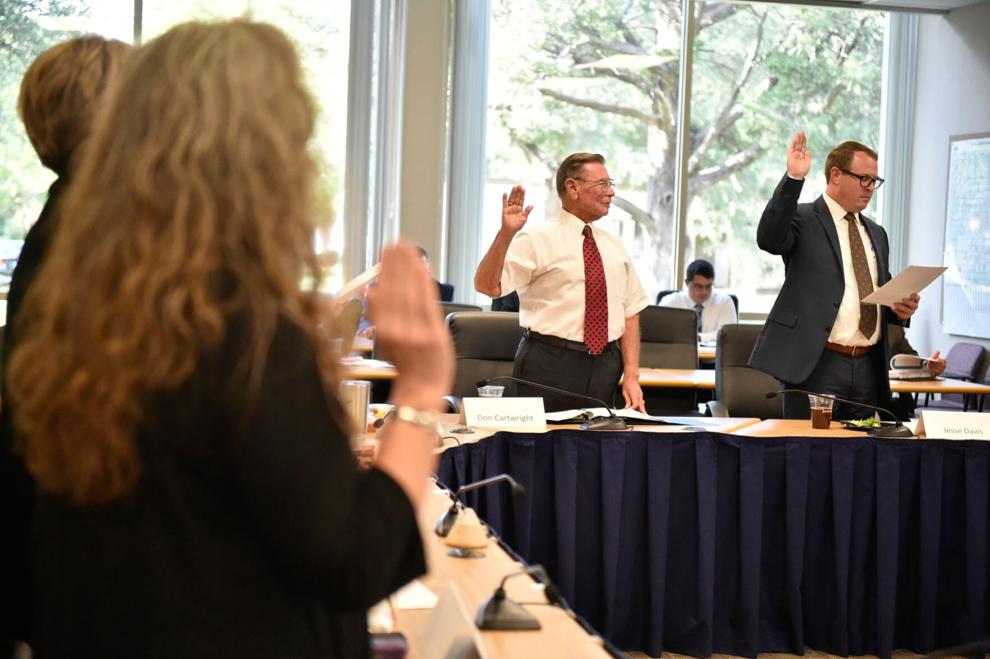
Members take the oath of office during the city’s first-ever Board of Ethics meeting at City Hall, in July 2018.
DRC file photo
Published: Thu, 02/09/23
Denton Record-Chronicle
By Christian McPhate Staff Writer cmcphate@dentonrc.com
February 8, 2023
In the past, Denton’s Board of Ethics said it has found itself weaponized during the political campaign season for what could be considered frivolous complaints.
It’s what happened to former Denton City Council member Paul Meltzer, who challenged Mayor Gerard Hudspeth in the election last spring. A Denton real estate agent filed a complaint about a mailer Meltzer sent to voters with the city secretary’s seal.
The complaint is supposed to remain confidential until its legitimacy can be determined by the board, but information soon began to appear on social media and on the campaign trail.
The issue, though, that the Denton Board of Ethics realized is that they could find a complaint frivolous, but there wasn’t a procedure for how to do that, said Lara Tomlin, the board’s chair.
On Monday, the Board of Ethics voted unanimously to send 10 of the 11 proposed amendments and clarifications to the ethics code to the City Council for consideration at the March 21 council meeting.
Two of these proposed amendments will help limit this political weaponization by implementing specific sanctions against people who file a frivolous complaint and clarifying the procedure to determine if a complaint is frivolous.
The board is still working on another proposal — updating the conflict of interest language — but does plan to include it with the 10 other proposed amendments for council members to vote on at the March 21 meeting.
David Zoltner, a board member, claimed that the conflict of interest section “is still obsolete” and “about 30 years behind the curve.”
At one point, the noted conflicts of interest section was relative to any amount over $600, and then it was suggested in August that it be changed to 10% — such as 10% ownership of a business, or 10% of funds received from a business as compared to gross annual income.
“We need to avoid percentages and dollars,” Zoltner said. “Conflict of interest is far more complicated than dollars and percentages.”
The board plans to discuss the conflict section at the early March meeting.
According to the Board of Ethics’ presentations to the council, the proposed amendments include:
As the Denton Record-Chronicle reported last May, if a council member violates the ethics ordinance, the board can send them a letter of reprimand and recommend suspension, but when it came to frivolous complaints against council, Tomlin pointed out that all they could do was “say it’s frivolous.”
Now the ethics board is seeking to change that.
CHRISTIAN McPHATE can be reached at 940-220-4299 and via Twitter at @writerontheedge.