Parker, Palo Pinto counties seek water partnership
Published: Tue, 12/27/22
Parker, Palo Pinto counties seek water partnership
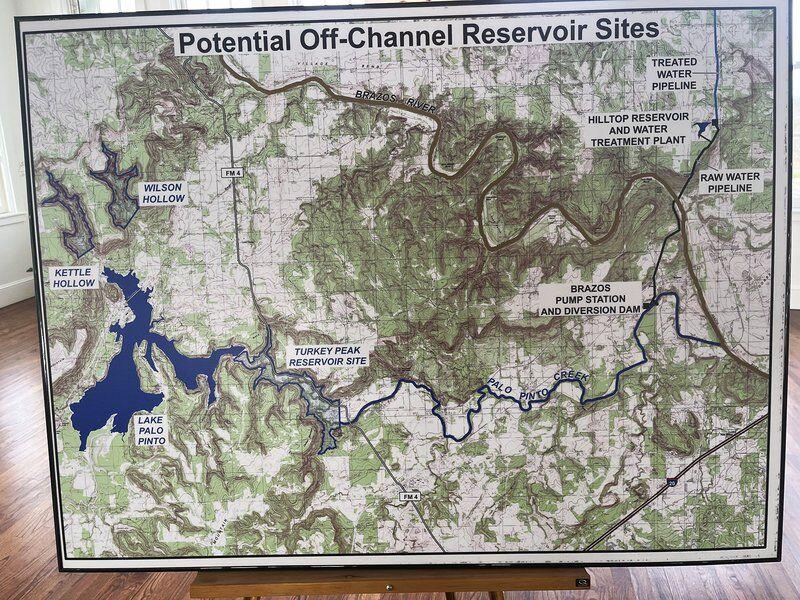
The water infrastructure, with Turkey Peak Reservoir at the center of Palo Pinto County, is described in this topographic map planners looked over at the two-county discussion that centered on forming a regional alliance.
Glenn Evans | Weatherford Democrat
Weatherford Democrat
By GLENN EVANS gevans@weatherforddemocrat.com
December 26, 2022
MINERAL WELLS — Water planners in Parker and Palo Pinto counties took a preliminary step Wednesday toward a partnership that will speak up louder than either can alone.
“I don’t think we have any choice,” Palo Pinto County Judge Shane Long said, nearly two hours into a discussion attended by some 60 leaders of water utility companies from the two counties in the Crazy Water Hotel. “I don’t see any reason Palo Pinto Commissioners Court and Parker County Commissioners Court can’t work together.”
In addition to the elected leadership from Palo Pinto and western Parker counties, water providers from Mineral Wells, Santo, Millsap, Brock, Peaster and Palo Pinto were joined by state agencies officials and experts in the discussion.
“This is not going to be easy — it never is when you’re dealing with water,” Texas Rep. Lyle Larson, R-San Antonio said, recommending Long and Parker County Judge Pat Deen take the lead in appointing members to the two-county partnership.
Larson is a member of the Natural Resources Committee in the Texas House of Representatives and is acknowledged statewide as a seasoned water planning expert. He attended at the behest of Rep. Glenn Rogers, R-Graford, who represents the two counties as well as Stephens County immediately west.
No official action was taken during the informal discussion, but agreement was coalescing around potentially expanding the board that governs Lake Palo Pinto to accommodate voices from both counties.
That will require legislation in Austin, where the 88th Legislative Session begins on Jan. 10. And with the 40-day session looming, Rogers recommended that he file a “shell bill” now and fill in the details later.
Those would include how many sit on the two-county panel, how they are selected and for how long, and even what to name the body.
“It’s a historic name for it. I don’t have a problem with it,” Deen said of the Palo Pinto County Municipal Water District No. 1, which owns its namesake lake (though Mineral Wells operates it for municipal, industrial and recreational purposes).
Parker County Commissioner Larry Walden countered the district’s one-county name could hinder grant applications if the awarding agencies do not see both counties in the name.
“At some point, it needs to describe the region,” he said, later adding the new panel will not make sense unless all the governments and water districts have equal representation. “As we move forward, I want to make sure that nobody gets bypassed.”
The two counties are separated by more than a county line.
Parker County is within the 16-county Region C Water Planning Group, which is dominated by Dallas/Fort Worth. Palo Pinto County is in Region G, 37 counties where Georgetown, Waco, Temple and Hillsboro have the loudest political voices.
The state also has legislatively created regions for flood mitigation, with Palo Pinto County and far west Parker County in one and the northeast half of Parker in another.
Howard Huffman, manager of the lake district, used the theme of the meeting that emerged from a multipoint slide show the group studied.
“We are in the spaces between spaces,” he said.
Rogers later asked if anyone opposed expanding the lake board, as opposed to creating a new entity. No one spoke or raised a hand.
“We can do that this legislative session,” the state representative said.
Larson, who will enter his seventh session in January, urged the planners to act now for future generations.
“If you guys are serious, there’s water out there,” he said. “You’ve got to get aggressive, and you’ve got to pay for it.”
The meeting started with a kind of backdrop description of the two counties’ mutual need. Though Parker County seat Weatherford pulls water from lakes to its east, much of its rural areas are tapped into Lake Palo Pinto.
Along with Parker County Special Utility District, the lake also supplies water to six other water wholesalers and Mineral Wells for a total of 35,000 people.
That city and the lake board have secured all but two large parcels for a new lake, Turkey Peak Reservoir, immediately south of Lake Palo Pinto, but they comprise roughly the southern one-third of the lake’s footprint.
Mineral Wells City Manager Dean Sullivan told the group the Texas Water Development Board recently changed its policy and requires 100 percent land acquisition before considering a low-interest loan. Formerly the standard was “substantial” land acquisition, Sullivan said.
“That has moved our timeline about three years (off),” he said. “And that’s alarming.”
Meanwhile, both of the two counties are in the crosshairs of investors selling lots for housing developments built on the assumption adequate water supply will be there.
Jason Knobloch, deputy director of the Texas Rural Water Association, noted that 1,000 to 1,200 people move to Texas every year.
“The problem is, they are not bringing water,” he told the group. “You can’t mine all the aquifers and feel good about it, because your grandkids won’t have water.”