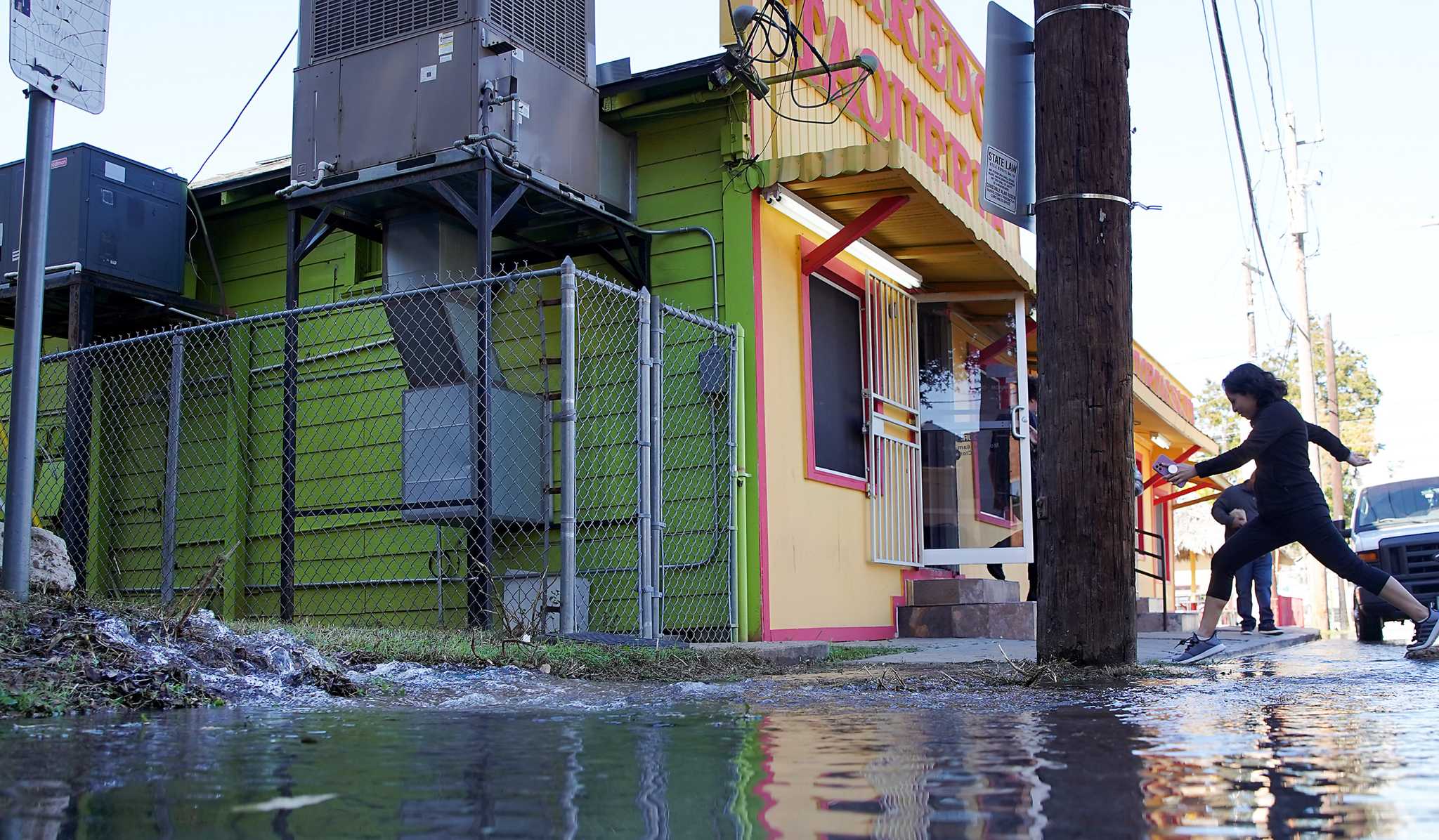
Customers at Laredo Taqueria try to keep dry as they step over an ever-growing puddle from water flowing out of the ground on Wednesday, Nov. 30, 2022 in Houston.
Elizabeth Conley/Staff photographer
Houston Chronicle
Yilun Cheng, Staff writer
As Houston grapples with aging infrastructure and dwindling pipe replacements, the city's Department of Public Works is urging residents to reduce water usage, emphasizing that a quarter of its water supply during the next
50 years must come from conservation efforts.
The Texas State Water Plan projects that by 2070, Houston's metropolitan population will grow from 4.7 million to 6.2 million, leading to a potential water shortage of 220,772 acre-feet per year — greater than the entire volume of Lake Houston.
To address the potential shortfall, Houston Water has developed an education campaign called "Give Water a Break." The initiative aims to help secure 18 percent to 28 percent of additional water supplies through conservation efforts to meet the increasing demand in the following decades.
The education materials feature eye-catching graphics inspired by Houston's space culture and are paired with slogans such as "Your ex ain't fixable; leaks are," "Your yard isn't a sauna" and "Size matters: full loads only."

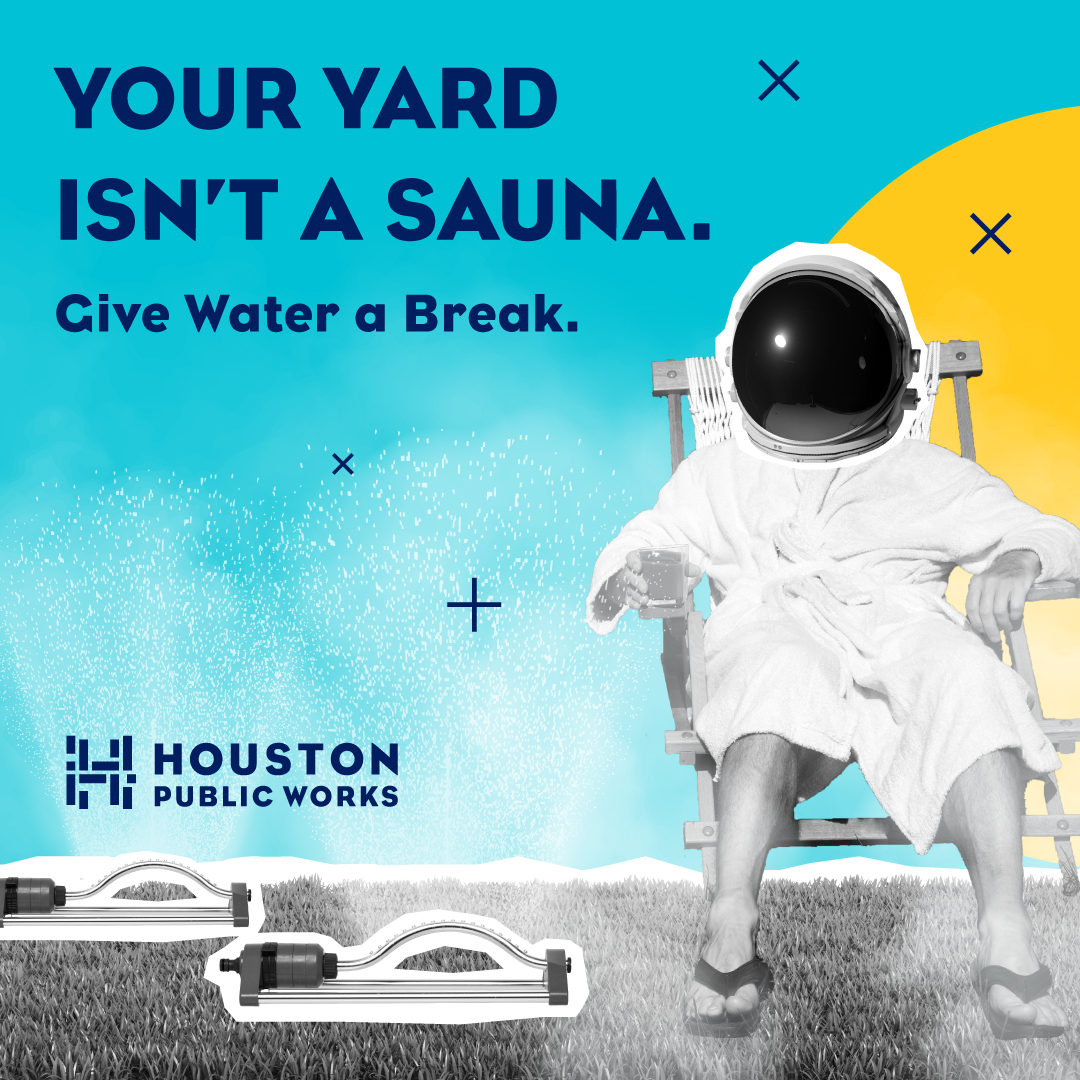
Houston Water has been testing the materials with city employees to gather feedback, with plans to incorporate them into a variety of formats, including education videos, online advertising, yard signs and T-shirts. The team has ads on radio, YouTube, Google and Hulu, targeting high water user ZIP codes to promote its message.
“We needed to create a Houston-centric campaign that would allow us to create customized materials to fit our needs and messaging,” said Lacie Ulrich, Houston Water's event planning and outreach lead. The goal is to “switch Houstonians’ mindsets from ‘wasting because I can’ to ‘conserving because I should.'"
Water conservation is essential not just for Houston, but for the entire state. By 2070, conservation strategies will have to account for nearly 30 percent of Texas’ water supply needs, according to the state water plan.
Houston faces distinct challenges when promoting conservation among its residents, as the city's fewer droughts and greater rainfall when compared with other Texas cities lower the perceived sense of urgency, Ulrich explained. This is where the "Give Water a Break" campaign comes in.
“Our access to reliable sources of surface water and groundwater and high average rainfall creates a perceived sense of water abundance,” she said. “But climate projections from Houston are showing that droughts are becoming more and more frequent in our future. Houston can expect increases in the number of hot days per year, lengthening of our summers, increases in the temperature of the hottest days experienced each year and longer multiday heat waves.”
Houston's conservation efforts are taking place against the backdrop of an aging water infrastructure and increasingly extreme climate conditions, which have led to more pipe breaks, leaks and a massive amount of water loss.
In just the first eight months of 2022, Houston lost nearly 20 billion gallons of water because of leaky pipes, which represents about $75 million in potential revenue for the city's water utility system. At the height of last year's drought, the city lost 20 percent of its total monthly water supply.
At the same time, efforts to replace the city's 7,600 miles of water pipes have drastically declined over the past decade, falling from around 140 miles in 2014 to just 10 miles in 2022, according to data from Houston Water.
Notably, 32 percent of the city's current water lines are made from outdated materials, including cast iron and asbestos concrete, which historically have been responsible for most of the breaks.
Venus Price, Houston Water's drinking water operations director, attributed the reduced pace of replacement to substantial infrastructure investments made after the 2011 statewide drought. She noted that a series of recent water rate increases could allow the city to ramp up its replacement efforts again.
"We've experienced a noticeable reduction in water main replacements leading up to last year's drought," Price said. "But thanks to the much-needed rate increase, we're now able to get projects scoped, funded and underway."
yilun.cheng@chron.com