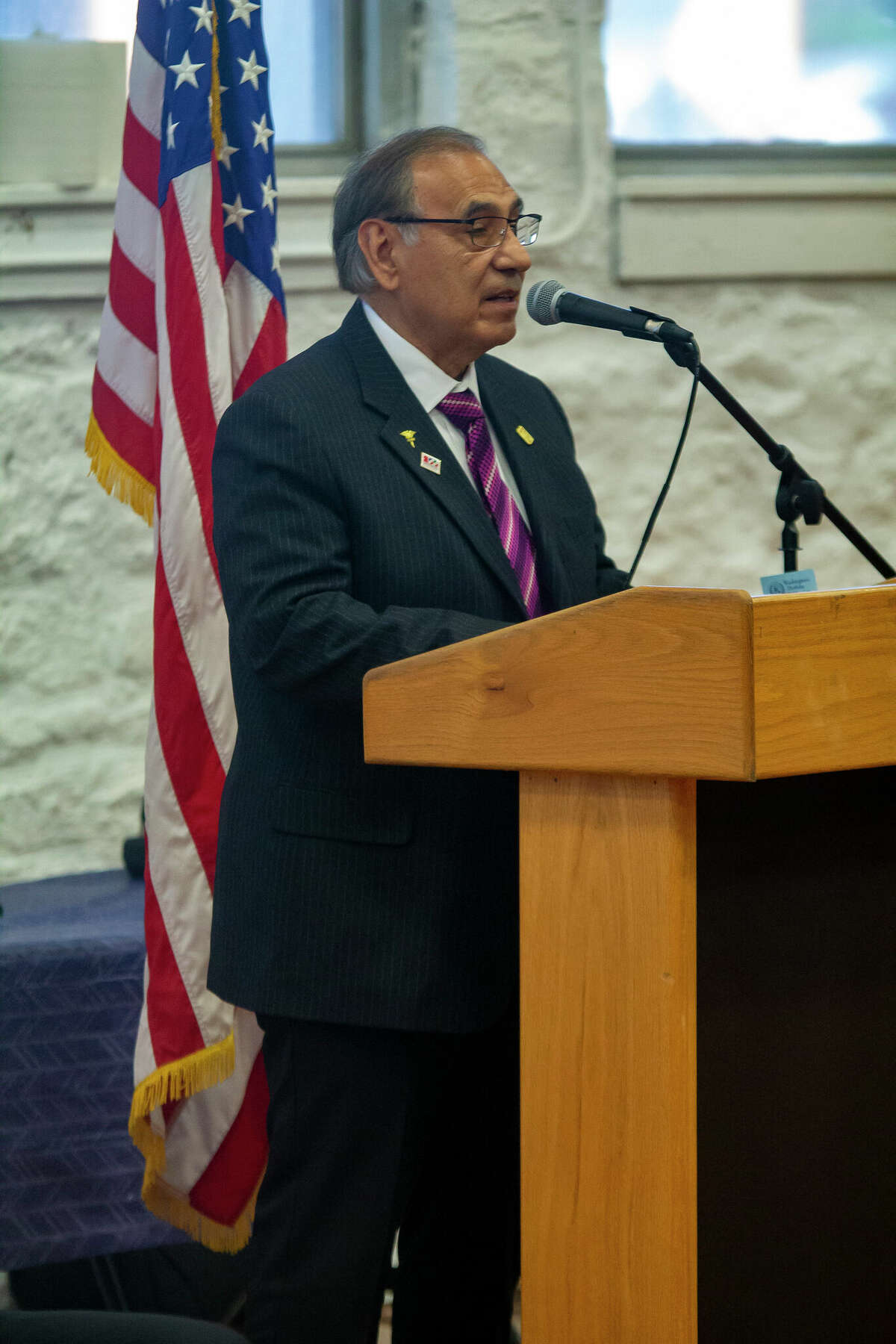
Laredo Mayor Dr. Victor Trevino speaks at the second annual Juegos de Amistad at the Benavides Boys and Girls Club on Friday, Feb. 17.
Garrett Kroeger/Laredo Morning Times
Laredo Morning Times
Jason Mack, LMTonline.com / Laredo Morning Times
A motion by Laredo Mayor Dr. Victor Trevino to restrict campaign finances from individuals or groups involved in open negotiations with the City of Laredo failed this week, but a motion to consider a revised version of the idea based on research from the city’s legal council passed.
Trevino said the goal of his motion was to enhance transparency and to avoid the implication of impropriety whether it exists or not.
“It is not to say that accepting campaign contributions means you are going to vote a certain way,” he said. “It is more of an issue of public trust, so that when we are in contract considerations or negotiations that we are not receiving money from entities that we are negotiating with, creating the appearance of influence.”
The motion from Trevino was to restrict campaign contributions to both councilmembers and the mayor from Political Action Committees, campaign committees, unions and vendors while they are in open contract negotiations with the city.
“As we are looking to reform different departments within the city, we can also look to reform ourselves and set the example,” Trevino said.
One question asked about the motion was from District V Councilmember Ruben Gutierrez Jr. He said he had no issue with placing constrains on donations, but he wasn’t sure how the rule would be regulated regarding the private sector.
“I don’t have any idea when the city is in negotiations with a private vendor, private citizen or private company,” Gutierrez said. “If I should receive a check for a contribution in the mail tomorrow, and the city was in talks with them about a contract that they may be working on, how am I privy to that information? I certainly don’t want to be in any type of an issue or for me to be brought up here or anywhere else saying that I violated an ordinance or whatever this motion may bring up.”
Laredo City Attorney Doanh Zone Nguyen said they could place language into any ordinance basing it on a knowing violation. This means it would be a violation if you knew about it. If you didn’t, they could establish a policy such as being required to return the contribution once it is brought to your attention.
Nguyen also responded to a question from District IV Councilmember Alberto Torres Jr. about whether existing ethics code language addressed the issue by saying, “ethics code says there should be no contact if there is an appearance that contact is to influence a particular contract. Here we are talking about campaign contributions making that implied influence. It is going a step beyond.”
Torres suggested that if they are already going a step beyond, they should consider going several steps. He raised concerns about how the timing of any restrictions could potentially be worked around, and he suggested diving deeper into many aspects of campaign financing.
“It is stretching it to a grey area, because if that were the case then I think we should engage in a workshop to also cap how much you receive as a contribution, how much you invest of your personal money, how much you get in loans from a financial institution,” Torres said. “We really want to bring reform and transparent government, but … if we’re going to reform then let’s reform from top to bottom. Because some of us would not be able to fund our own campaigns, or anybody out there for that same matter. If we are talking about reform, then it should be done in its entirety and not just cherry picking.”
District II Councilmember Daisy Campos-Rodriguez agreed with the idea of looking into other aspects of campaign financing saying, “What about the ones who have the ability to self-loan thousands of dollars? If you go into campaign reports, you have certain councilmembers where they can self-loan thousands and thousands to themselves and then pay it back from the same campaign.”
District III Councilmember Melissa Cigarroa suggested several ideas such as scheduling all contract negotiations to occur in off-election years. She also stressed the importance of transparency.
“The perception of malfeasance by councilmembers is a real issue,” Cigarroa said. “What we need is for the public to be able to see the amount, the expenditure, the purpose so that there is a procedure that is transparent for the expenditure of these campaign donations. If you look at this last round, this last campaign, there were people who didn’t fill it out. There were people who left blank many parts of the information.”
Cigarroa suggested having someone locally monitoring the campaign finance paperwork and identifying issues, but Torres spoke against the idea. He said there are remedies for these issues via the Texas Ethics Commission and that it is up to candidates to police their own campaigns and report violations.
District VII Councilmember and Mayor Pro Temp Vanessa Perez said the intention of the motion was good but expressed concern over other methods of influence which it wouldn’t address.
“This is not going to be a one-size-fits-all to address every situation and every scenario for every person,” Perez said. “You can have somebody influence your decisions on council and never give them a dollar. It’s not always tied to money. You could be good friends with somebody.
“I’ve spoken to somebody about an issue, then afterwards, ‘Oh, I’d like to support your campaign.’ It was just too soon of the timing that I knew it could be seen as support in favor of a decision. But how do you track that when there is no monetary contribution? It is up to the candidate and up to the person, and I think that we just have to continue being transparent and ethical and have a strong ethics code that we all agree to and follow.”
District VIII Councilmember Alyssa Cigarroa suggested adopting a system similar to San Antonio which imposes blackout periods on contributions from anyone involved in contracts with the city. Nguyen said it could be a viable idea.
“The overriding law is the First Amendment right. If you want to curtail that, it has to be narrowly tailored,” Nguyen said. “San Antonio’s instance hasn’t been challenged by somebody, but it seems to pass muster in that they have a municipal campaign finance code provision that has a blackout period 10 days after a high-profile contract and 30 days after the completion of that high-profile contract.”
After a few minutes deciding the semantics of how to incorporate Cigarroa’s suggestion into the overall motion, City Council voted on the original motion as amended with the suggestion to explore the feasibility of blackout periods. The motion failed as Alyssa Cigarroa, Melissa Cigarroa and District VI Councilmember Dr. Tyler King voted in favor, while Campos-Rodriguez, Gutierrez, Perez, Torres and District I Councilmember Gilbert Gonzalez voted against.
After opposing the motion, Torres suggested an alternative idea to have legal council come back with a recommendation encompassing everything. He proposed holding a workshop to cover the original motion, Cigarroa’s amendment and any other input that could benefit the reform.
“Have a workshop. Let’s give everybody an opportunity, start the conversation with what other cities do,” he said. “Let’s review blackout periods. Let’s review everything that is available out there. Let’s see what works best for cities, limitations, caps, let’s really look into everything and take it from there.”
The motion from Torres passed, and City Council will revisit the idea after the completion of a workshop.