As landfill nears capacity, Waco may start on replacement as permitting continues
Published: Wed, 04/12/23
As landfill nears capacity, Waco may start on replacement as permitting continues
Kourtney DavidWaco Tribune-Herald
Rod Aydelotte, Tribune Herald file photo
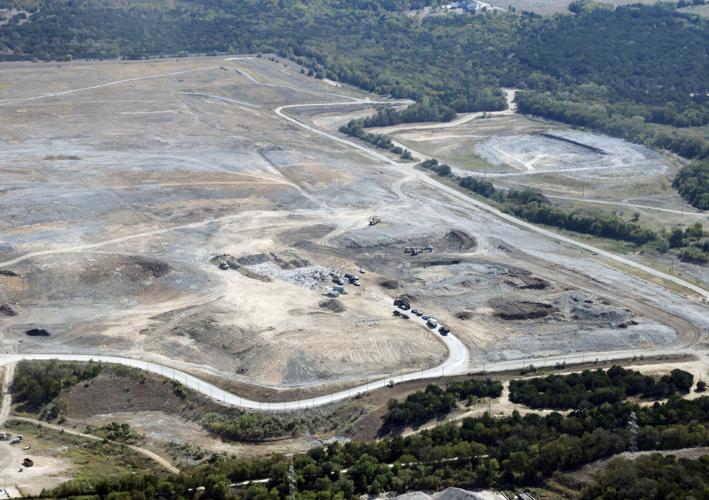
The pace of new trash entering Waco Regional Landfill has been picking up in recent years.
To ensure a new setup is ready when the old landfill hits capacity, the city may have to start limited construction on new landfill operations before final permits are in place.
The current landfill is projected to fill up and close in July 2025. It took in some 295,000 tons of material in 2017, which grew to 364,000 tons in 2022, only dipping slightly in 2020, according to data presented to the Waco City Council last week. Solid Waste Director Kody Petillo said landfill intake has grown faster than expected because of a large amount of development and more people moving to the area as houses are built, especially in the past two years.
The city of Waco’s collections, including residential trash collections, have remained at about 35% of the total material entering the landfill each year. The greatest increase since 2017 has been in self haulers, from 22% to 29% of the total, reflecting the city’s booming development.
Petillo said being proactive in recycling materials like cardboard and glass will help restrict growth at the future landfill, but probably will not make much of a difference with the current site’s capacity fill date. He said the biggest difference that could be made right now is in concrete from construction and demolition.
The landfill could hit capacity sooner than projected if tonnages continue to increase as they have in past years, if compaction slows and if Lacy Lakeview, whose landfill will reach capacity even sooner, begins to divert waste to the Waco landfill.
Though the timeline for hitting capacity remains a concern, the projected fill date is later than it was when the city started buying land near TK Parkway and Highway 31 for the landfill. It has spent $6.5 million buying about 1,400 acres there. At the time of the first land buys, officials said the current landfill was expected to fill up in 2024.
Petillo said the solid waste department has made efforts to increase the landfill’s overall compaction rate, including adding larger compactors, opening up recycling options for glass and Styrofoam, and increasing fees for construction and demolition material. However, efforts have been offset by increasing total tonnages over the past two years, he said.
The planned landfill near Axtell is still in a contested case with the Texas Commission on Environmental Quality, with three parties left challenging the permit, which Petillo said he is working and hoping to settle. If the remaining challenges are not resolved through settlements, the process of hearings, discovery and the commission’s decision could push its permit date to January 2024.
“If we want to have a landfill open by January 2025, we’re going to have to start some construction early, and that’s going to be some construction dollars at risk. … But if we don’t start construction earlier we are almost impossible to hit that January 2025 date,” Petillo said.
Petillo said TCEQ has given the city permission to start work on roadways, drainage, fencing and excavation of about a million yards of dirt that must be moved for the planned landfill’s first cell. Once the city gets a permit, it may start issuing contracts for vertical construction and the landfill liner.
The landfill project is estimated at $23.8 million, about $11 million of which would go toward the first cell and a haul road to the site. Petillo said staff is still working to find ways to cut costs, specifically in the $4 million administration building and $1.2 million on-site water supply system.
A new landfill would give the city of Waco an additional 34 years of landfill capacity.
Transfer station
The planned landfill is farther from town than the current landfill, which means the city is planning to build a transfer station to reduce transportation costs.
The station at the corner of South University Parks Drive and Radle Road would receive waste from curbside trash collection trucks, and the waste would be compacted and loaded onto semi-trucks to be moved to the new landfill. Trash trucks used for curbside pickup are made to go shorter distances, and if the haul distance is more than 15 miles to get to a landfill it is more cost effective to have a station, Petillo said.
The transfer station will be constructed over an old landfill and will only require an existing development permit to be modified, making for a faster process than construction of a new landfill. The station also would include a station to collect waste from residents, similar to the setup at the Cobbs Recycling Center.
The first of two proposed construction timelines, which Petillo said is preferred, would allow design and construction to start before the city receives registration for the station from TCEQ. Though it risks construction money, the first option would open the transfer station around December 2024, before the current landfill is expected to reach capacity.
“If we don’t receive that transfer station registration from TCEQ then we have a big warehouse that we can’t take waste at,” he said. “But we feel really good about the actual permitting process. It’s not a new concept.”
The second option does not risk money, with construction beginning after registration, but it would finish the transfer station 11 months after the projected finish of the new landfill and about three months after the current landfill’s closure.
Petillo said if for some reason the new landfill were not permitted by TCEQ and construction on the transfer station were deferred, the city’s waste would have to be diverted to landfills in Itasca or Temple. With post-registration construction of the transfer station, the city would not be equipped to haul the waste long distances in time, meaning it would need third-party assistance and the cost of service would increase significantly, he said.
Having a transfer station in time for the old landfill’s final days would ensure there is a way for the city to haul waste in lieu of a place to store it. The transfer station, regardless of timeline, is estimated to cost about $11 million.
Petillo said city of Waco customers could see the cost of their solid waste service increase 7% per year over the next five years, from $17.70 per month now to about $23.34 in 2027.
The projected 2027 rate is more than Round Rock’s current $22.14 per month, Fort Worth’s $22.75, Arlington’s $18.50, College Station’s $18.48 and Lubbock’s $17.50, according to figures presented to the city council. The new rate also would make Waco’s service more expensive than it currently is for some other McLennan County municipalities, but would not come near the $50.15 per month rate in Austin or $35.81 in Dallas.
“Especially when you look at Woodway, Robinson and Hewitt, those communities are going to grow with our rate because their disposal costs are going to increase just like ours because they utilize our landfill, especially when Lacy Lakeview drops off,” Petillo said. “So we still should be the most competitive rate for residential collections in our area, and then we’re competitive with all of our aspirational cities as well.”