Bell County: City, county officials react to filing of Proposition A lawsuit
Published: Fri, 04/14/23
City, county officials react to filing of Proposition A lawsuit
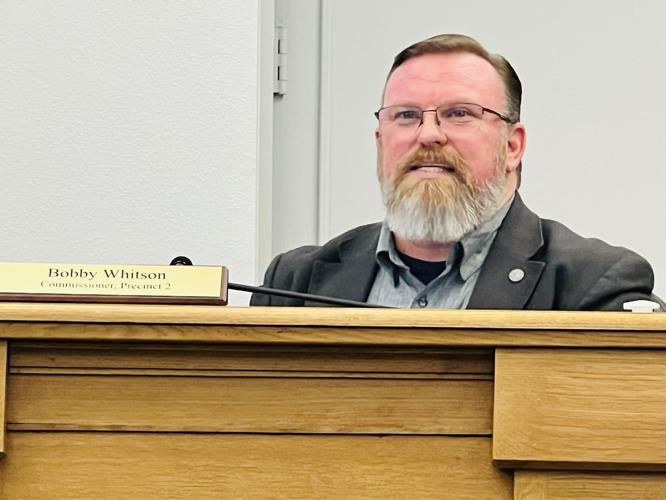
Precinct 2 Bell County Commissioner Bobby Whitson talks about Killeen's Proposition A during a special meeting on Dec. 22, 2022
Killeen Daily Herald
By Paul Bryant | Herald Staff
April 13,2023
In their lawsuit against Killeen, Bell County prosecutors take city officials to task for adopting Proposition A — a voter-approved ordinance they say is in “direct contravention” of Texas law.
“The State of Texas and Bell County have been harmed by defendant’s action and this suit brings this honorable court to provide the judicial remedy sought by declaring the ordinance unconstitutional and enjoining the defendant from enforcing it.”
On Dec. 22, Commissioners Bobby Whitson, John Driver, Bill Schumann and Russell Schneider met in executive session for an hour before authorizing District Attorney Henry Garza and County Attorney Jim Nichols to sue one of the county’s own cities over Proposition A, which decriminalizes possession of misdemeanor amounts of marijuana. County Judge David Blackburn joined the meeting remotely.
‘An illegal ordinance’
“Our county and district attorneys feel Prop A is an illegal ordinance that interferes with law enforcement’s ability to protect our community,” Whitson said. “Bell County Commissioners Court and some Killeen council members, staff and citizens agree with their assessment and support their actions to present this to the courts to make a determination of the law.”
Filed in the 146th Judicial District Court in Belton on Tuesday, the lawsuit is “seeking declaratory relief ... against the city of Killeen’s actions as unconstitutional; and seeking injunctive relief in district court against the city of Killeen from enforcing either the special order or ordinance; and seeking injunctive relief against the city of Killeen from punishing police officers for enforcing marijuana laws under the Health and Safety Code, Penal Code, and Code of Criminal Procedure.”
Killeen residents on Nov. 8 approved Proposition A with 69% of the vote. Then, on Dec. 6, council members in a 4-3 vote, amended Proposition A by removing Section 22-83, which requires that “Killeen police officers shall not issue citations or make arrests for Class A or Class B misdemeanor possession of marijuana offenses, except in the limited circumstances,” including the investigation of a “felony-level narcotics case that has been designated as a high priority.”
Furthermore, consistent with the initiative ordinance that led to the approval of Proposition A on Nov. 8, “city funds and city employees are prohibited from requesting, conducting or obtaining testing for THC.” Proposition A also allows Killeen police officers who violate the ordinance to be disciplined.
A provision in the ordinance that provided that using “the odor of marijuana or hemp shall not be considered for probable cause for any search or seizure” was removed by the City Council on Dec. 13.
Reporting requirement
Meanwhile, Killeen police are following the requirements of the city’s marijuana-decriminalization ordinance, Interim Chief Charles Kimble told council members on March 21.
“We contacted 188 people (who) had some sort of marijuana on them,” he said. “The majority of those people (146) were released because it fell within the guidelines of the ordinance. We seized the marijuana, and they were on their way. Forty-two of those people were arrested. So 77% of those people were let go.”
The data was presented as part of Kimble’s first “marijuana enforcement ordinance implementation report” since voters approved Proposition A.
“To be within the spirit of the ordinance, we had to have a start date and an end date,” Kimble said. “The date that we used was Nov. 9 ... and we used an end date of Feb. 28 because we had to stop somewhere. We’ll do it every quarter now.”
None of the other Texas cities where decriminalization initiatives have been approved — Elgin, Denton, San Marcos and Austin — has faced litigation.
Opponents of Proposition A, including Garza, say it conflicts with state law — where low amounts of marijuana is still a misdemeanor — and therefore should not be allowed in individual cities.
‘A long process’
“I have always been in favor of having the courts decide on this issue,” Councilman Jose Segarra said. “I am sure it will be a long process full of decisions and appeals through our court system if our state Legislature does not step in before that.”
In the lawsuit, Nichols and Garza have asked the court to grant “an immediate temporary restraining order and injunction,” preventing Killeen “and its agents” from enforcing Proposition A.
“Plaintiffs request that the city secretary immediately remove from publication the ordinance in print forms, including online municipal code database,” the lawsuit shows. “Plaintiffs request a permanent injunction against the city and its agents from enforcement of Article V Chapter 22, Killeen Texas Code of Ordinances.”
Julie Oliver, executive director of Ground Game Texas — the progressive grassroots organization in Austin behind decriminalization ordinances across the state — criticized Nichols over the lawsuit.
“It seems that the Bell County attorney is hell-bent on squandering taxpayer dollars,” she said. “It’s a waste of resources to have police arresting folks for low-level marijuana possession. It’s also a waste of taxpayer resources to file this frivolous lawsuit when Bell County has not been harmed by Prop A.”
‘The best mechanism’
But Whitson said litigation “is the best mechanism to get a legal determination of the law.”
“I encourage residents to take a quick reading of the Texas Constitution, Article 1, Sec. 28: ‘No power of suspending laws in this State shall be exercised except by the Legislature,’” Whitson said. “Article II, Sec. 5 (says) no charter (of a city over 5,000 population) or any ordinance passed under said charter shall contain any provision inconsistent with the Constitution of the State or of the general laws enacted by the Legislature of this State.’”
Further, Whitson said, Section 370.003 of the Texas Government Code prevents Killeen from adopting Proposition A.
“If we don’t follow these laws, which other laws will our city decide not to follow, and what chance does the average citizen have to fight a lawless city?” he said. “The state continues to change laws concerning marijuana. Whatever the Legislature decides, the county will enforce and our cities should, too. If we do not, our elected officials have broken their oath of office to protect and defend our federal and state constitutions and laws and promoted lawlessness.”
Louie Minor, a Ground Game activist who helped garner support for decriminalization ordinances in Killeen and Harker Heights, defeated Republican Chris Bray in their race for the Precinct 4 commissioner’s seat on the same night voters approved Proposition A. He has rejected the argument by opponents of Proposition A that he has violated his oath of office by supporting the ordinance here and in Harker Heights, where council members repealed the same ordinance.
‘Anecdotal situations’
“The Bell County (attorney) and district attorney are suing a city over a voter- approved ordinance which directs city resources in a more efficient manner,” Minor said. “The lawsuit mentions several anecdotal situations that have not occurred (firing of police officer, not executing an arrest warrant, not following state law). My counter question to the county and district attorneys would be: How many times do they exercise discretion and make plea bargains? I think if we start looking, there would be far more serious crimes plea bargained down.”
In Harker Heights, Proposition A is on the ballot for May 6, when voters will decide whether the ordinance repealing Proposition A should be approved.
“I believe the city of Killeen will stand with its voters and defend the ordinance,” Minor said. “To the citizens of Harker Heights, this is what profiles in courage look like, I urge you to vote in the upcoming municipal elections for candidates that respect the will of the voters. I will continue to advocate for my constituents as we work through this lawsuit.”
The petition also asks the court to “consider other grounds for invalidating” Proposition A.
“Sections 22-80(b)(1) and 22-82(b) are unconstitutionally vague regarding the ‘high priority’ or ‘violent felony’ categories that put police officers back in the position of mandatory arrest under CCP 2.13,” court documents show. “The term ‘violent felony’ is not defined. Additionally, the Killeen ordinance does not define ‘arrest’ and in case law, detention while seizing someone’s marijuana is an arrest. Such vagueness and overbreadth render the ordinance unconstitutional because it fails to apprise people of the actions which might lead to arrest.”
Nichols also complains in the lawsuit that Killeen “makes no provision” for other law-enforcement agencies to “take over” misdemeanor marijuana warrants.
“The county attorney does not have staff to complete what should have been Killeen’s job in the first place. The city’s position regarding prosecutions the county attorney is eager to pursue is along the lines of, ‘We saved the information regarding the seizure if you want to come and get it.’”
Philip Kingston of Sheils Winnubst of Richardson represents Killeen as outside counsel in the case. He told the Herald on Thursday he does “not have the authority to be on record” until Tuesday.