'We have some big city needs that we need to address' | Austin mayor talks first 100 days in office
Published: Wed, 04/19/23
'We have some big city needs that we need to address' | Austin mayor talks first 100 days in office
KVUE
Author: Ashley Goudeau, Britny Eubank
Published: 1:11 PM CDT April 18, 2023
Updated: 5:30 PM CDT April 18, 2023
AUSTIN, Texas — Austin Mayor Kirk Watson is now more than 100 days into his term – and it's been a busy couple of months.
Watson, who previously served as mayor of Austin from 1997 until 2001, was elected to be the current mayor back in December after defeating then-State Rep. Celia Israel in a runoff election. He took the Oath of Office in early January.
In the months since, Watson has been faced with a series of challenges.
"I joke that shortly after I got into the office, we had darkness, freezing and disease," Watson told KVUE Managing Editor of Political Content Ashley Goudeau.
An ice storm in February knocked out power for thousands of residents and caused significant damage to local trees. In the weeks that followed, the city council voted to fire then-City Manager Spencer Cronk. The general manager of Austin Energy also retired.
And those weren't the only key leadership shakeups. The City named Jesús Garza, a former Austin city manager, as the interim city manager following Cronk's termination. Less than a month later, Garza announced that one of the City's assistant city managers had announced his retirement and the executive director of Austin's airport had announced her resignation.
Also in Watson's first few months in office, the Austin Police Department (APD) has begun an unprecedented partnership with the Texas Department of Public Safety (DPS), enlisting DPS troopers to help APD officers with patrols.
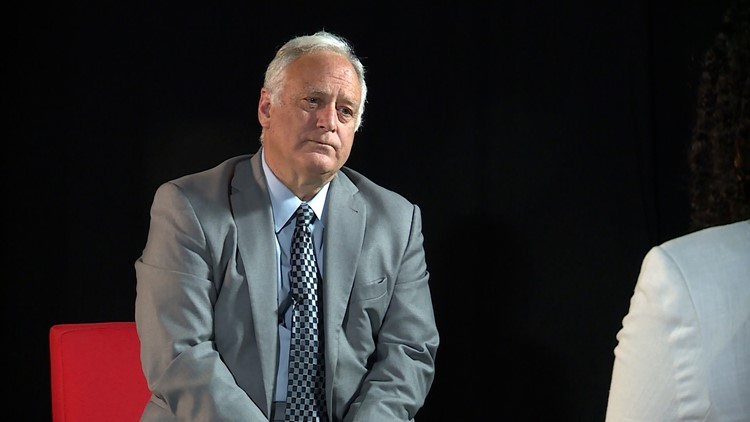
Goudeau sat down with Watson on April 17 to discuss his first 100 days in office, some of the major storylines that have sprung up so far and his plans for the future. The full interview will be available to watch on KVUE+ and our KVUE YouTube page Tuesday evening, and we will also air clips from the interview during KVUE News at 5 and 6.
Below are abridged excerpts from some of the main topics Goudeau and Watson discussed.
Austin's response to the ice storm
Goudeau: A month after you were in office, the storm hit. And do you think now, looking back, there was anything that Austin could have been doing differently to prevent some of, you know, how disastrous that was?
Watson: "You know, as I did at the time, I'll take full – as the mayor of this city, I take full responsibility for how things get handled. But a whole lot of that was kind of a unique way that the storm hit. And, you know, there was the National Weather Service saying one thing even as things changed from what they had said. But there are some things that needed to be handled differently. First of all, was the acceptance of responsibility. And some of the folks that were involved in the day-to-day operations and how things got managed needed to accept responsibility. I'm the mayor and I accept responsibility for, but we have people that were that were managing things.
But most importantly was – that we could make a change on – was how it is that we communicate with our customers and the people that are being impacted and how we make sure that they're aware and prepared, but also being candid and forthright and accurate when we tell them what to expect. So for example, we don't tell people, 'We ought to have everybody's power restored on this Friday,' but it ends up being the following weekend, things like that. Because people want to know that their government is acting in an accurate way. And that was one of the biggest failings during that period of time."
Goudeau: We talk about communications and communicating with Austin residents. Some people say, "Well, you're the mayor. Surely you can call a press conference whenever you please."
Watson: "Well, in fact, what happened was that we had a couple, we had the real big day on Wednesday, and on Thursday, we did have a press conference. But part of what was going on was you had an emergency operations center that had people that – I was saying, 'Let's have the press conference, let's go with it.' And they wanted to wait on some other things to come in. So we had the press conference the next morning. I wish that we had had a press conference the day before. But, you know, you try to balance out and make sure you have the accurate information that you need. And that's why, on the day before, I said, 'We're going to start having press conferences every day, and we're going to make sure that people do know what's going on.'"
Firing Spencer Cronk
Goudeau: Why was it necessary for [Spencer Cronk] to leave?
Watson: "Well, it wasn't just because of that. There were other reasons that that ended up happening, although that was a very obvious moment. And ... that was one of those things that highlighted some of the problems that we had at City Hall. And it included things like, with regard to how he presented the police contract. But the other thing that is important about this, and one of the reasons that we moved with the urgency of getting a new city manager with real experience as a city manager and you see the reorganization going on is – as I said before and I believe it even more now – we inherited a City Hall that wasn't organized for success, and that falls to the manager.
Many folks don't know that in Austin, we have a council-manager form of government where the city manager is the one that is actually responsible for the overall workforce and for the management of things like Austin Energy. There's a general manager, but they report to the manager, the city manager. So you have things like that. And, in our view, the place wasn't organized to succeed the way Austinites deserve."
Goudeau: You said a city manager with real city manager experience. This was Cronk's first time being the city manager. And do you feel like some of the mistakes, perhaps, that he was making – in your view and the view of the council – is because this was his first time?
Watson: "Well, I'll say two things about that that may answer that question. One is we really needed somebody that – we didn't want bring in an interim that hadn't been a city manager. Because the changes needed to be made, and we needed to get things stabilized. The second thing I'll say about that is that what we're looking for, I think – what I'm looking for and I think the council will be looking for – is someone with real experience as a city manager to come in as the permanent city manager. Because we believe, I believe, that it makes a real difference in how you get things done. We've already seen it, I believe, in the way that the interim city manager, Jesús Garza, has gone about approaching things and how he even interacts with the council. In the hallways and on the dais, it makes a difference."
Naming Jesús Garza as interim city manager
Goudeau: When it came to appointing an interim city manager, you move pretty swiftly to name who was the city manager when you were formerly mayor. What was the decision behind that rather than one of the assistant city manager?
Watson: "... We needed somebody that had been a city manager. And we were very fortunate because right here in Austin, Texas, we had someone that had experience as being a city manager and being a successful city manager – a city manager that had even received awards from 'Governing' magazine. And he indicated that he would be available for such a thing. And so we got very lucky. And he's, he's doing a great job."
Goudeau: Is there any concern about the message that, that sent to the assistant city managers?
Watson: "Well, the truth of the matter is we wanted somebody if you want somebody that has experience as a city manager, bring in somebody with experience as a city manager and then create the appropriate process to pick a permanent city manager. That if there are assistant city managers that want that permanent position, they'll be in a position to compete for that."
APD-DPS partnership
Goudeau: DPS plays by its rules, APD plays by its rules, its own rules, in terms of how they do business, how they go about those day-to-day operations. Any concern that what DPS is doing or will do could run counter to the policies of the city?
Watson: "A couple of things about that. First of all, the Austin chief of police and the regional director of DPS for this area, they talk every day. And they speak every day, in part, so that what they make sure happens is that DPS is supplementing and supporting APD and doing things the way we would want them to do to meet Austin's values. The other thing is that it's not uncommon. In fact, it happens, where DPS follows certain policies of the county in which they're located so that it's not doing it just their way, it's doing it more the way of the local community.
So you ask the question: are their concerns? Sure. But we're monitoring that. So far, what they're doing is following what we've asked that they do. And we're going to monitor that. Because when I say to people that I want Austinites to be safe and feel safe, that includes when they see a heightened presence of police. I don't want them to be fearful of that situation. That also includes if you see a light flashing in your rearview mirror and you're being stopped or police are approaching your car and you're a person of color – I don't want there to be that fear. So we're going to monitor this closely.
And then the other thing I'd say about it is what we've asked them to help us with, and what they're primarily helping us with, is traffic and violent crime, dealing with violent crime. And so that doesn't necessarily put them in a position that some of the concerns would, would come to fruition. And setting it up that way, I think makes a difference."
Project Connect
Goudeau: [Project Connect] was a very big talking point during your campaign, during the election season. And we recently had ATP [Austin Transit Partnership] come out and show the five options. And the five options don't look like what people originally voted for, but the five options are within budget. Talk to us about your thoughts about where Project Connect stands right now.
Watson: "Well, the truth of the matter is it has to be within budget. Some say or act like they think it's different than that but the truth of the matter is, it has to stay in budget. Because what the voters said is that they're willing to raise their tax – they ratified raising their property taxes by a very specific amount to pay for a rail system. And yes, at the time they voted ... that tax amount, based upon projections of what you would receive, could build 'X.' But like every infrastructure project out there ... the inflation and supply chain have added to the cost.
So when you have a live-within-your-means election, where you just have a certain amount, what you have to do – you only have two factors that you can deal with. One is the product, the other is time. So what you see are five different proposals that live within the means, but get us on the path of what the voters said they wanted. They said they wanted to solve certain types of problems and reach certain goals. One of the goals was to get us some alternative transportation options, such as rail, and one of the problems they wanted us to address was the fact that we had a dearth of those sorts of options and that it makes an impact on how we can even grow in this city.
The city council – I guess it was two weeks ago – unanimously voted to begin the process of allowing for what are referred to as 'equitable transit-oriented developments.' What those will do is they will allow for density in development, in a responsible way, that will also allow for more housing options. So we need to move forward on those kinds of things but live within our means. And, like I say, if you were just fixing a bathroom, it's gone up in price. And nobody's surprised by that. But we need to keep moving."
"It will take longer to build some of that rail, but we will begin the process. Listen: I was mayor a couple of years ago when, in 2000, when it was the first time we ever put rail on the ballot. And it lost by less than 2,000 votes. Think about what we would be doing today had that passed ... We would be so far down the rail on these alternatives, and think about how much money we would have saved. Because things have gone up in price. This is for rail. That's what the five options talk about. It's for rail. It's just that when you have two factors you can deal with, when you have inflation like what we've seen in the last couple of years and you've had the supply chain problems that we've had as a result of the pandemic. That's unique, and it makes a difference in all infrastructure projects."
Watson's future as mayor
Goudeau: Do you still think you'll seek a second term?
Watson: "Oh, my anticipation is that I will. Yes. I tease about it, but yeah ... Let me put it to you this way: Being mayor of Austin is truly a unique and wonderful position to be in if you want to serve ... if you to get some dirt on your fingernails and actually be doing the service. And while it's been, this first 100 have been, as I said, hurried, but I also said they've been happy."
Goudeau: "Hurried but happy." How do you hope to describe the days going forward?
Watson: "Eventful and successful. I'm really looking forward to the next 100 days and beyond. We've been working, for example, on a really significant workforce development. We've announced aspects of that workforce development. In fact, I came here from an event dealing with that. That will only be expanded in the next 100 days. Child care is something that I want to see us address with a real passion, make Austin the best city in America to raise a kid. I look forward to that, the eventfulness of something like that. In the next few weeks, we'll be announcing a program related to how we address some of our friends and neighbors that are living homeless that will make a real difference in the community.
So, eventful, and then with a high degree of success. But I don't want us to lose that urgency because I think that that is something that we desperately need right now. We're a big, big city now, whether we like it or not. We're a big city, and we have some big city needs that we need to address pretty quickly."