Former Congresswoman and state Sen. Barbara Jordan broke barriers for Black women in Texas during her years in public office.
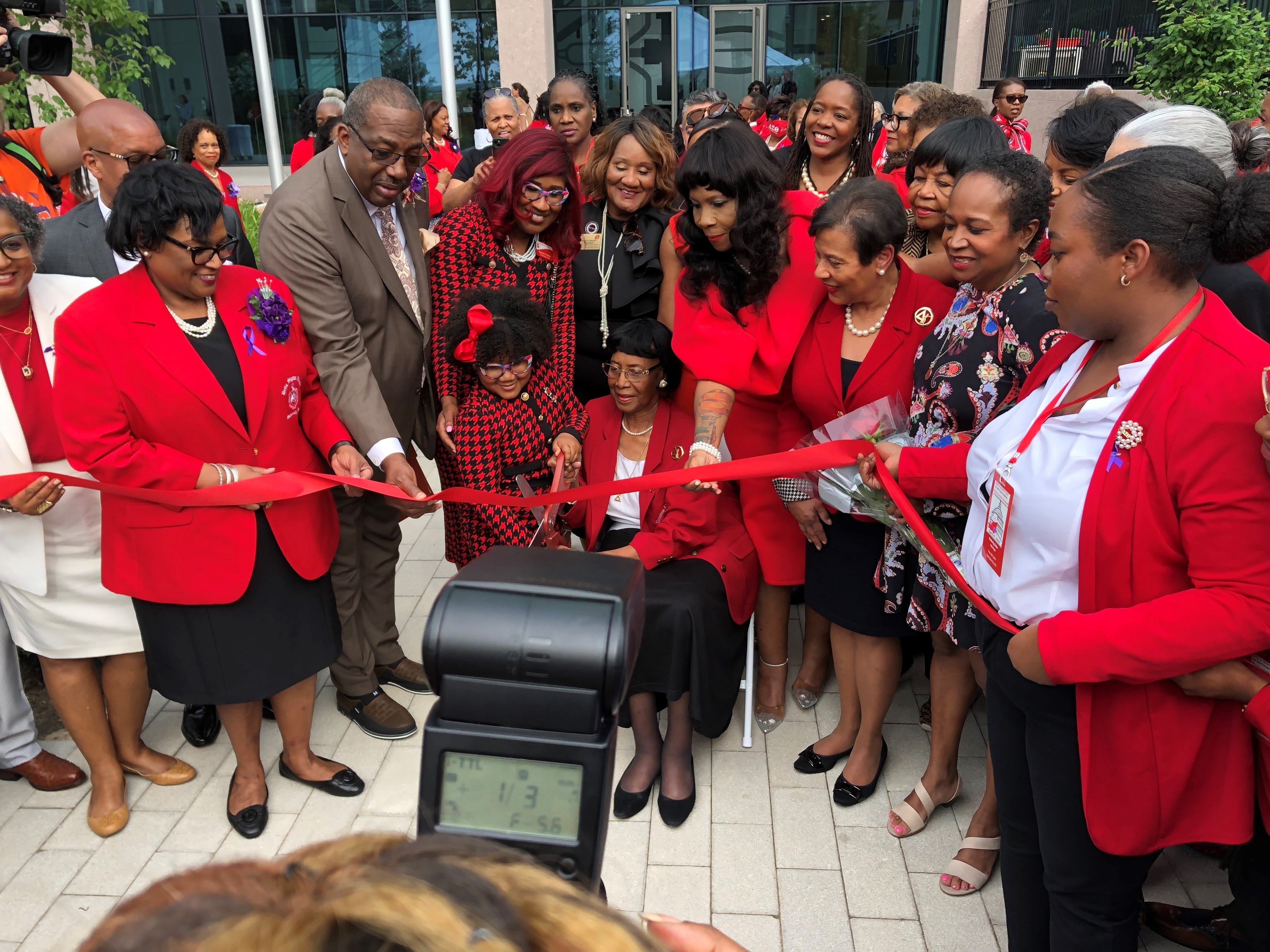
Rosemary McGowan, the sister of Barbara Jordan, cuts the ceremonial ribbon to dedicate the Barbara Jordan State Office Building in the Texas Capitol Complex on Monday.
John C. Moritz/USA TODAY Network
Corpus Christi Caller-Times
John C. Moritz, Corpus Christi Caller Times
April 18, 2023
AUSTIN — In a mostly joyful but sometimes poignant ceremony late Monday afternoon, several Texas lawmakers and members of the Delta Sigma Theta Sorority dedicated the Barbara Jordan State Office Building, the first such building named for a Black Texan.
The 12-story, 416,000-square-foot glass and granite structure rising 180 feet a block north of the Texas Capitol anchors an emerging pedestrian mall connecting the University of Texas to the seat of state government. Jordan, a former state senator and congresswoman, was recognized as a pace-setter and revered icon for Black women in Texas and across the nation.
"Barbara Jordan was not only a trailblazer as a Black woman, but also as a lawmaker and a leader," said state Rep. Sheryl Cole, an Austin Democrat who authored the 2021 resolution to name the building after Jordan. "As a member of Congress, Barbara Jordan fought to expand the Civil Rights Act and the Voting Rights Act. She sponsored bills to help women expand Social Security benefits that did not work outside the home."
State Sen. Royce West, who carried the measure in the Senate, said Jordan was among the first political figures he contacted after joining the upper chamber in 1993. At the time, Jordan was on the faculty of the Lyndon B. Johnson School of Public Affairs at the University of Texas after closing out her congressional career 14 years earlier.
West, a Dallas Democrat, said one of Jordan's iconic quotes has guided his 30 years of public service.
"I believe that many things Barbara Jordan said during her lifetime provide us important lessons today, including these words: 'If the society of today allows wrongs to go unchallenged, the impression is created that those wrongs have the approval of a majority,'" West said.
The daughter of a Baptist preacher, Jordan was born in Houston in February 1936. Because she was Black, Jordan was unable to attend the then-segregated University of Texas. She enrolled in the historically Black Texas Southern University, where she majored in history and political science and became a national champion debater, honing her oratory skills that would bring her national acclaim.
She also pledged to Delta Sigma Theta Sorority, considered one of the most influential sororities for Black women.
After earning her law degree from Boston University School of Law, Jordan entered politics. She lost bids to win election to Congress in 1962 and again two years later. In 1966, she became the first Black person elected to the Texas Senate since Reconstruction. Six years later, she was elected to Congress.
During the 1974 hearings to consider the impeachment of President Richard Nixon, Jordan explained her support for removing the 37th president from office in a speech that made her a national figure.
"My faith in the Constitution is whole; it is complete; it is total," she said in a nationally televised meeting of the U.S. House Judiciary Committee. "And I am not going to sit here and be an idle spectator to the diminution, the subversion, the destruction, of the Constitution."
In 1976, Jordan broke another barrier by becoming the first Black woman to deliver a keynote address at a national political convention.
Jordan's sister, Rosemary McGowan, now 90, cut the ceremonial ribbon to officially open the building that is now the headquarters of the Texas Department of Insurance and for the Capitol Complex child care center.
Jordan's sorority sisters — many of whom attended Monday's "Red and White Day" that honors the organization — remarked on the irony that it took 44 years after she left public office and 27 years after her death in January 1996 for her to be honored among such legendary Texans as Sam Houston, William Barrett Travis and Lyndon Johnson with a state building named for her.
West said the long passage of time does not diminish the significance of naming the building for Jordan.
"Hopefully, this will not be," West said, before stopping to rephrase his thought. "No, this will not be the last one named for an African American woman."