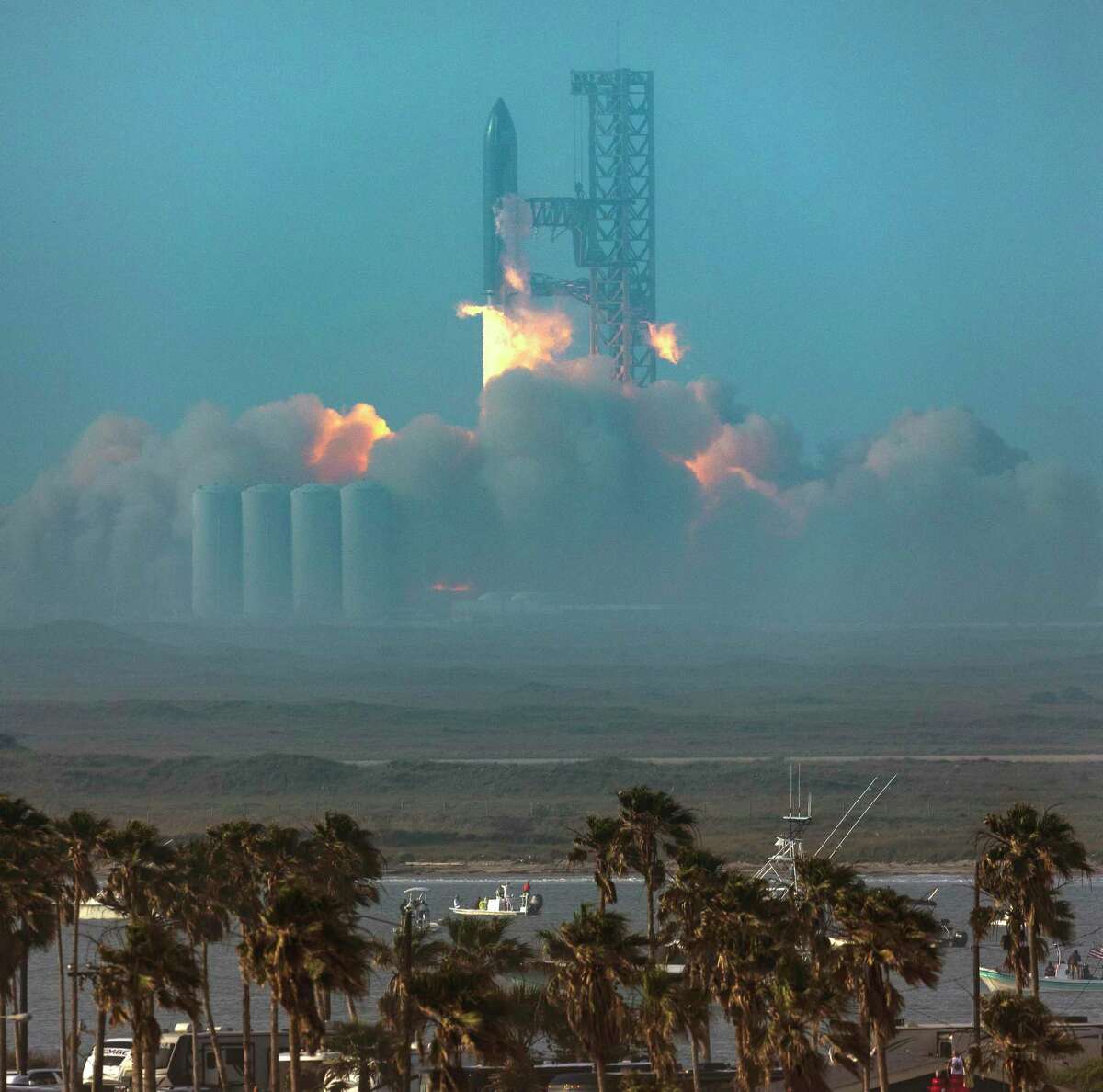
SpaceX’s Starship and Super Heavy rocket system take flight Thursday. While the flight and explosion were spectacular, environmental concerns abound.
San Antonio Express-News
Brandon Lingle, Express-News Columnist
PORT ISABEL — After Starship’s engines ignited, a plume of sand and smoke billowed far above the 480-foot-tall launch tower.
The cloud rolled over Boca Chica Beach’s tidal flats and dunes like a volcanic eruption, but people weren’t watching the smoke, their eyes were fixed on the world’s largest, most powerful rocket as it lumbered skyward.
From my vantage 6 miles away, there was no way to see the carnage happening on the ground. The booster’s 33-engines obliterated the concrete under the launch pad, gouging out a crater and blasting rocks and wreckage hundreds of yards in all directions.
Chunks of concrete smashed through a van parked 1,200 feet from the launch pad. Debris splashed into the Gulf of Mexico a quarter of a mile away. Objects pelted the wetlands around the site. And four minutes into its maiden flight, the Starship exploded 24 miles above the sea.
Not long after that, flecks of dust kicked up by the launch began floating down on us. The particles coated vehicles and hung in the air. They demonstrated Starship’s power and perhaps some poor planning.
With Thursday’s launch, science fiction collided with reality on a strip of land in the middle of a national wildlife refuge. While Starship brings much opportunity and money to the region — maybe even hope for humanity — the full toll on the community and environment here will take years to comprehend.
Strip away the politics and egos, temper the blind faith of SpaceX founder Elon Musk’s fan base and work through the fear many locals have of talking candidly about SpaceX, and it becomes clear that it’s too early to tell if Starship launches from Boca Chica are worth the costs.
Thursday’s launch proved that the company needs to make some changes.
The people
SpaceX says it employs 1,800 people at Starbase, and Nathan Burkhart of the Brownsville Community Improvement Corporation, told me 75 to 80 percent of those employees are locals.
So far, the commercial space giant’s presence has brought several businesses to the area, he said. It’s also supercharged tourism, drawing thousands from across the globe to visit Starbase or see a launch. And direct commercial flights from Brownsville to Burbank and Orlando will start in May.
SpaceX’s growth has spiked area home values and property taxes. Some locals fear being priced out.
In 2021, after a Starship prototype blew up and rained steel onto the wetlands, the Elon Musk Foundation donated $20 million to Cameron County Schools and $10 million to Brownsville to revitalize its downtown. However, according to Burkhart, the Musk Foundation has gone quiet since October, after its namesake purchased Twitter.
Brownsville’s Texas Southmost College saw opportunities with SpaceX, said Joseph Fleishman, who leads the school’s training and continuing education programs. The junior college’s foundation invested $24 million over the last three years to expand training programs, including structural welding, orbital tube welding, laser welding, pipe fitting and rigging — all skills in high demand at SpaceX.
So far, the school has produced 400 welders and is on track to train 1,000 annually. Fleishman sees potential for developing a direct collaboration with SpaceX as it has with other employers.
The jobs and economic wins are a boon for Brownsville, which is historically one of the poorest cities in America.
Many residents, though, may not have the luxury to think about how space travel might help them.
Musk has said Starship will someday help humanity become multiplanetary, but in our troubled world it’s hard to see the potential long-term payoff. Most people are focused on taking care of basic needs, paying bills and keeping their families safe.
For many, the vision of going to the moon and Mars is little more than an escape for the imagination. At the same time, the dream of space travel offers hope and inspiration. Millions of kids around the world saw Starship roar into the sky. For some, the spectacle will ignite a passion for science and exploration.
On Wednesday, the eve of the launch, hundreds of people milled along Highway 4 and across the flats behind the launch pad. A SpaceX flag waved in the breeze and graffiti messages such as “We are explorers,” or “To Mars and beyond,” added to the mystique.
Here at Starbase, people can get closer to a rocket than they ever could at Kennedy or Vandenberg. As the sun dropped toward the horizon, they looked up at Starship, snapped photos and talked about its potential. Some drew pictures, recorded YouTube videos or carved messages in the sand. Others rode horses, bikes or skateboards. A few hung out in beach chairs near vans and campers.
Seeing Starship bring people together is inspirational, but less visible is how SpaceX operations have made it more difficult for locals to visit Boca Chica Beach due to frequent road closures.
The place
In the shadow of Starship, a black bird perches on a sign that warns people away from the “Sensitive Wildlife Habitat.”
Behind the sign, tidal flats and sand dunes unfold toward the sea. In front is the launch facility that looks like an industrial construction site. Tankers hauling liquid oxygen, liquid nitrogen and methane roll by. Potholes litter the road where traffic has doubled over the last year.
Texas politics helped land Starship near Boca Chica Beach. In 2013, the Legislature passed a bill that allowed Cameron County to approve beach closures and another that cleared space companies of civil liability from damages caused by “testing, launching, reentering, or landing.”
Environmentalists continue to warn of the impacts of SpaceX operations on the pristine habitat that’s home to multiple endangered species and serves as a waypoint for migratory birds from across the Western Hemisphere.
“Ecologically, the Boca Chica area is really unique and immensely valuable,” said local activist Jim Chapman two days before the launch. “You can launch rockets from a variety of places, but you can’t move Boca Chica, you can’t move that area, you can’t replace it.”
He believes the 174-page federal environmental assessment of the project was flawed in finding “minimal” or “no significant impacts” for issues such as air and water quality, noise, lighting, traffic and hazardous materials.
The assessment describes how a launch will generate 212-degree temperatures up to one-third of a mile from the rocket, “but there’s no discussion of what impacts that level of heat is,” he said. And wildlife outside of the heat plume are still vulnerable to the extreme sound and vibrations.
The government required SpaceX to complete 75 environmental mitigations, but Chapman said the measures are largely “vague, good intentions” rather than enforceable measures.
David Newstead, a scientist with the Coastal Bend Bays and Estuary Program, said SpaceX has already impacted the area’s bird population. His group has found that the number of endangered piping plovers in the area have decreased since SpaceX operations began.
The day before Starship launched, Newstead told me nobody really knows what the impact of the massive rocket could be, let alone repeated launches. Migrating birds from the Arctic to Patagonia pass through the area, and he said the launches are testing the “link in a chain theory — birds are dependent on that site, and if it’s functionally is destroyed, then the chain is broken.”
As I left Starbase Wednesday evening, I spent a few minutes watching the tiny plovers feeding in shallow water a quarter mile from Starship. Nobody would warn these creatures of the chaos that would come to their habitat the next morning.
The aftermath
After Starship blasted off, chunks of concrete and debris littered the area. SpaceX crews began cleaning up the mess, but as of Friday morning, federal and state wildlife experts were still not allowed access to assess the damage.
The biologists will look for hurt or killed wildlife, but that won’t answer all the questions. And the data they collect becomes less accurate as time passes.
Thursday’s launch proved SpaceX must do more to protect the delicate environment it’s a part of. We should not hasten the destruction of our planet as we look to the heavens.
After the spectacle, I’m still thinking about those plovers and the lessons their plight teaches about our own species.
brandon.lingle
@express-news.net