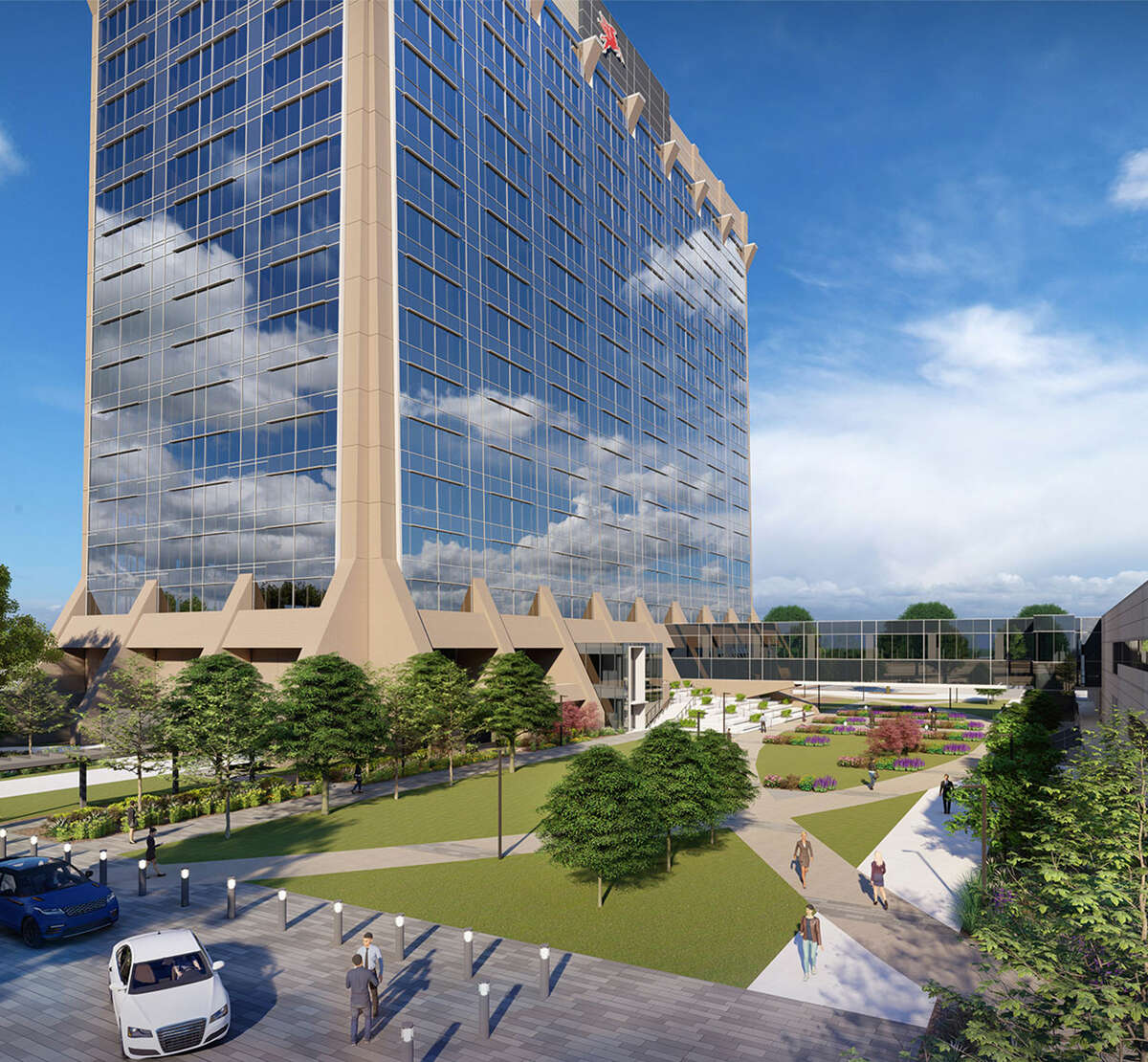
An 18-story office tower is the centerpiece of Pegasus Park, a former oil industry campus near downtown Dallas that's the target site for a federal biotech hub. The massive project has support in San Antonio.
Courtesy
San Antonio Express-News
Eric Killelea, eric.killelea@express-news.net
April 26, 2023 at 03:30PM
San Antonio is teaming up with Austin, Dallas, El Paso and other cities to bring a new federal biomedical research agency to North Texas.
The Biden administration created ARPA-H early last year to accelerate biomedical health and technology discoveries. It’s set its sights on establishing a headquarters in Washington, D.C., and is expected to review applications from several states vying to host one of its two hubs.
The Texas team is expected to hear by May 12 if their pitch, which was made Friday, has been accepted to the next stage of the proposal process. ARPA-H said it expects to announce the two remaining hub locations by early fall.
Heather Hanson, president of BioMedSA, a nonprofit that promotes San Antonio’s health care and bioscience industries, has been representing the city in the joint campaign to bring the agency to the state. She said San Antonio would benefit financially by having a hub in the state — even if it’s located in North Texas.
Pegasus Park’s selection came out of a process begun more than a year ago. It’s a 23-acre campus with more than 750,000 square feet of office space. A former oil industry campus, Pegasus Park is close to UT Southwestern Medical Center and about 13 miles from Dallas-Fort Worth International Airport. It’s anchored by BioLabs, a co-working lab space company designed to help launch and expand other emerging companies.
“Ultimately, Pegasus Park was selected as the physical location due to the proximity to the DFW airport and facility strengths,” Hanson said in an emailed response to questions.
San Antonio benefits
She and other local backers of the massive project say it would benefit San Antonio’s $44 billion health care and biotechnology industry, which already is the largest economic sector in the city. It includes Brooke Army Medical Center, the largest military health complex in the U.S.; three national disease centers; and the National Institutes of Health-approved national primate center at Texas BioMed.
“This means close access to a significant biomedical funding agency and national awareness of their capabilities through the ‘immersive experiences’ (tours/presentations at local facilities) and collaboration meetings in specific medical areas selected by ARPA-H for funding programs,” Hanson said.
Sarah Carabias Rush, chief economic development officer at Greater:SATX, said securing the hub would “best position our San Antonio regional bioscience and life science companies to secure ARPA-H funding.”
“Our goal in this effort is to position the San Antonio region to access these critical federal funds and working with our counterparts across the state, we believe our San Antonio life sciences ecosystem is going to benefit,” said Carabias Rush, who came to San Antonio’s economic development arm last year from the Dallas Regional Chamber, where she’d worked for 18 years.
The effort to establish a Texas-based ARPA-H hub began taking shape in October 2021 when BioMedSA and Lyda Hill Philanthropies in Dallas agreed to compete against Silicon Valley, North Carolina’s Research Triangle and other locations on the East Coast vying for it.
Lyda Hill is a Dallas-based organization dedicated to funding advancements in science and nature. The organization most recently partnered with Research Bridge Partners to invest $4 million in helping UT Southwestern scientists spin out their discoveries into biotechnology companies.
Based on “intelligence and the insight” from a consortium management firm they contracted, San Antonio and the other coalition cities determined that the highest probability of success would be to apply for the hub as a team rather than individual cities, she said.
The group invited other cities to participate in their advocacy.
“Houston was invited to participate in the Texas Hub but declined in order to present their own hub independently,” Hanson said. Its effort reportedly is being led by the Texas Medical Center.
While losing a major city from its roster, the group also has support from College Station and other cities in the Rio Grande Valley, North Texas and West Texas.
The three ARPA-H hubs will serve different purposes in the research process.
The already-decided D.C.-area hub will focus on stakeholders and partners near the U.S. capital. The second hub, which the San Antonio-Austin-Dallas consortium is vying for, will specialize in customer experience and lead user testing, access and trust of ARPA-H projects. Hub No. 3 will be an “investor catalyst” focused on bringing science to market.
eric.killelea@express-news.net