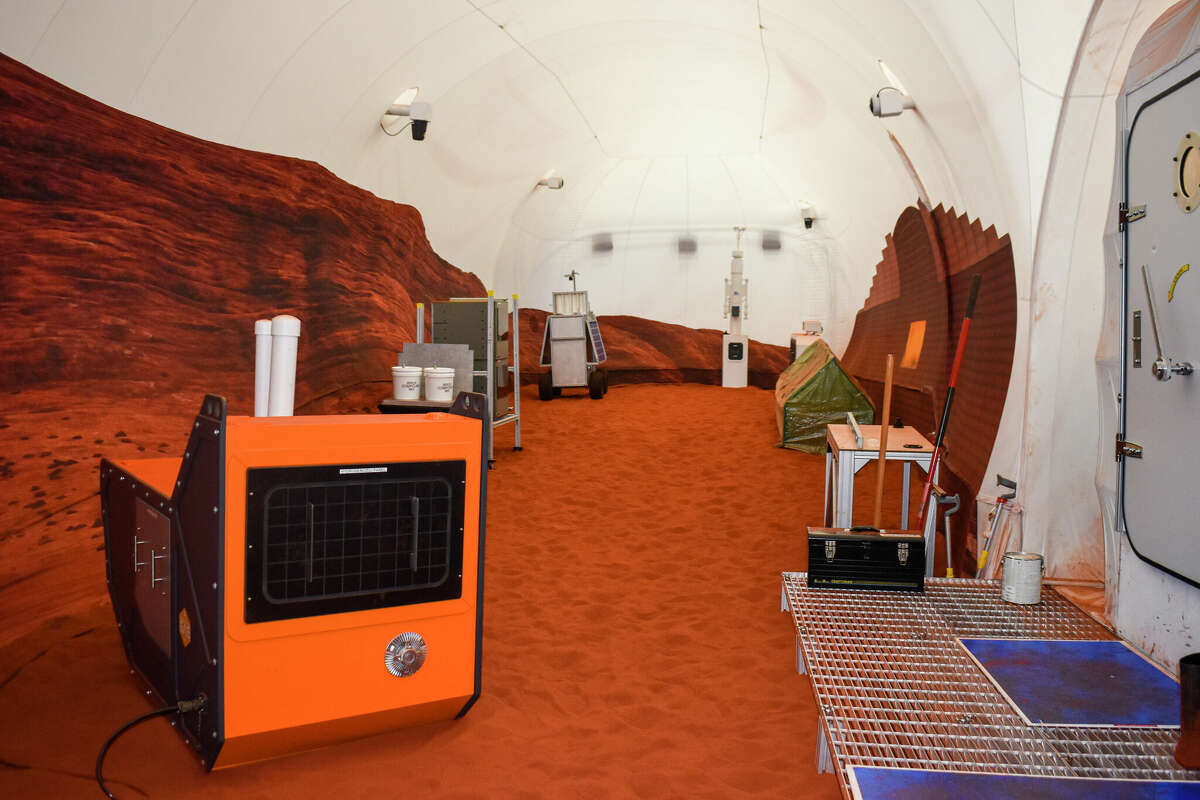
NASA has announced the crew of four who live inside a simulated Mars habitat for a year to prepare for future missions to the Martian surface.
Ariana Garcia
Houston Chronicle
Ariana Garcia, Chron
NASA recently unveiled its 3D-printed, simulated Mars habitat located inside the Johnson Space Center campus in Houston. Now, the
space agency has unveiled the names and faces of the four non-astronauts who will live and work inside the confines of the isolated 1,700-square-foot structure for about a year in order to test how humans would fare living on the red planet.
During the first Crew Health and Performance Exploration Analog (CHAPEA) mission crew members will be forced to live with limited food and resources, along with equipment failures, communication delays, and other "environmental stressors" thrown their way. The data collected on participants' mental and physical well-being will be used to help send astronauts to Mars in the future, the ultimate goal of the Artemis moon missions.
"The simulation will allow us to collect cognitive and physical performance data to give us more insight into the potential impacts of long-duration missions to Mars on crew health and performance," said Grace Douglas, principal investigator of CHAPEA, in a statement. "Ultimately, this information will help NASA make informed decisions to design and plan for a successful human mission to Mars."
The well-rounded crew of four were selected through NASA's 2021 call for applicants. They include Kelly Haston, a biomedical scientist who will serve as the mission's commander; Ross Brockwell, a structural engineer and public works administrator who will be the mission's flight engineer; Nathan Jones, a board-certified physician who specializes in prehospital and austere medicine and will serve as medical officer; and the mission's science officer Alyssa Shannon, an advanced practice nurse.
NASA also selected two backup crew members, including Trevor Clark, a senior aerospace engineer; and Anca Selariu, a US Navy microbiologist. Set to begin in June, the first CHAPEA mission is one of three planned one-year analog missions. The second will be in 2025 and the third in 2026.