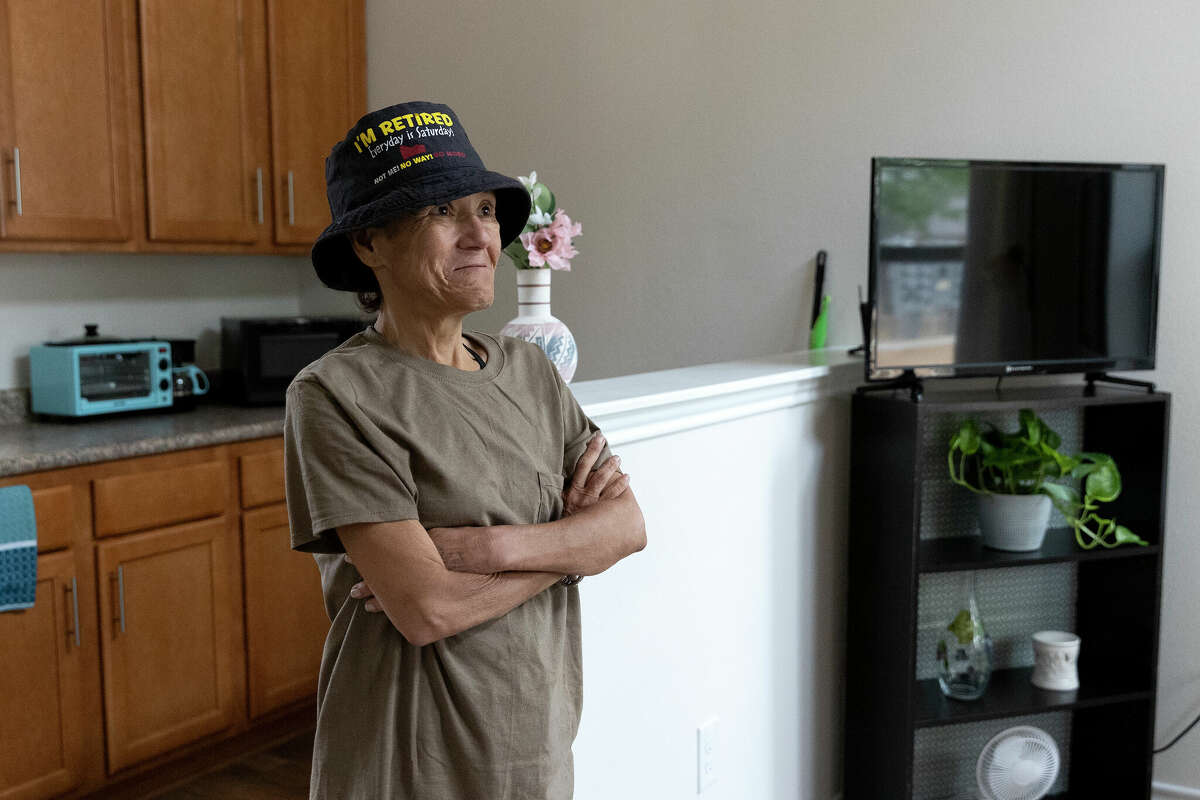
Margarita Chavera, 51, smiles in the living room of her new home at Towne Twin Village, which provides housing for homeless older adults.
San Antonio Express-News
Madison Iszler, Staff writer
Making his way toward his new home at Towne Twin Village with his staff and cane, Jose Anicieto Salinas Gomez was beaming.
The 93-year-old ran his hands over the screened-in porch and walls and practiced locking and unlocking the front door. Village staff guided him around his bathroom, bedroom and kitchen, showing him his bed, dresser, a couch, shelves and a refrigerator. He smelled a cilantro plant on a shelf and tore off a few leaves to taste it.
Salinas Gomez couldn’t stop grinning. He hopes to see a specialist for cataracts that limit his vision, he said through a translator, and is looking forward to sitting on his porch and chatting with his neighbors. After decades living on the streets and at a homeless shelter, he felt like a king in his new home.
“It’s like I won the lottery,” he said.
This month, the first residents began moving into Towne Twin Village, San Antonio’s first permanent, single-site housing community with services for older homeless people.
In an RV trailer nearby, David Wilson Greer was putting away tonic water, packages of Oreos, rolls, hot dogs, mozzarella cheese and oranges.
Community in the making
Towne Twin Village, the first-of-its-kind permanent housing community for older homeless adults, has been years in the making.
1983: Towne Twin Drive-in Theater on Dietrich Road closes
2017: Housing First Community Coalition is founded by volunteers and supporters of San Antonio’s Catholic Worker House
2019: HFCC buys and rezones the roughly 17-acre former theater site
2021: Construction at Towne Twin Village begins
2023: The first residents move in
The 54-year-old moved from an encampment near Evers Road and Loop 410, where he had written “Today is my last day out here” on a piece of cardboard. He said he is getting used to how quiet and safe Towne Twin Village is — “not having to look over my shoulder and defend myself around the clock.”
“It’s a real hard life out there,” Wilson Greer said.
'Housing first'
Towne Twin Village is spearheaded by the Housing First Community Coalition, a nonprofit that’s developing about 17 vacant acres at 4711 Dietrich Road on the East Side into 204 units — 100 tiny homes, 24 RV trailers and 80 apartments — along with laundry facilities, a multi-use center with an amphitheater, a community garden, a dog park and a chapel.
The housing units, which range from 400 to 500 square feet, have kitchenettes, living and sleeping areas and bathrooms that comply with regulations of the Americans with Disabilities Act. Towne Twin Village offers meals, a food pantry, counseling, case management, barber, nail grooming and classes, along with on-site medical, dental and mental health care clinics. A VIA Metropolitan Transit bus stop is nearby.
The community is geared toward some of the city’s most vulnerable residents: homeless people 50 and older who have disabilities, including chronic illnesses and mental health problems. It anchors a “housing first” strategy of starting with providing permanent homes for homeless people, said Edward Gonzales, the coalition’s executive director.
“You’re putting a roof over their head, you’re letting them be settled, before you start working on those intense behavioral health, medical and care coordination-type issues,” Gonzales said.
“When you’re able to lock your door and take a shower and get a good night’s rest without having to worry about someone stealing your stuff, then you’re more open to saying, 'You know, I want to see a doctor about this wound I’ve been dealing with for the last month' or 'I want to see somebody because I’ve been having these episodes of depression,’ ” Gonzales said.
Towne Twin Village’s approach is also aimed at eliminating barriers to securing housing. If someone has a broken lease on their record, struggles with substance abuse, has a low credit score or been arrested for public urination, such situations can prevent them from finding a safe, affordable place to live, Gonzales said.
Local nonprofits help connect potential tenants with the coalition, which has a committee that reviews prospective residents who learn about Towne Twin Village through other means, Gonzales said.
Residents sign a lease and must abide by the law, he said. Their rent is limited to no more than 30 percent of their income, which could include Social Security and disability benefits, and those without an income pay nothing. Some may have vouchers they can use to help cover their rent payments.
Towne Twin Village is intended to be their permanent quarters.
“Most of the individuals that are on campus are really going to need those supportive services for the rest of their lives,” Gonzales said.
Long in the works
The $41 million community, which is named after a drive-in theater that closed in the 1980s, has been in the works for more than a dozen years.
Organizers refined the concept, started the nonprofit, bought land and had it rezoned, raised money, visited a permanent supportive house site in Austin, and grappled with the COVID-19 pandemic. The Housing First Community Coalition was founded by longtime volunteers and supporters of Catholic Worker House, which serves the homeless and is moving from a site on Nolan Street to Towne Twin Village.
They “realized that although providing daily meals, clothing, hygiene supplies, books, movies and laundry service greatly assists individuals experiencing homelessness with daily basic needs, (Catholic Worker House) members continued to experience homelessness year after year,” they wrote in a case statement. Coalition “board members shared a vision to develop compassionate permanent supportive housing and hospitality, to create a community for the most vulnerable where all are cherished.”
Towne Twin Village is being built in phases and receiving funding from multiple sources. They include the city of San Antonio, Bexar County, the San Antonio Housing Trust and philanthropic donations. So far, the coalition is about $8 million shy of its $41 million price tag and working to raise that money for the apartments by the end of this year, Gonzales said.
The community is expected to be complete by the end of 2024.
“This really takes a community and a number of diverse funding sources to accomplish,” Gonzales said.
Need for solutions
The South Alamo Regional Alliance for the Homeless conducts point-in-time counts of sheltered and unsheltered homeless people on a single night. According to its count on March 1, 2022, the homeless population had increased by 2 percent from 2020, though as a percentage of the area’s growing population, it remained flat at 0.14 percent.
But the number of chronically homeless people — those who have been homeless for a year or more and are disabled — jumped 77 percent. Meanwhile, the number of chronically homeless people who are unsheltered increased 4.5 percent, a sign that many are finding safer housing options but that “more permanent supportive housing development is needed for long-term solutions,” the homeless alliance said.
The city’s Strategic Housing Implementation Plan, which was adopted in 2021, set a goal of adding 1,000 site-based permanent supportive housing units for homeless people by 2031. Last year, San Antonio became the first among cities participating in the Biden administration’s “House America” effort to place at least 1,500 homeless people in permanent supportive housing.
“There are numerous advantages of site-based supportive housing that include a greater sense of autonomy, sense of integration in the community, and appreciation of security measures,” the Strategic Housing Implementation Plan says. “Additionally, site-based supportive housing has proven to have better outcomes for the well-being of residents as well as cost savings to the health, justice, and emergency services systems that people often cycle through as they navigate homelessness.”
As residents at Towne Twin Village get used to their new homes, Gonzales said he’s seen a “dramatic change” in some who were previously hesitant to talk and engage with those around them. When staff came to check on them, some said they had been sleeping because they had not rested in a long time.
“Showing people that there is a place for them is important,” Gonzales said.
In her yellow home — the color she was hoping for — Margarita Chavera, 51, took in her new surroundings as she flipped through television channels.
She’d learned about Towne Twin Village through employees at Corazón Ministries, a local nonprofit, and it was very quiet compared with the noise she’d become accustomed to. She told a reporter she was most excited about having a place of her own.
madison.iszler@express-news.net