Outlook for the Texas Economy
Published: Sun, 05/07/23
Outlook for the Texas Economy
Joshua Roberson, Weiling Yan, and John Shaunfield (May 2, 2023)
TAMU.edu
Click here to receive email notifications each time this report is published.



Summary
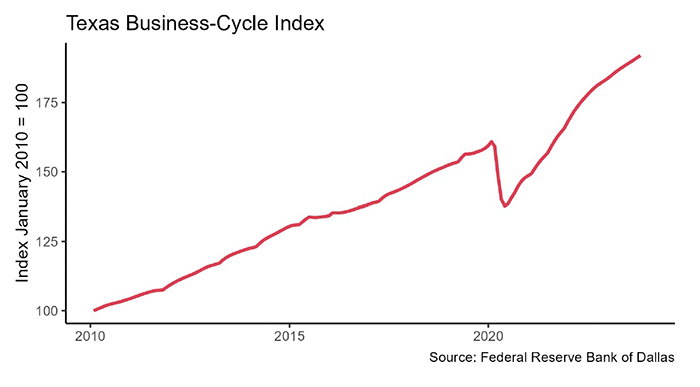
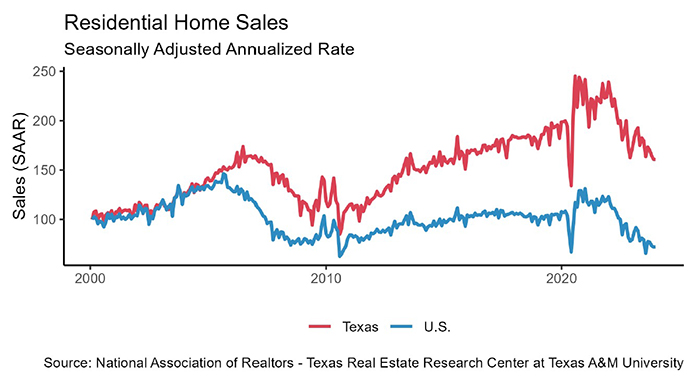
Economic uncertainty continues to creep into the Texas economy due to the Federal Reserve's commitment to combat high inflation. Despite robust employment growth the unemployment rate increased to 4 percent. Housing sales are trending upward but are below pre-pandemic sales levels for this time of year. Trade levels have stalled since the second half of 2022.
Housing Market Follows Seasonal Upward Trend
Housing demand started the new year with an upward trend as sales volume expanded for two consecutive months. Total home sales had a strong month-over-month (MOM) boost of 7.8 percent, doubling last month's 3.7 percent growth. Sales gained more than 2,000 transactions in a month, moving upward to a seasonally adjusted rate of 29,728 closings. Austin and Houston, the two metros that had their great rebound in January, stayed flat this month (Table 1). Meanwhile, Dallas and San Antonio spiked. Dallas' 17.1 percent growth brought more than 1,200 additional homes under contract in February.
Texas homeowners' financials are in good standing. Texas' fourth-quarter foreclosure rate inched up from 0.3 to 0.5 percent in the past year. However, this change was not robust considering the five-year average of 0.5 percent. Additionally, the number of all mortgages past due was down 13 percent to 145,800 in a year.
International Migration Returns to Texas
Texas welcomed a big wave of workers last year, including its largest number of international migrants of the past five years. One out of every ten net immigrants chose to reside in Texas. The Lone Star State welcomed 118,614 net international immigrants, a historical high in 2022. These immigrants plus domestic migrants added a net 349,575 residents to Texas' population.
Unemployment Grows Despite Robust Employment
February marked the fastest growing month in the Texas labor force levels since the start of the pandemic, resulting in the labor force participation rate expanding to 63.7 percent. Despite Texas employment growing by 110,300, the sudden boost in labor force engagement resulted in the unemployment rate rising to 4 percent.
Leisure and hospitality was among the strongest performers for February, adding 10,900 new employees. The goods-producing sector had nominal gains of 3,200 new jobs. Construction had strong numbers as well with 7,000 new payroll employees and an increase in average hourly construction earnings to $31.71 per hour compared with $28.37 per hour three years ago.
Texas' major metros experienced employment growth across the board, though with a large spread between them. Houston and DFW had the largest payroll increases (29,200 and 18,500, respectively). Austin has had a faster growing employment index than all other metros since the pandemic. In February, it gained only 2,500 employees, increasing by much less than the rest of the state. San Antonio's employment levels is the smallest of the four major metros, gaining 10,500 new employees for the month.
Service-Providing Sectors Waned as Uncertainty Swells
General business activity in the service sector continued to grow according to the February Dallas Fed's Service Sector Outlook Survey. Revenue inched up while overall employment fell. Outlook uncertainty dipped seven points for February as broader business perceptions followed suit. Future general business activity remained unchanged in negative territory. Consequentially, the future revenue index remained high in positive territory. Mixed feelings about the future of the sector reflect the public's general uncertainty about the economy.
Retail sales fell at a faster pace in February than in recent months, correlating with an increase in inventories as products lingered on store shelves. The Dallas Fed's Retail Outlook Survey remains in negative territory as conditions worsened in February. Employment increased along with shorter workweeks, indicating a rise in part-time employment in the industry. The future business activity index was unchanged in negative territory for the month, while capital expenditure and employment indexes were in stark contrast remaining positive. This paints a conflicting outlook for retail in the coming year, with much of it riding on the economy's performance and inflation.
Global Trade Shuttered as Inflation Persists
The Texas trade-weighted value of the dollar index1 had a strong year in 2022, gaining 5.7 percent because of the inflation fight and international investors' perception of U.S. economic stability. Amid the strong dollar value, foreign traders must pay more in their local currency for the same Texas exports. The result has been decreasing order values since the second half of last year. Texas' all-commodity exports, which make up one-fifth of the national share, dropped close to 10 percent quarter over quarter (QOQ).
Demand for the top three manufacturing exports — petroleum/coal products (24.3 percent), chemicals (19.5 percent), and computer/electronic products (19.1 percent) dwindled. Despite a 45 percent year-over-year (YOY) expansion in 2022, demand for Texas' crude oil exports shrank 7.6 percent QOQ.
Other Economic Indicators
- The Texas Leading Economic Index was balanced at 104 for five months (2007=100).
- Texas consumers reported being 4.6 percent more confident about the economy than average U.S. consumers.
- The Consumer Price Index continues to moderate, decelerating for the eighth month in a row to 6 percent in February. Rising grocery bills remained a concern for shoppers; meanwhile, transportation inflation settled.
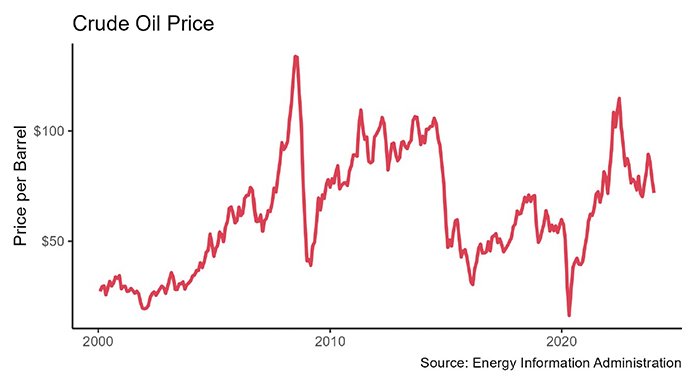
- Corroborating with the lowered energy bills, the West Texas Intermediate (WTI) crude oil spot price dropped 16.2 percent YOY to $76.80, and the Henry Hub spot price plummeted 49.3 percent YOY to $2.38 per million British thermal units in December, marking the lowest price in the past two years.
- Texas' crude oil production inched up to 5.2 million barrels per day in January as active rig count climbed to 379, seven rigs higher than last month.
- The falling ten-year U.S. Treasury bond yield at 3.8 percent suggested investors prefer lower-risk, lower-reward investment.
- The Federal Home Loan Mortgage Corporation's 30-year fixed-rate in February was mostly unchanged from the previous month's 6.3 percent.
____________________
1 The release of active rigs and crude oil production typically lag the Outlook for the Texas Economy by two months.

To access the complete report with all figures, click the download button.
To see the previous month's report, click here. For the report from a year ago, click here.
Previous reports available with data from:
2023: January
2022: January, February, March, April, May, June, July, August, September, October, November, December
2021: January, February, March, April, May, June, July, August, September, October, November, December