Austin's Rainey Street Historic District
Courtesy of Robin Soslow, Special to MySA
MySA
Chris O'Connell
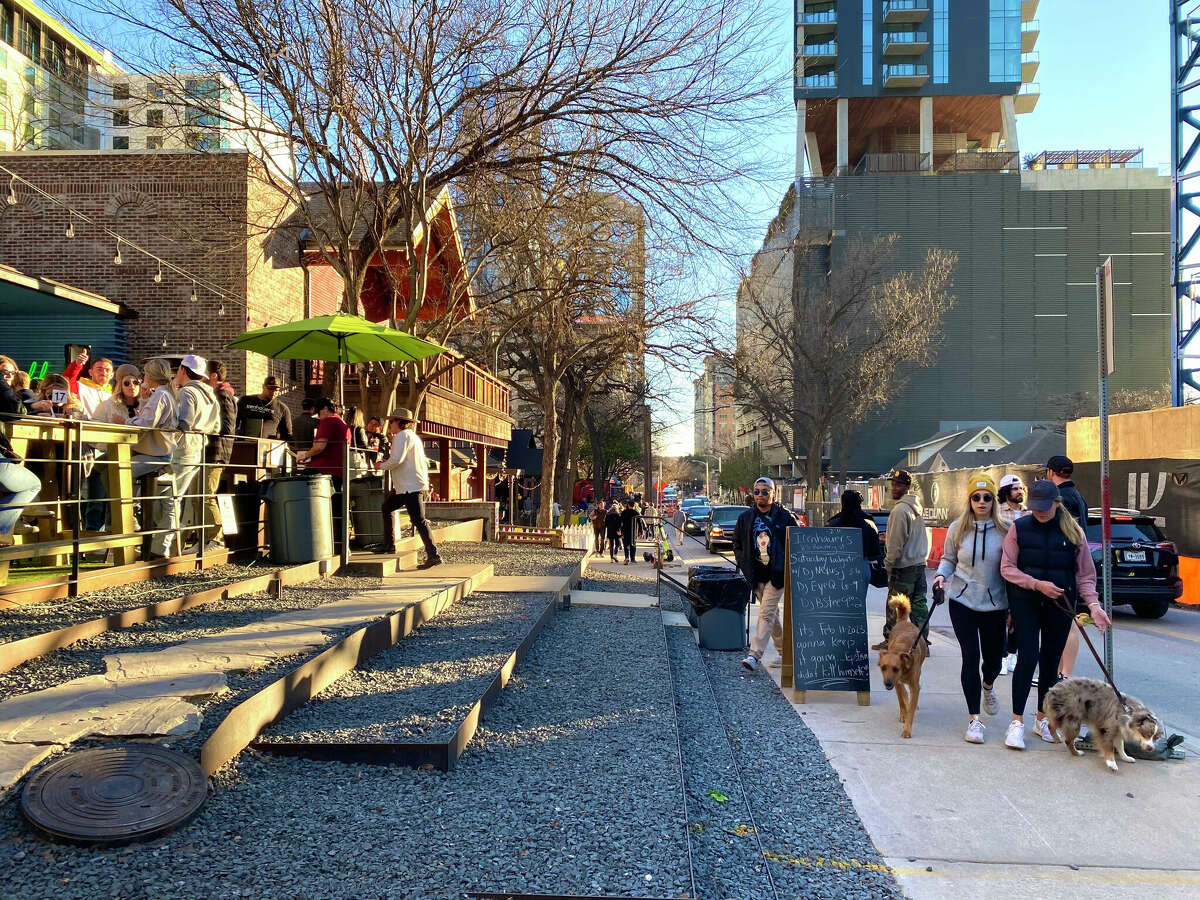
On a recent Friday, the forecast calls for heavy rain. But instead of cowering inside and waiting for the downpour, Rainey Street is packed front to back with lunchtime diners and day drinkers.
At Little Brother, a microscopic bar on the street that attracts industry types, punks, and bachelorette parties alike, it's no exception. Patrons down shots of whiskey at the bar and unwrap burritos out on the patio. Unless you had been trawling Facebook or Austin-centric subreddits, you wouldn't know that there was a supposed serial killer stalking young people and tossing them in Lady Bird Lake.
"It's way more of a deal for people on the internet," says Little Brother bartender Johnny Laporte.
Some rumors on the internet, crescendoing as they are right now, aren't enough to halt the flow of capital and Lone Star beer in a bustling downtown metropolis. Nor has it stopped bartenders and other restaurant industry staff from coming to work.
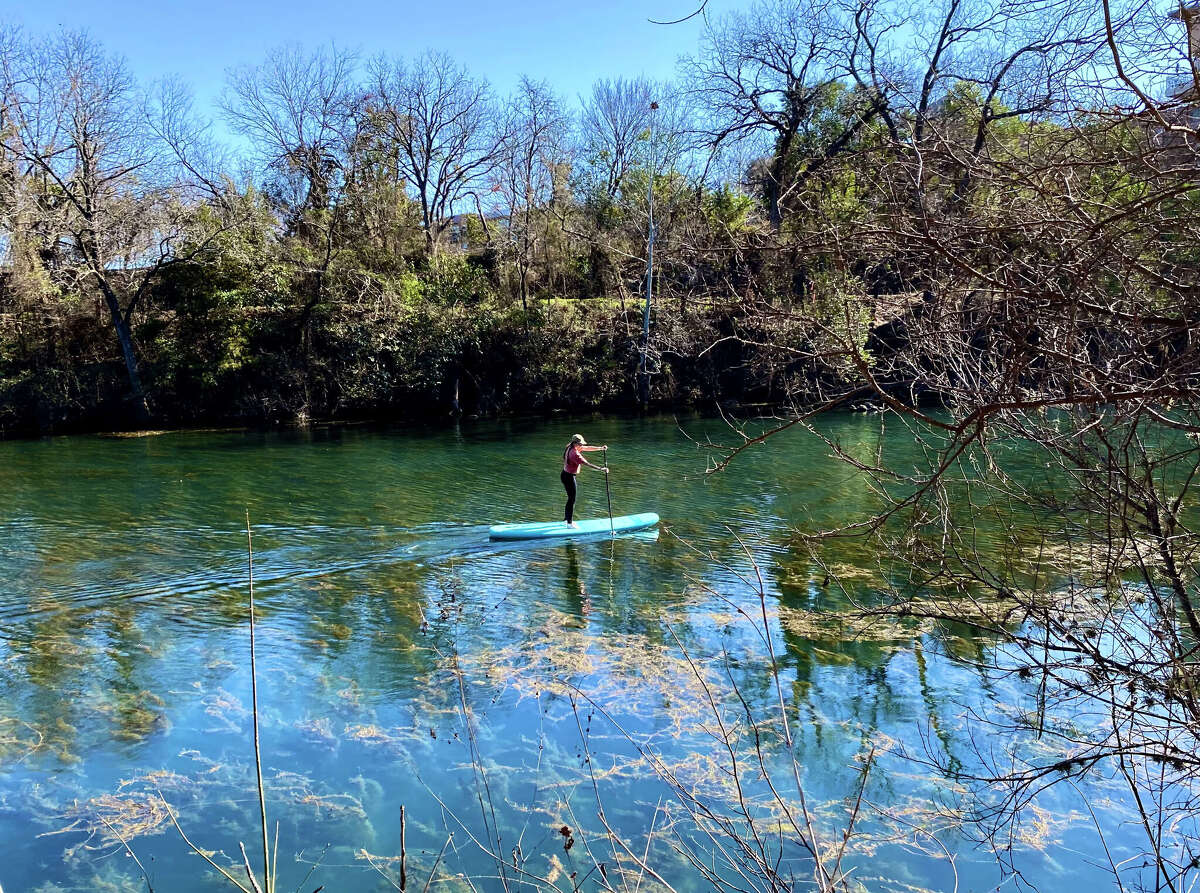
One might not find blame with them if they did. In less than a year, eight bodies have been pulled from Lady Bird Lake: John Christopher Hays-Clark, Jonathan Honey, Clifton Axtell, and Jason John were found this year. Four people, including three unidentified victims and a man named Josue Moreno were all from December.
If one were to believe the diatribes posted on Reddit and Facebook, the deaths are absolutely connected, either the work of one person — a disgruntled bartender, a rich West Austin doctor, the theories abound — or as part of a crime ring, perhaps the work of the Smiley Face Killers.
There's only one issue for those who don't believe: the loudest — and the majority — of voices comes from concerned citizens with no investigative background. (At least one of the victims' family members does not believe in the autopsy's finding of accidental drowning. "We definitely don't agree with that," Jason John's mother Elsie told Fox 7, while also noting the similarities in age between her son and Jonathan Honey, the time they disappeared, and Rainey Street as a location.)
But Austin Police have said there is no evidence to support the serial killer theory, furthermore that there is no evidence of foul play. Journalists don't see the there there. Bartenders in the district do not lend it much credence. Bar and restaurant patrons are making their feelings known with their wallets, as Rainey Street and the surrounding downtown areas are as busy as ever.
So why is the narrative persisting?
Lady Bird Lake
Courtesy of Robin Soslow, Special to MySA
Critical Theory
A few months ago, even before Honey and Hayes-Clark were found dead, a group popped up on Facebook called Lady Bird Lake Serial Killer/ Rainey St Killer. It has been a major driver in discourse connecting the deaths in and around Lady Bird Lake, with cases stretching back to 2008.
There are long threads about theories, motives, and paeans to independent journalism not marred by lazy, mainstream writers just taking the police and the medical examiners at their words. It's incredibly active, with membership growing daily.
Here's where the disconnect really manifests. On a soon-to-be drenched Rainey Street, nobody is murmuring about getting home lest someone hop out from behind the bushes and snatch them.
Laporte says that occasionally he hears about the alleged serial killer from time to time, but that most of the conversation about it on Rainey Street is done in a joking manner, as if it weren't true. Perhaps it's because people are nervous about the possibility being real. Maybe it's gallows humor. Laporte has a third idea.
"I think that nobody necessarily has proper information to know what is actually happening," he says, never ruling out that there is a serial killer, but warning that some online are stoking fears based on conjecture. "You're talking about a bunch of people who have watched too much CSI, a bunch of people who just need some new tea. But is it concerning? For sure. Multiple people dying is obviously a concern."
Laporte is a pragmatic on the matter. He says that if there is a serial killer, or even merely people targeting partiers in the district, everyone should be aware of their surroundings. If they're drinking all day, they should probably not be alone, with a dead phone, thinking the world is their playground. Everyone's head should be on a swivel regardless.
"Texas is a beautiful place, but we still live in a very f***ed up world," he says.
Maybe people are getting hammered and falling into the lake in the middle of the night. Maybe it's something even more nefarious. For many on the ground on Rainey Street, the outcome is dire enough regardless of the mode.
Getting it Right
On April 3, two days after Honey was was found in Lady Bird Lake near Rainey Street, APD released a statement about the serial killer rumors. It reads, in part, that "investigators approach every case with an open mind," but that "there is no evidence in any of these cases to support allegations of foul play."
This only inflamed online investigators, chiefly among them, the Facebook group dedicated to finding the alleged serial killer. The morning the statement dropped, membership in the private group nearly doubled to 41,000 people. Five weeks later, it has more than 87,000 members.
Robert Quigley, a UT journalism professor and former editor for the Austin American-Statesman, explains the bump after APD dropped its statement.
"There's an undercurrent here, in this excitement, of distrust for of institutions," he says. "The institutions being the government, the media, the police. All of those institutions deserve some level of mistrust for past misdeeds, of course, but there's a distrust, right, I believe it's so high that anything said even evidence to the contrary of their beliefs is a conspiracy."
For this to be a serial killer, one has to believe that either the police have bungled multiple investigations or is suppressed information on multiple investigations, or that APD is acting in concert with the Travis County Medical Examiner, responsible for performing autopsies in the city, to cover up the real crime.
One thing is for sure: the people who believe that a serial killer or a gang is stalking young men and killing them and dumping them in the lake really want it to be true. And any notion to the contrary, like the APD statement or a recent Texas Monthly story with the headline "Reality Check: There’s Almost Certainly No Serial Killer in Austin," invokes anger, resentment over "mainstream media" coverage (or lack thereof), and the feeling that an injustice is being done to victims and their families.
The group went apoplectic when Peter Holley's story on the magazine's website went live. Much of the criticism focused on the lack of representation in the story, in members of the group (they claim to have been interviewed but not quoted) and among the victims' families. Perhaps that color was in an initial draft of the story; I don't have access to the Texas Monthly CMS.
But the criticism aimed at Texas Monthly from those who believe in a serial killer on Rainey Street only serves to reinforce why the media — and the police, to an extent — is largely frustrated with the narrative. The loudest voices (including that of University of Texas softball star turned influencer Lauren Burke) are the ones who are convinced, based not on hard evidence but on conjecture, that the deaths are connected. They want justice for victims where perhaps none exists, which elicits a feeling of hopelessness.
Quigley points to a culture obsessed with true crime as a form of entertainment: podcasts, Netflix series, cold case board games.
He mentions a video posted in the Facebook group that a woman recorded featuring a "white truck with smiley face on the back" with "3 latin guys in the truck." The video is posted with the license plate unblurred and a declaration that "as soon i saw the smiley... i realized its related to the potential serial killers or some kind of gang."
"I think we overestimate our abilities to solve things," he says. "People pursuing truth is not necessarily a bad thing, it's just a matter of being careful not to hurt somebody along the way: pointing to somebody as a suspect, or instilling fear in the community where it's unwarranted. I think both things are happening in this Facebook group."
Quigley doesn't necessarily believe that everyone in the various groups are nefarious in nature, but are perhaps misguided. He recognizes that many advocating at this moment seem genuinely concerned about violent crime in Austin and justice for the victims.
He says that for all he knows, a serial killer could be on the loose in Austin. A similar case, the Chicago Strangler, popped up around 2018, after activists convinced CPD to investigate the murders of dozens of Black female sex workers dating back to 2001. In that instance, those without a background in criminal investigations — though aided eventually by the nonprofit Murder Accountability Project — had a material effect on what they believed to be connected killings. But one key difference in those cases is that each were initially classified as murders, just unrelated.
"I just want good evidence," Quigley says. "Until I see something like that I don't have a reason to just assume that everybody's lying to us."
Toward the end of his career at the Austin American-Statesman, Quigley worked in breaking news. He's familiar with the churn of the news cycle, particularly when it's something as salacious as a potential serial killer. He uses an adage with his students that rings true, particularly now, when information (and misinformation) proliferates at unforeseen levels.
"There's far more value in being right," he says, "than being fast."