Future of legalized gambling unclear; measure had local support
Published: Sun, 05/14/23
Future of legalized gambling unclear; measure had local support
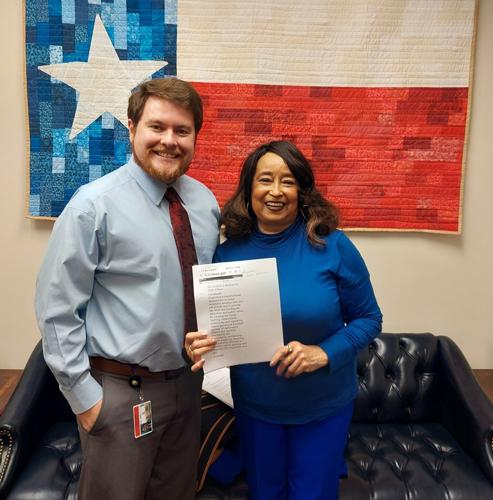
Killeen resident Rachel Brent went to the State Capitol recently to speak to the office of Sen. Pete Flores (not pictured) about gaining his support for proposed legislation that would legalize gambling and casinos in Texas. In this photo, she poses with one of his staff members.
Killeen Daily Herald
By Thaddeus Imerman | Herald staff writer
May 14, 2023
Though it is unclear how state efforts to legalize casinos and sports gambling will play out, there is support for it from the Killeen area.
Texas lawmakers rolled the dice this legislative session with efforts to legalize casino gambling and destination resorts in the state.
Republican Reps. Hugh Shine and Brad Buckley — Bell County’s two state lawmakers — voted in favor of House Joint Resolution 155, which would have put the measure on November’s ballot. Needing a supermajority of 100 to move it to the Senate, the resolution failed to garner enough support and has been postponed for consideration.
Rep. Charlie Geren, R-Fort Worth, who authored House Joint Resolution 155, decided to postpone consideration of the potential constitutional amendment until 2027, according to the Texas Tribune.
Shine said in a phone interview with the Herald last week that joint resolutions merely get the item on the ballot, but each resolution needs enacting legislation to pass.
Though he voted in favor of the failed resolution, Shine voted against House Bill 2843, which was House Joint Resolution 155’s enabling legislation. Buckley, however, voted in favor of both.
House Bill 2843, needing a simple majority, received more favorable votes, but shortly after going to the Senate, its future appears bleak.
John Kuempel, R-Seguin, also postponed consideration of his related bill, House Bill 2843, until November.
A Killeen resident who follows state legislative decisions closely, Rachel Brent, also showed her support for the bill and spoke with Buckley about it at an NAACP event and also spoke with Sen. Pete Flores’ office at a recent trip to the Capitol.
Brent said she thinks casino gambling should be legalized because of the potential revenue.
“They could be using it,” Brent said last week.
Brent said the state also allows game rooms.
Casino gambling is only legal in Texas at a few casinos owned by Native American tribes, according to a report by Texas Standard in 2021.
According to The Texan, a “loophole” in the state’s law is what allows the game rooms with slot machine-style games to operate.
“That’s what everyone’s saying,” Brent, a member of the Bell County Coalition of Black Democrats, said. “They’re allowing the game rooms, why don’t they do the gambling?”
Game rooms in Texas have limits to how much they can pay out.
Gaming machines that allow non-cash prizes of less than $5 — referred to as the “fuzzy animal” exception — are considered an exception to state law, according to The Texan. City and county governments can also offer game room permits by ordinance, The Texan reported.
“They have a lot of little spots around here where you can play the slot machines,” Brent said.
She also mentioned bingo, which is allowed.
“People are gambling in the state anyway — whether legally or illegally,” she said. “What is bingo? That’s a form of gambling, which is very popular in Texas.”
When she does have the itch to leave the state, Brent said her favorite casino of choice is the WinStar World Casino and Resort, a gaming facility run by the Chickasaw Nation in Thackerville, Oklahoma, just north of the border of Texas.
Revenue
In fiscal year 2022, the Oklahoma state government received over $191 million in revenue from the gaming industry through an agreement set up with the indigenous tribes in the state. Total revenue from all table games in the state was nearly $3.2 billion, according to a fact sheet distributed by the state.
The state-tribal compact in Oklahoma dictates that for the first $10 million in revenue, tribes pay 4% to the state; for the next $10 million, the payment is 5%; and for revenues more than $20 million, the payment is 6%. Tribes pay 10% of the monthly net win from table games.
Money that the state of Oklahoma receives goes to three different funds: the Education Reform Revolving Fund, the General Revenue Fund and the Department of Mental Health and Substance Abuse Services.
Texas Standard also reported that the Choctaw Casino in Durant, Oklahoma, has a customer base that is approximately 80% Texan — about two-thirds of whom are from the Dallas-Fort Worth area.
In 2019, the Dallas Morning News reported that the state is leaving a lot of money on the table by not legalizing casino gambling in the state.
In that 2019 report, the Dallas newspaper said Texans spend approximately $2.5 billion annually at out-of-state casinos — and it’s not just Oklahoma. Casino gambling is also legal in the other three bordering states of Louisiana, Arkansas and New Mexico.
Sports betting
The state hasn’t struck out on all gambling measures, however, as a prospective resolution and its enacting legislation passed the Texas House last week that would allow for sports gambling.
In a razor-thin margin that required the House to verify the vote by member, the resolution received 101 votes. Buckley and Shine were also among the 101 in favor of it.
Brent said she is not in favor of sports gambling on its own.
“I would not be satisfied with that,” Brent said. “That’s not my forte. I go to the casinos to gamble. I don’t participate in the horse-racing and all that stuff.”
In its 2018 decision in Murphy v. National Collegiate Athletic Association, the U.S. Supreme Court struck down a federal law that prohibited states from legalizing sports betting, according to the House analysis of the resolution.
Since then, more than 30 states — as well as Washington, D.C., and Puerto Rico — have legalized sports wagering.