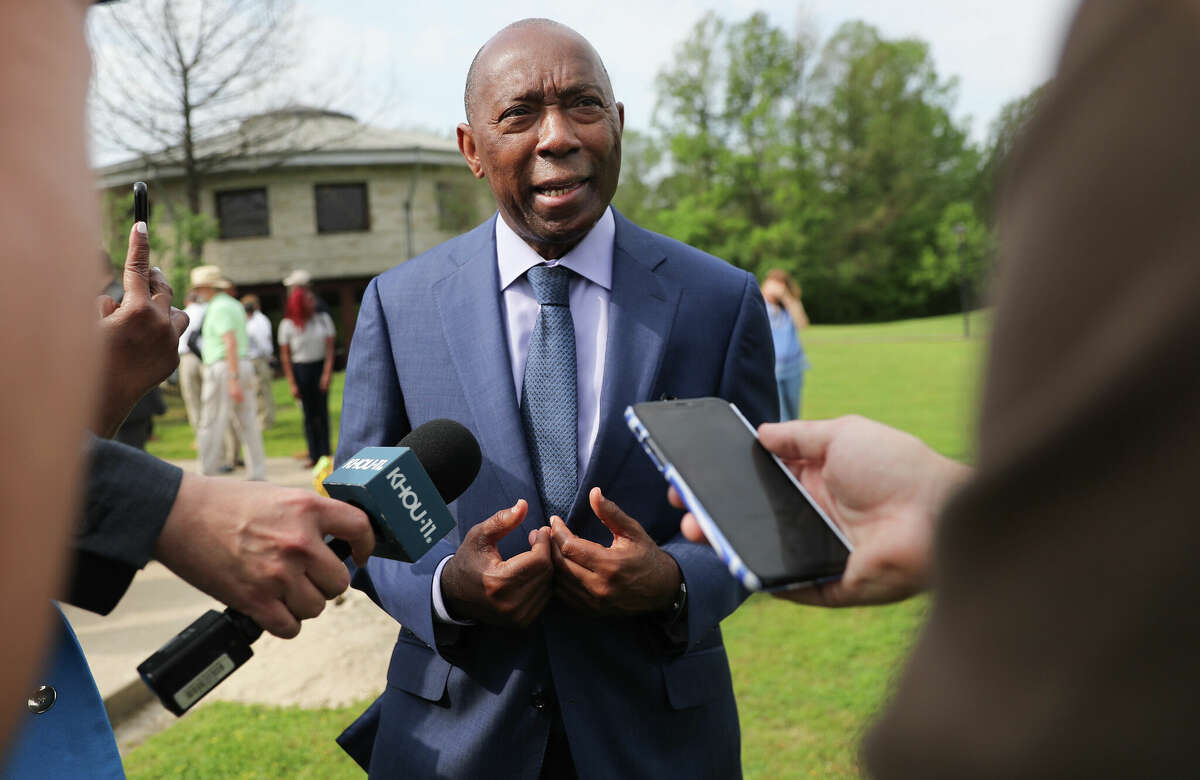
Mayor Sylvester Turner talks to news reporters in March. Turner is expected to unveil his final budget this week, a $6.2 billion plan that he says saves enough money to cover his successor's first deficit next year.
Elizabeth Conley/Staff photographer
Houston Chronicle
Dylan McGuinness, Staff writer
Mayor Sylvester Turner will unveil a $6.2 billion budget proposal this week, the final spending plan of his tenure and one he predicts will have enough savings to cover his successor’s first budget gap.
The budget plan includes previously announced pay raises for all city workers, continues the mayor’s plans to address crime and illegal dumping, and adds another $11.3 million toward the city’s backlog of deferred maintenance. It also includes a stark increase in tax dollars for "Build Houston Forward," the city's streets and drainage program, jumping from $77 million this year to $123 million next fiscal year.
Perhaps most notably, though, it would sock away $401 million in savings, $220 million above the required reserve of 7.5 percent of the general fund's expenditures. That, essentially, matches the latest estimate for what the city will have saved at the end of this fiscal year, and it marks the largest reserve in decades at City Hall.
“This represents the strongest fund balance in recent history for a proposed budget,” Turner wrote in his message accompanying the budget. “Additionally, the budget fully funds the Budget Stabilization Fund representing more than $20 million and does not include any deferrals, one-time land sales, or fund balance drawdown.”
Turner is set to outline the budget at a news conference at noon Tuesday. His office declined requests for comment, and Finance Director Will Jones said he would not comment until after the news conference.
City Council will begin budget hearings Wednesday, which will continue for the next two weeks to hear from each of the city's departments on their budget requests and desired outcomes for the year.
Houston typically operates at a structural deficit with expenses growing faster than revenues, and it must close annual budget gaps with stop-gap measures. As in the last three years, this year’s spending plan would rely heavily on federal COVID-19 relief money to avoid that fate.
The Fiscal 2024 budget, which would take effect July 1, would use $160 million in funds from the American Rescue Plan Act. The city received more than $1 billion in aid from the federal government during the last three years, money that has helped it avoid “significant” service cuts and layoffs, Turner wrote.
The city’s financial outlook likely will be a hot topic during this year’s mayoral race. Previous forecasts have called for deficits of between $114 million and $268 million during the next mayor’s first term, as the city weans itself off federal assistance. The city has spent $344 million of the $607 million it received from the American Rescue Plan Act, as of March 31.
That would leave the city with roughly $263 million left before the adoption of this year's budget, and about $103 million if the fiscal 2024 budget is adopted as drafted. Cities must obligate the relief money by the end of 2024 and spend it by the end of 2026.
As part of his message, Turner argued the strong fund balance would give his successor breathing room when crafting next year’s budget.
“As we look ahead, strong financial management will need to continue,” Turner wrote. “The city of Houston operates under one of the country’s most restrictive property revenue caps — in addition to complying with the State of Texas revenue cap, and the pressure of inflation. Despite those challenges, the financial health of the city is much stronger than existed on January 1, 2016. Any gap that may exist in FY2025 can be full covered by the fund balance.”
Turner was referring to Houston's voter-approved revenue cap, which limits yearly growth in property tax receipts to a combination of population and inflation growth or 4.5 percent, whichever is lower. The city has cut its tax rate eight of the last nine years to comply with that restriction, foregoing about $1.5 billion in revenue since Fiscal Year 2015 through last year. In that time, it has saved the median homeowner roughly $946.
The city’s budget generally is divided into two categories: the general fund, supported mostly by taxes and funding many core services, such as police, fire and garbage collection; and enterprise funds, which get their money from dedicated revenue sources and operate in silos, such as Public Works, which gets much of its money from water bills; and the Airport System, which uses airline fees.
The $3.3 billion general fund — which includes $2.9 billion in spending and the $401 million in reserves — represents a 7.7 percent increase from last year, mostly funding public safety. The police, at $1 billion, and fire, at $593 million, departments make up just under half the operating budget, or 68 percent if debt payments are not included. They are set to receive five and four cadet classes, respectively, to boost their ranks this year. It marks the first time the Houston Police Department's operating budget will exceed $1 billion.
Firefighters will see another 6 percent pay hike, the third and final installment of a three-year, 18-percent increase. Turner, who has been locked in a contract dispute with the fire union since taking office, circumvented the bargaining process to award those raises. Police officers and municipal workers will see 3 percent pay hikes.
The Health Department is the only department to see a significant decrease in general fund spending, with its budget reduced from $66 million to $56 million. It is unclear whether it will recoup that money elsewhere; the departments give detailed accounts for budget changes during their hearings.
Much of the budget's annual increase stems from Public Works, which is expected to see a 21.8 percent hike in water and sewer revenue. The budget will swell from $1.5 billion last year to $1.8 billion this year. City Council last year passed the largest increases in decades to the city's water and sewer rates, money the Turner administration said was necessary to comply with a $2 billion agreement with the Environmental Protection Agency to limit sewer overflows.
The mayor's budget proposal also is the first to use outcome-based budgeting, a strategy meant to tie costs to desired outcomes or results. As part of that effort, the city conducted a survey of 2,500 residents, seeking their priorities. Public safety, at 38 percent, and services and infrastructure, at 32 percent, were the most common responses.
Council is expected to vote on the budget in June.
dylan.mcguinness@houstonchronicle.com