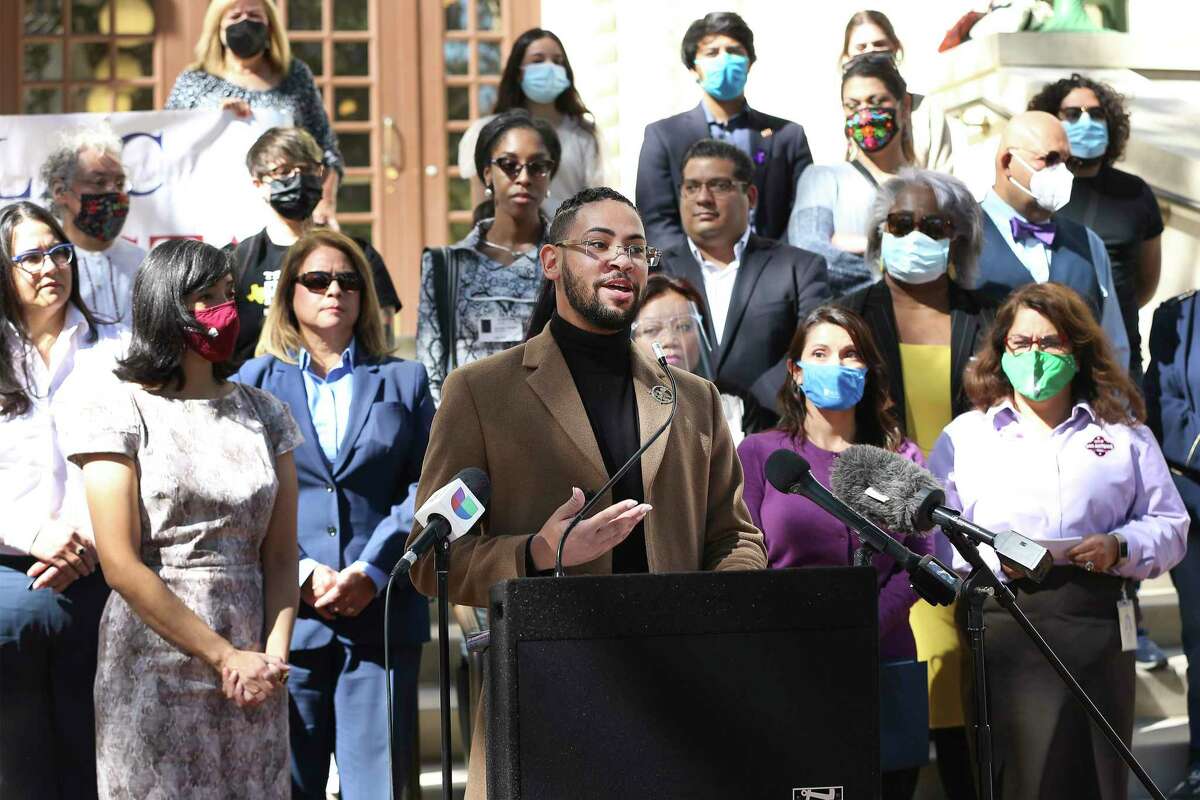
District 2 Councilman Jalen McKee-Rodriguez (center) leads a press conference outside City Hall to talk about filing a request for the council to consider an expansion of San Antonio's non-discrimination ordinance on Oct. 28, 2021.
Kin Man Hui /Staff photographer
San Antonio Express-News
Molly Smith, Staff writer
As his first term comes to a close, Councilman Jalen McKee-Rodriguez’s goal of expanding the city’s nondiscrimination laws to private businesses may still be far from reality.
“The next step in protecting San Antonio residents from discrimination is to expand and improve the current NDO,” reads the proposal he filed in October 2021.
Any discussion of such an expansion was noticeably absent Wednesday when Department of Diversity, Equity, Inclusion and Accessibility staff briefed a council committee on suggested revisions to the ordinance. Those rules have not been updated since 2013 when City Council expanded protections to cover sexual orientation, gender identity and veteran status.
McKee-Rodriguez said after the committee meeting he still believes that the proposed changes would be an improvement. He pointed to the staff’s recommendation that the city reviews the nondiscrimination ordinance every five years.
“We’re not going to have to wait for someone like me” to push for updates, said McKee-Rodriguez, the city’s first openly gay council member.
“I’m excited for what I heard today,” he continued. “Even if I don’t get everything that I want out of it, we’re moving in a very positive direction, and maybe five years from now we do get what I want.”
He noted that would still be more than what existed in 2021 when he took office.
He skirted questions as to whether he would still push for the nondiscrimination ordinance to extend to businesses with 15 or more employees.
“I think that conversation will take place over the course of the next few months,” McKee-Rodriguez said when pressed, conceding, “It’s still my intention.”
Looming over council is the ongoing Texas legislative session where Republican lawmakers may try to limit the control that cities — particularly blue ones like San Antonio — have when regulating businesses.
“I’m trying to conceal all of my joy and excitement because, while we’re sitting here, the legislative session is going on, and there’s still a level of political calculus that we have to maintain,” McKee-Rodriguez told his colleagues.
Another likely consideration is the impending May 6 election when all 10 council members and the mayor are up for a vote. All face at least one challenger — some more than others. McKee-Rodriguez will have to fend off nine opponents for the East Side seat, the most of any district.
Expanding the ordinance to private employers could anger the city’s deep-pocketed business community.
“I think they would probably not react well to any ordinance that would attempt to do something that is preempted by state and federal law,” District 8 Councilman Manny Peláez, an employment attorney, said Thursday.
“The proper place to change laws regarding discrimination and EEO (Equal Employment Opportunity) rules is at the state and federal level,” he said, adding, “I don’t have any reason to believe that the city staff and the city attorney are going to include that in the final package of changes” presented to council.
Peláez is not on the committee discussing potential changes to the ordinance.
None of the five council members in attendance Wednesday — McKee-Rodriguez, Adriana Rocha Garcia, Phyllis Viagran, Teri Castillo and Rosie Castro — brought up whether the city would extend the ordinance to the private sector in their questions following the staff presentation. Instead, they largely focused on the makeup of the proposed Human Rights Commission and the types of legal support the city could provide to complainants.
Currently, the nondiscrimination ordinance covers city officials, employees, commission and board appointees, city contractors, housing and “public accommodation” — businesses open to the public that sell a product, service or facility, such as a restaurant or movie theater. It protects people from being discriminated against based on their race, color, religion, national origin, sex, sexual orientation, gender identity, age, disability or veteran status.
Staff recommends redefining some of these terms and adding definitions of gender expression and religious entity to ensure “we’re using more inclusive language,” said city Civil Rights Manager Samantha Smith.
Another proposed change would make it explicit that hairstyles and hair texture fall under race discrimination. That’s part of another proposal McKee-Rodriguez filed earlier this month.
Smith said after the meeting that staff doesn’t plan to expand the revised nondiscrimination ordinance to private businesses unless directed to do so by the council committee.
“We’ll wait for council to tell us what to do,” she said.
The ordinance will return to the committee in May for further discussion. Between now and then, city staff will meet with the community for feedback on the proposed revisions and updates.
Once the committee OKs the revised draft, the updated ordinance would then go to the full council for final approval.
molly.smith@express-news.net