Wildfire season looms in Parker, Palo Pinto counties; Forest Service warns heat drying out fuels
Published: Tue, 06/20/23
Wildfire season looms in Parker, Palo Pinto counties; Forest Service warns heat drying out fuels
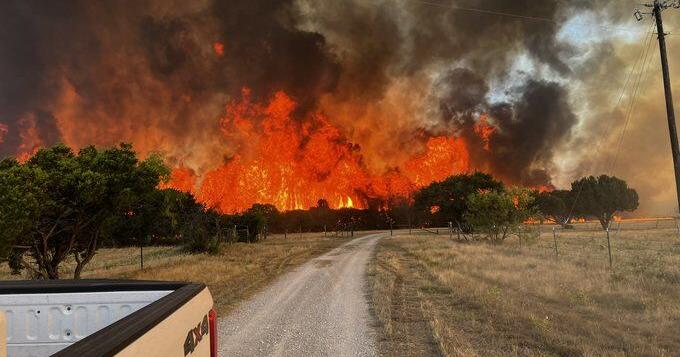
A photo taken of the Dempsey Fire in Palo Pinto County in June of 2022.
Courtesy | Texas A&M Forest Service
Weatherford Democrat
By Glenn Evans gevans@weatherforddemocrat.com
June 19, 2023
Officials in Parker and Palo Pinto counties are urging residents to make their homes unfriendly to fire as the season of scorched ground nears.
Wildfires burned 16,328 acres in Palo Pinto County last year and claimed another 825 acres in Parker County, according to the Texas A&M Forest Service.
No serious injuries were reported in either county, though some firefighters were treated in the field heat exhaustion.
Statewide, 650,712 acres were scorched in 12,411 wildfires.
The Forest Service, which provides crews and equipment that fight alongside local fire departments, warns that triple-digit heat that arrived in North Central Texas last week will combine with other phenomena to ratchet up the fire risk.
“As high pressure establishes over the state, timber litter fuels will begin to dry out,” the service reported in its weekly Texas Fire Potential Update. “And wildfire activity is likely to being to increase slightly by mid-June. (High temperatures will) begin to drive moisture out of both dead and live fuels nearly statewide.”
That backdrop is on the minds of local public safety officials who are bracing for Wildfire Season 2023.
“This is a season where we’re all on high alert,” Parker County Emergency Management Coordinator Sean Hughes said, recalling last year. “It was fairly busy because it was so dry. We’re hoping to not be as dry this year.”
The A&M Forest Service agent stationed in Mineral Wells hopes to enlist every property owner in this year’s firefight. That starts with defending the home well before flames arrive.
“When structures have brush directly against them, these homes have a significant risk of burning,” Adam Turner said.
The regional wildland urban interface coordinator in Mineral Wells singled out junipers near homes as major culprits when homes are lost to wildfire.
“When firefighters see a home with lots of junipers around it, these houses typically require lots of attention to prep them,” Turner said. “And when rapid fire spread is occurring, these homes may be written off.”
Palo Pinto County Emergency Coordinator Ricky Hunter urged residents to visit the Forest Service’s page for fire preparation, at tfsweb.tamu.edu/ProtectYourHome/
There, residents can find directions for creating defensible space.
Those start with clearing overgrown shrubs or other vegetation from growing next to a house. That includes trees too close to the house, known to wildfire fighters as ladder fuels that flames can climb to upper parts of homes.
Recommended plants nearest the house, three to 10 feet, include primrose, violets and columbine because they hold moisture and grow low to the ground.
Palo Pinto County earlier this year signed a 43-page Community Wildfire Protection Plan designed in partnership with the A&M Forest Service.
It can be seen at www.co.palo-pinto.tx.us/page/palopinto.Emergency/
And Hughes said Parker County and the Forest Service are completing the data and hope to sign the county’s own Community Wildfire Protection Plan by September.
“When dealing with Mother Nature, we all know that things can change quickly,” Hunter said. “Planning now can save valuable seconds in an emergency.”
Hughes also noted that residents inside city limits in this part of Texas are not immune from wildfire.
“We call that the wildlife urban interface,” he said. “And we’re so close to these open ranges and vegetation in Parker County, so everybody should be thinking about grass fires and wildfire.
“Water your grass, keep it mowed. Folks can work on building a buffer around your house.”
Plow the perimeters of fields, he added, aand landscape with gravel in the yard.
Hughes said too many wildfires are caused by property owners burning trash without paying close attention.
In the first place, residents in unincorporated areas must check their county website to see if a burn ban is in place. The notice, ban on or off, will be prominent on the front page.
Those local websites are at www.parkercountytx.com (click Facebook link at upper left); and www.co.palo-pinto.tx.us/
Hughes warned that violating a burn ban carries a $500 fine — for each fire.
“If you’re burning five piles on a non-burn day, that’s $500 apiece,” he said. “Just wait.”
And if a burn ban is not in place, Hughes urged residents to pay attention to their trash fires every second.
“Some fires are set by people not attending to their burning,” he said. “Someone has to stay with it at all times. You have to stay with it — ‘I just went in to grab a sandwich.’ We’ve had that happen in Parker County.”
He also reminded that only natural, non-treated wood may be burned outdoors. Burning tires, or letting that neighbor bring his old, dead tree over to burn, are not allowed, Hughes said.
But if the worst does happen, harm is minimized by planning ahead.
“One of the big things we talk about is the five P’s,” Turner said:
• “Pets are often forgotten when rapid evacuations are occurring;
• “The next P is prescriptions, making sure you have a good supply of medications, batteries and medical supplies — typically enough to last 48 hours;
• “Papers, is the third P. This covers legal documents, contracts, identification paperwork and insurance documents;
• “The fourth P is personal items. This is what you and your family need to live off for 48 hours including clothes, food, cash, phone chargers, first aid kits and any important things you need;
• The last P is priceless items. Have a plan for what to do with ... things that would be devastating to lose.”
Turner listed supplies to keep on hand year-round: fire extinguishers, smoke and carbon monoxide detectors with fresh batteries, a go-bag with important documents including ID, important contact information. and keep vehicles fueled and an evacuation route — plus a secondary route — mapped.
Finally, Hughes asked residents to remember the people who protect their property when it is endangered by fire.
“The public can help,” he said. “Take a case of water by your local fire station and just say, ‘I’m thinking of y’all. Here’s a case of water.’ It is always appreciated.”