Killeen: Public comment process debated in city council workshop Tuesday
Published: Fri, 06/23/23
Free speech: Public comment process debated in city council workshop Tuesday
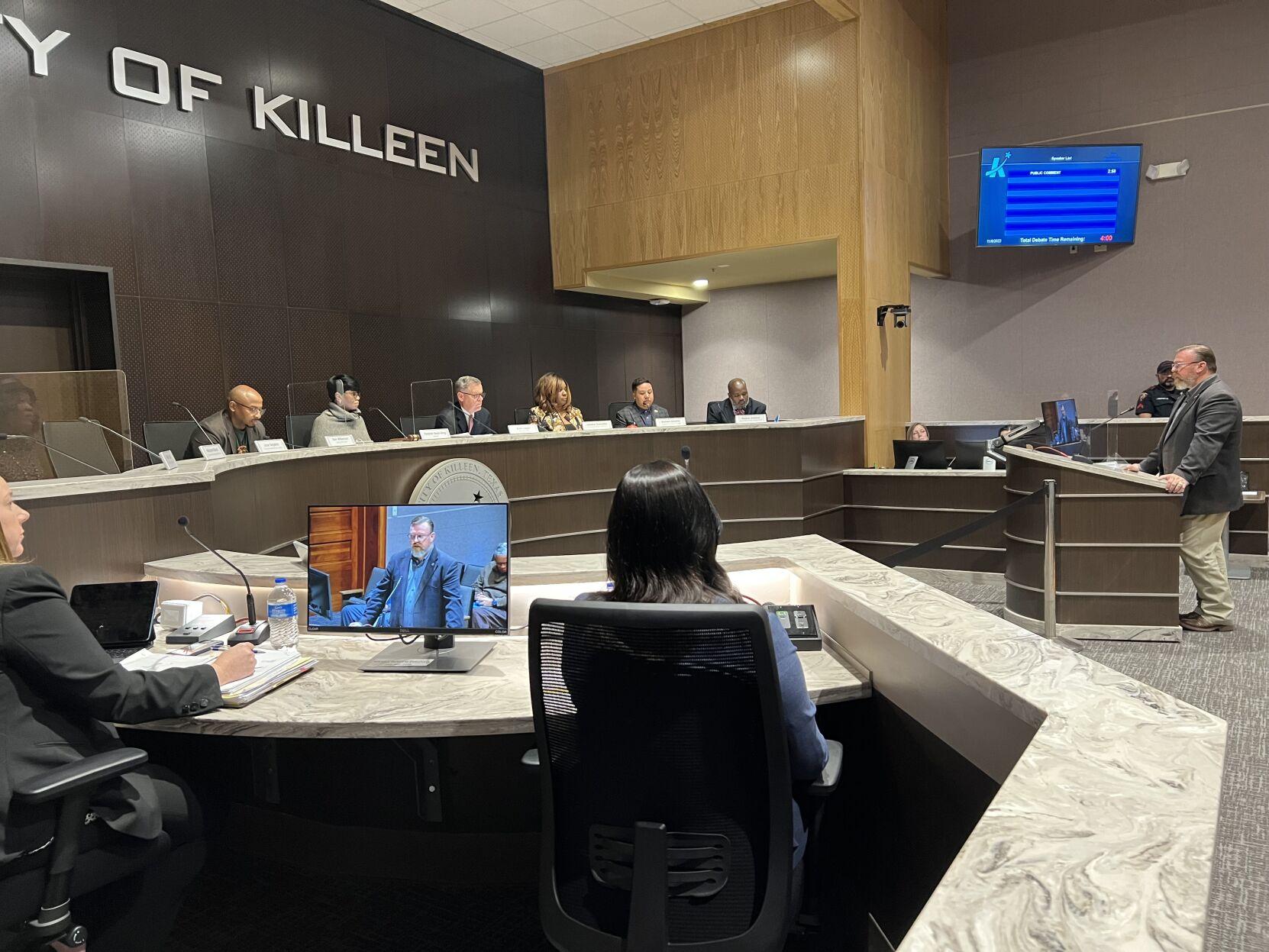
During a public comment period, Bell County Precinct 2 Commissioner Bobby Whitson addresses Killeen City Council members in November about Proposition A, which decriminalized marijuana in Killeen. The Killeen City Council debated this week about changing its policy on public comments during meetings.
File photo | Herald
Killeen Daily Herald
By Jana Lynn Kilcrease | Herald Staff Writer
June 22, 2023
Each year, following an election cycle, Killeen City Council members typically review and make any desired changes to the city’s Governing Standards and Expectations prior to the end of July.
At Tuesday’s council workshop, Councilman Joseph Solomon, who was elected in May, proposed changing the current policy on “citizen comments” which effectively says that citizens may speak for four minutes on any subject that is included on that meeting’s agenda.
“I would like to make a motion of direction to allow citizens to speak on any subject they wanted for a time of three minutes in citizen comments because I believe we should allow citizens to speak on what they want,” Solomon said.
According to state law, cities can choose to limit public comments to only what is on a meeting agenda, which is the current Killeen policy. Other cities, including Harker Heights, allow residents to speak on any topic, whether it’s on the agenda or not.
After Solomon’s proposal, Councilman Jose Segarra reminded council that this method had been tried some time ago.
“It didn’t work out well,” Segarra said.
Currently, if someone wants to speak about something that is not on the agenda, they must first complete a petition to the city secretary prior to 2 p.m. the Wednesday before a scheduled meeting, which are usually held on Tuesdays. An agenda item is created in order to allow council members to discuss the subject. Speakers who complete a petition are given four minutes in which to talk, but council members may agree to allow an additional minute, by majority vote. Following an individual’s presentation, since it is on the agenda, council members may have an open discussion.
City Attorney Holli Clements also commented on Solomon’s proposal.
“You would have to make sure that council would not be deliberating or discussing any item that’s not on the agenda,” she said. “Council would be accountable for governing themselves.”
Mayor Debbie Nash-King asked Solomon to restate his motion of direction and asked for a second. Following a second by Councilman Michael Boyd, the mayor called on councilman Ramon Alvarez.
“I agree with the intent, I think this item needs improvement and clarification,” Alvarez said. “If you have 100 residents that come and want to say something, do we want to be here for 300 minutes? Is there a cap?”
Clements offered some clarification on capping either allotted time or number of speakers.
“Texas state law on open meetings requires the city to allow any citizen to speak on anything on the agenda with no cap,” Clements said. “You would not be able to limit the number of people speaking on what’s on the agenda. You could cap the number of people speaking on other subjects.”
Clements went on to say that in her experience she found most comparable cities have just one citizen comment period and that they open it up to anyone on any subject.
Segarra was concerned about people who might not understand that council members could not speak to their comments.
“I’m not in favor of just opening it up to everybody on everything, because it stinks that we cannot have that discussion,” Segarra said. “I think that the system we have now is better, from my perspective.”
He added: “If it’s something they want, they can reach out to us and we can put it on the agenda for discussion.”
Boyd concurred with Alvarez and Segarra.
“I do think it should be fine-tuned through continued discussion,” Boyd said. “There is an existing system in place; it’s just not favorable.”
Boyd turned to City Manager Kent Cagle and asked him for input.
“In your experience, what have you seen?” Boyd asked.
“We’re the only ones I know of that do a citizen petition period. A citizen comment period,” said Cagle. “I don’t think anybody’s happy about the way it works anywhere. We’re not the only ones who wish there was a better way to do it.”
Councilwoman Jessica Gonzalez questioned the efficiency of a change to the current process.
“If we can’t give a response, what benefit is that to them if there is no response given to them?” Gonzalez said. “I completely believe in a citizen-centered approach.”
She went on to say that, at the request of individuals, council members have scheduled town hall meetings and that those meetings could be where concerns could be addressed.
“I did honor a request to put something on the agenda tonight,” Gonzalez said. “If we can’t respond, what is the purpose of that?”
Solomon added to his comments about changing the policy.
“I don’t think it’s about responding, as much as it is about listening,” Solomon said. “Giving them the opportunity to speak. All the municipalities around us do it. They’ve been doing it for years. I believe it’s a process. It’s about listening to our citizens and what they have to say to us in a council meeting.”
“We said we are fair. If we’re transparent, then we ought to be able to allow them three minutes to speak,” Solomon said. “I don’t think it’s as big a problem as we think it is. Let them share, let them give us feedback on what they think. That’s all I’m saying.”
Following the mayor’s call for a vote, the motion of direction failed by a vote of 4-1 with Solomon being the lone “for” vote. Councilwoman Nina Cobb did not attend the meeting.
The Killeen Governing Standards and Expectations can be viewed at www.killeentexas.gov/DocumentCenter/View/91/Governing-Standards-and-Expectations-PDF.