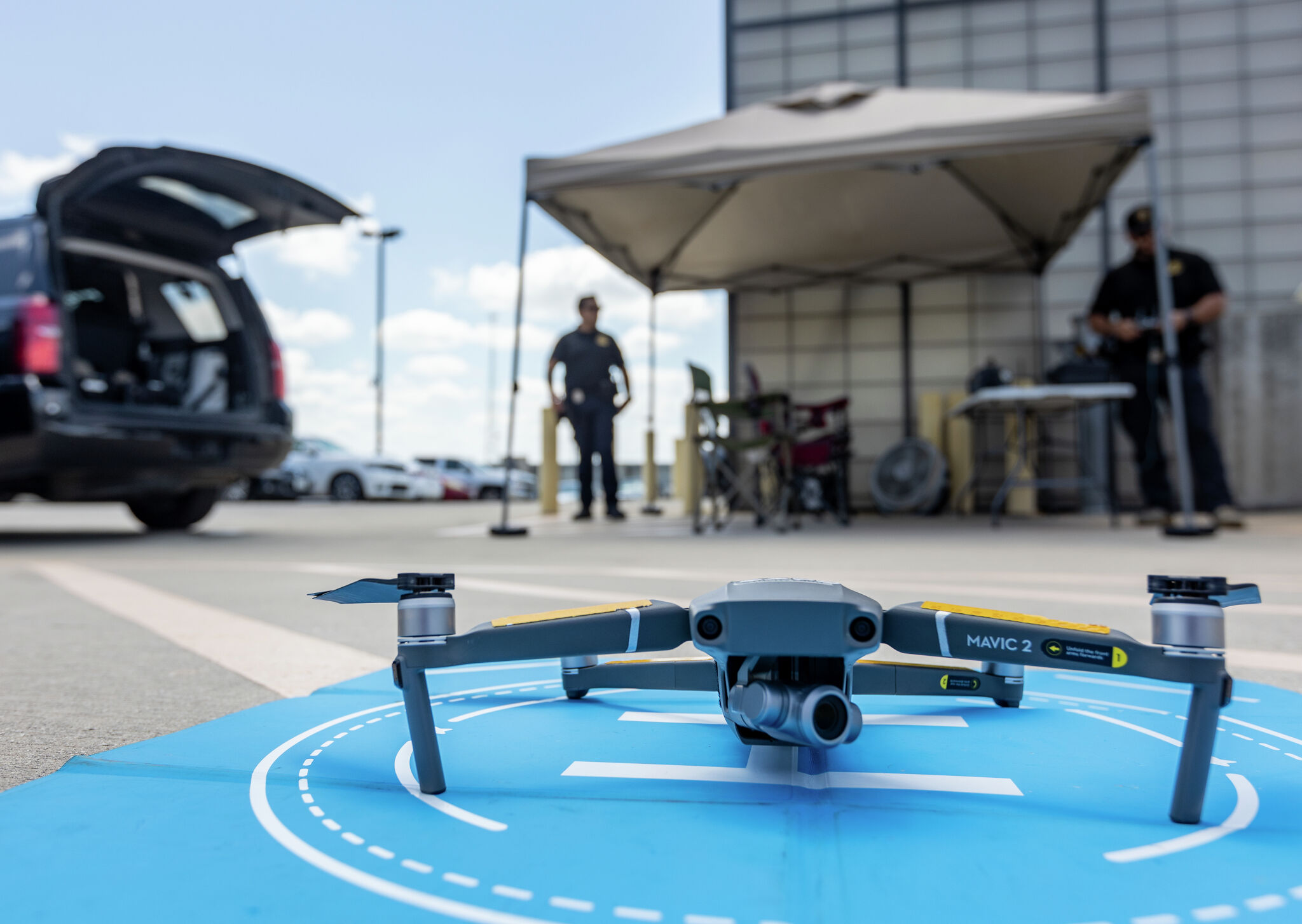
A drone sits at the ready May 31, 2023, on the San Antonio public safety headquarters building parking garage downtown as part of SAPDs expanded drone program called RAVEN.
William Luther/Staff
Eric Killelea, Emilie Eaton, Staff writers
Officer Willie Hooten, a 13-year veteran of the San Antonio Police Department, checks the battery on a 2-pound camera-equipped drone before placing it on a launch pad on a rooftop at the department’s downtown headquarters.
In an intelligence-gathering hub inside the building on South Santa Rosa, helicopter pilot Scott Clark programs the address into the system and presses a button to dispatch the automated drone on a mental health call to the 400 block of North Frio. On the roof, patrol officer Arieh DeLeon monitors the drone’s video feed as it buzzes away. Officer Christian Manck monitors the craft visually as it heads off and canvasses the area several blocks away. It finds nothing suspicious and returns to automatically land on its launch pad.
Such scenes have become common in recent months as the department has begun testing a method of policing called Drone as First Responder — a program based on the premise that an automated drone based on a rooftop can respond to a call for service more quickly than officers on the ground.
It’s the newest part of an existing but little-known unmanned aerial vehicle program intended to provide support to the department’s helicopters and on-ground officers, reduce response times to emergency calls and de-escalate tactical operations. And according to members of the team, the automated drone program is the latest step toward Police Chief William McManus’ goal of using the devices as first responders across San Antonio.
For nearly five years, eight officers in the department’s RAVEN program — short for Robotic Aerial Vehicle Enforcement — have been flying a fleet of a dozen nonweaponized drones on assignments such as monitoring crowds at the Alamodome, recording images of major crashes on U.S. 281 and assisting tactical and SWAT teams by providing views inside homes or other structures in emergency situations.
The team responds to an average of 300 calls a month, records show. During Fiesta celebrations in April alone, officers flew drones for 150 hours.
It’s not yet an official unit within the department, but that could be coming.
Members of RAVEN say they expect that McManus will soon ask City Council to make the drone program official — and for a budget to support it. If approved, it would buy more equipment and hire 20 officers to expand the program to cover the city.
“It’s proven its value over and over,” said Sgt. Daniel Anders, who leads RAVEN. “We’re getting to the point where the demand is exceeding our ability to meet the demand.”
McManus was not available to comment. Department spokesman Sgt. Washington Moscoso said there were “no immediate plans” to present a proposal to council — but that it’s coming.
“The program is still in its infancy,” he said. “While the idea is to implement this unit, it is still a long ways off as we collect data and best practices.”
Pros and cons
Such programs aren’t new; law enforcement agencies in Texas and across
the United Stateshave been using drones for years, most being flown manually by pilots on the ground.
In 2018, San Antonio police, the Bexar County Sheriff’s Office and the Texas Department of Public Safety launched drone units for use in vehicle crash reconstruction, to aid in search and rescue and for crime scene photography. The Texas National Guard has been using drones on the U.S.-Mexico border as part of Operation Lone Star.
Beyond the automated rooftop drone trial, officers in the San Antonio program monitor 911 calls and respond voluntarily, carrying more conventional drones in their patrol vehicles and launching from within blocks of a scene. They say the drones are an asset in part because they’re less expensive and easier to fly than helicopters.
Clark called them “great de-escalation tools” in potentially lethal situations. For example, he said the department must obtain warrants to enter homes for calls related to suicidal, homicidal and hostage situations. A drone can often get into a position to show them what’s happening without putting officers or subjects at risk.
“Having the drones up is having a new set of eyes,” Hooten said. “If we spot something, we can let other officers know. Before, we were blindly not knowing what to expect. Now, it gives us added safety.”
But such deployment of drone technology, which also uses artificial intelligence and infrared cameras, raises civil liberties concerns.
William Spelman, an emeritus professor of public affairs at the University of Texas at Austin who has researched criminal justice issues for more than three decades, said the “vast majority of use of drones are permissible, valuable and cheap.”
He said advances in drone technology have “completely changed” how police departments investigate traffic crashes, for example.
“You can get the drone there in a few minutes to take the picture and then immediately clean the site and let traffic pass,” Spelman said. “And then the investigator can examine the footage the drone photographs and draw the same conclusions that he or she would having been out there with a tape measure.”
Though police deployment of drones in tactical or SWAT situations raises valid concerns, Spelman said he sees such use “as frequently necessary or helpful to get the lay of the land so officers can plan” how they will enter a possibly violent emergency scenario.
Still, he said, officials must be cautious about how the technology is used and that many questions remain to be answered in programs like the one being developed in San Antonio.
“There are some things which are really bad ideas,” Spelman said. “It’s very, very murky from a constitutional point with what you can and can’t do with surveillance.”
Nick Hudson, a policy and advocacy strategist at the American Civil Liberties Union of Texas, agreed. As an example, he said the use of drones for surveillance at protests or other large gatherings can be problematic without a clear and specific reason for their presence.
“It is a basic principle that the government shouldn’t just surveil large groups of people in case something might happen,” he said. “Simply launching a drone to hover above a protest isn’t an appropriate use, in our view.”
Rather, such technology should be deployed only under well-defined and controlled circumstances: “With a warrant, in an emergency or when there are specific and articulable grounds to believe that a drone will collect evidence relating to a specific criminal act,” he said.
Building RAVEN
McManus created the RAVEN program in late 2018, after the Chula Vista Police Department in Southern California became the nation’s first law enforcement agency to receive approval from the Federal Aviation Administration to send automated drones to 911 calls as part of federal efforts to expand their use.
The San Antonio program was begun with grants and funds from the department’s long-established helicopter unit, Moscoso said.
To get started, the program received a waiver from the FAA to manually fly drones across the city. Officers were required to receive FAA commercial remote pilot certificates. And they’re required to keep line of sight contact with the devices as they soar to calls — including for the automated drones now being tested.
The department purchased a dozen drones made by Chinese technology giant DJI for prices ranging from $500 to $35,000, Clark said last month at a drone summit hosted by the University of the Incarnate Word. The sheriff’s office also flies DJI drones, though the Defense Department has blacklisted their manufacturer as a Chinese military company.
Today, eight officers — tech-savvy individuals who volunteered to be in the the program — have been pulled from instruction, patrol and tactical posts to be part of the program. They tout the drones' benefit for their counterparts in more traditional policing roles.
“We’re providing situational awareness for the officers,” said Manck, 30, who patrolled the St. Mary’s Strip entertainment district before joining the team in January. “Instead of putting officers in danger, we can send a drone to get 360-degree vision of an area. In a way, it’s less dangerous for us because we’re more removed from the front lines. But it’s still dangerous, especially when we’re helping with SWAT barricaded incidents.”
The San Antonio department, which covers 504 square miles and serves more than 1.4 million residents, is using drones as a less expensive complement to its helicopter unit, which was created in 1971 and now has four helicopters, 18 patrol officers, two supervisors and four civilian mechanics.
Anders, the department’s helicopter unit supervisor who now manages the drone program, knows well how the department’s helicopters, flying at speeds up to 150 mph, can assist officers in car chases and search and rescue operations. He said those capabilities are supplemented by the lightweight and disposable drones, some of which are capable of speeds ranging from 40 mph to 80 mph, can use infrared cameras for search and rescue, capture images of large crowds and highway crashes, and even swoop into homes and other structures.
“The drones aren’t replacing helicopters,” he said.
City Council this month approved the department’s plan to spend $23.2 million to replace three of its helicopters over the next few years.
Current, future uses
The automated drones in the rooftop first responder program are still being tested and having their value proved. In recent months, officers have been collecting metrics on types of calls answered and response times to build a case to present to the FAA to get approval for next steps.
The team has FAA approval to test the AI-powered drones within a half-mile of the rooftop launch pad at headquarters. Officers are trying to meet the chief’s long-held goal of adopting the Drone as First Responder program as an everyday tool — and setting up drone substations across the city where drones would be based on rooftops for rapid deployment.
“The chief’s original vision is for one day to have drones first respond to calls instead of officers,” said Anders, 50. “It will be beyond my years, but we’re laying down the groundwork.”
Today, the department’s drones “are used to support patrol on various calls for service,” Moscoso said.
Typically, the drones do not record images of crowds at events such as Fiesta and the Martin Luther King Jr. March, he said. But officers, who follow the procedural guidelines relating to so-called digital media evidence, can record video footage at the events.
Moscoso offered an example from Fiesta: As the RAVEN team flew a drone over an event, it was livestreaming images of the scene but not recording. When a “criminal situation happens,” he said, the images can be recorded. The recorded data is uploaded and stored in the police department’s digital management system just like any other digital evidence.
The department is also recording images of traffic crashes for use by investigators.
And it’s using drones to fly into homes and record footage only under specific situations, Moscoso said: in emergency situations, with a warrant or with consent of the owner.
Privacy concerns
Though they’re aware of such concerns, members of the drone team say they are “definitely not spying on people,” as Manck put it.
But to avoid missteps, academics and advocacy groups say law enforcement agencies should have clear policies on the use of drones, especially when livestreaming images of crowds, flying over private property — and when images are being stored and deleted.
“In our society, it is a core principle that the government does not invade people’s privacy and collect information about innocent, constitutionally protected activities just in case someone might do something wrong,” said Hudson of the ACLU. “The approach to safer communities should not include the use of unchecked surveillance technologies.”
Ananda Tomas, executive director at Act4SA, the police reform group that led the effort to get Proposition A on the May ballot, said residents should have the opportunity to provide input into the current and future drone programs.
“There’s a lack of transparency,” she said. “How do we hold the officers accountable if they do misuse drones?”
Spelman, the UT-Austin professor, had similar concerns.
“Putting a drone on patrol opens up a Pandora’s box of nasty issues, which police departments can deal with, but they’re going to have to build on standard operating procedures to deal with efficiently,” he said.
Members of San Antonio’s drone team say the devices' use is gaining acceptance in the department, though. They say more officers see them as a practical way to respond to emergencies and are increasingly requesting their presence.
“We used to look for calls,” DeLeon said. “Now other officers will ask for RAVEN.”