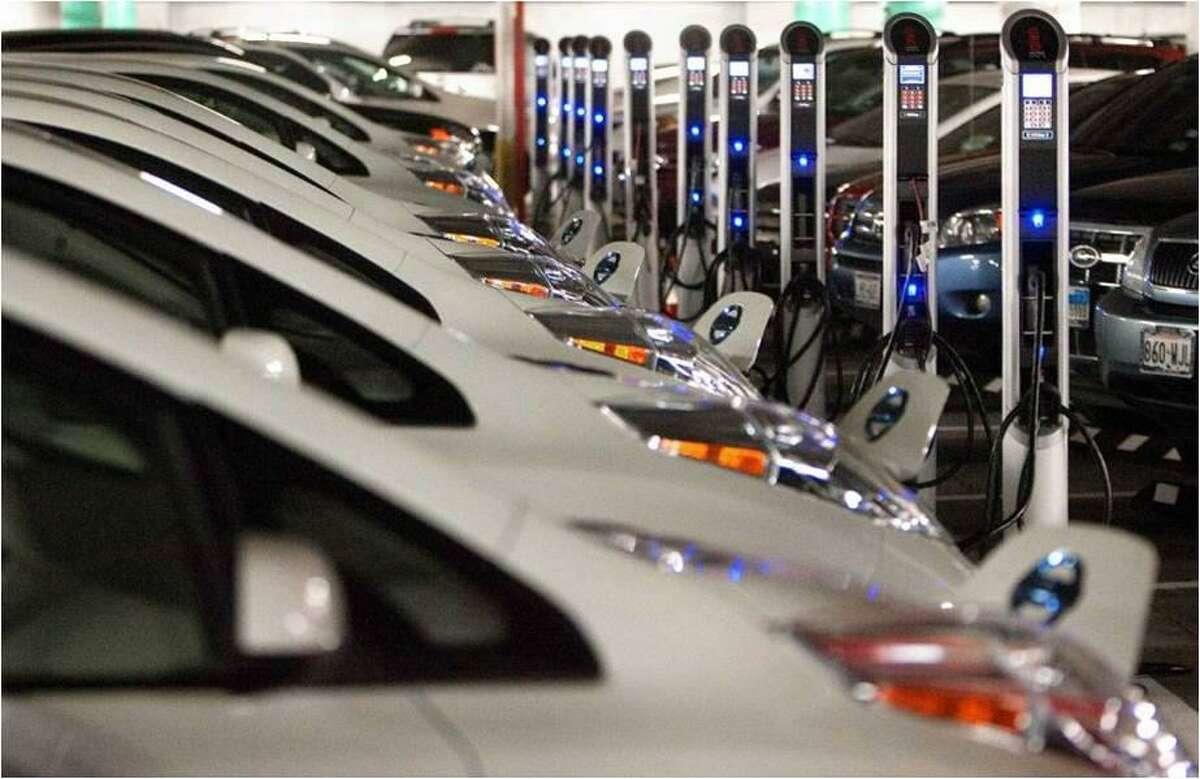
City of Houston electric vehicles sit ready for charging in a downtown parking garage in December 2013.
Houston Chronicle
Rebekah F. Ward, Staff writer
Governments with plans to invest in electric vehicles — including both Houston and Harris County — could be setting themselves up for long-term savings in spite of the vehicles' higher price tags, new research by three
public interest nonprofits focused on environmental issues shows.
Both governments aim to transition, but are far from running all-electric fleets.
The research, presented at a news conference Tuesday in Houston, estimated that Texas governments could save nearly $865 million in lifetime costs if they purchase electric replacements for vehicles retired in the next 10 years.
Such savings would call for flipping the state’s fleet as well as those run by city and county governments. In 2022, of 503 vehicles purchased by the Texas government, five were plug-in electric and six were hybrid.
Analysts for U.S. PIRG Education Fund, Frontier Group and Environment America Research & Policy Center based their calculations on what each region could pocket over time if local and state officials transition to electric fleets as their current light-duty vehicles retire.
Luke Metzger, Executive Director of Environment Texas, presented the research findings at Tuesday's conference.
"Shifting to electric vehicles can save money for taxpayers by significantly reducing fuel and maintenance costs, while also improving air quality," Metzger said. Local governments could also slash their up-front investments in the system through federal and state incentive programs.
Houston City Council member Abbie Kamin said at the news conference Houston's transition to electric vehicles will not only save tax dollars directly but will also cut greenhouse gas emissions, contributing to climate goals.
"There are billions at stake when it comes to having to respond to the extreme weather events that climate change exacerbates," Kamin said.
However, Houston's current commitments could require the city to transition more quickly to electric units than it has been. In its Climate Action Plan, the city said it would run an all-electric fleet of non-emergency, light-duty municipal vehicles by 2030. Its vehicles are typically in service for a decade or longer.
According to a release by city officials, its current fleet has 333 hybrid and 88 purely battery-powered electric vehicles. It is expecting 54 more hybrid and 107 more electric units before the end of the year. The release said Houston plans to continue leaning on public-private partnerships and grant funding to help with vehicle and charging station purchases.
This means that electric and hybrid units combined account for just over 3 percent of Houston's municipal fleet, which runs about 13,000 strong and includes mostly light-duty but some heavier duty vehicles as well, three years into the Climate Action Plan's decade-long target. By the end of 2023, their combined share could grow to between 4 and 5 percent.
In the Fleet Management Department's budget hearing earlier this month, director Gary Glasscock said his team remained concerned about investing in infrastructure that could be outpaced by new technology. He cited a recent purchase of Chevrolet Bolts that still function, but could prove more difficult to maintain after the company changed the battery technology they use.
But on Tuesday, Mayor Sylvester Turner said electrification was key to the city's Climate Action Plan, and he was "confident we will meet our goals."
Harris County's own climate action plan, adopted earlier this year, did not specify a timeline. But the document, released in January, said its fleet had only 12 fully electric vehicles and about 50 hybrids county-wide at the time.
Dylan McGuinness and Dug Begley contributed to this report.
rebekah.ward@houstonchronicle.com