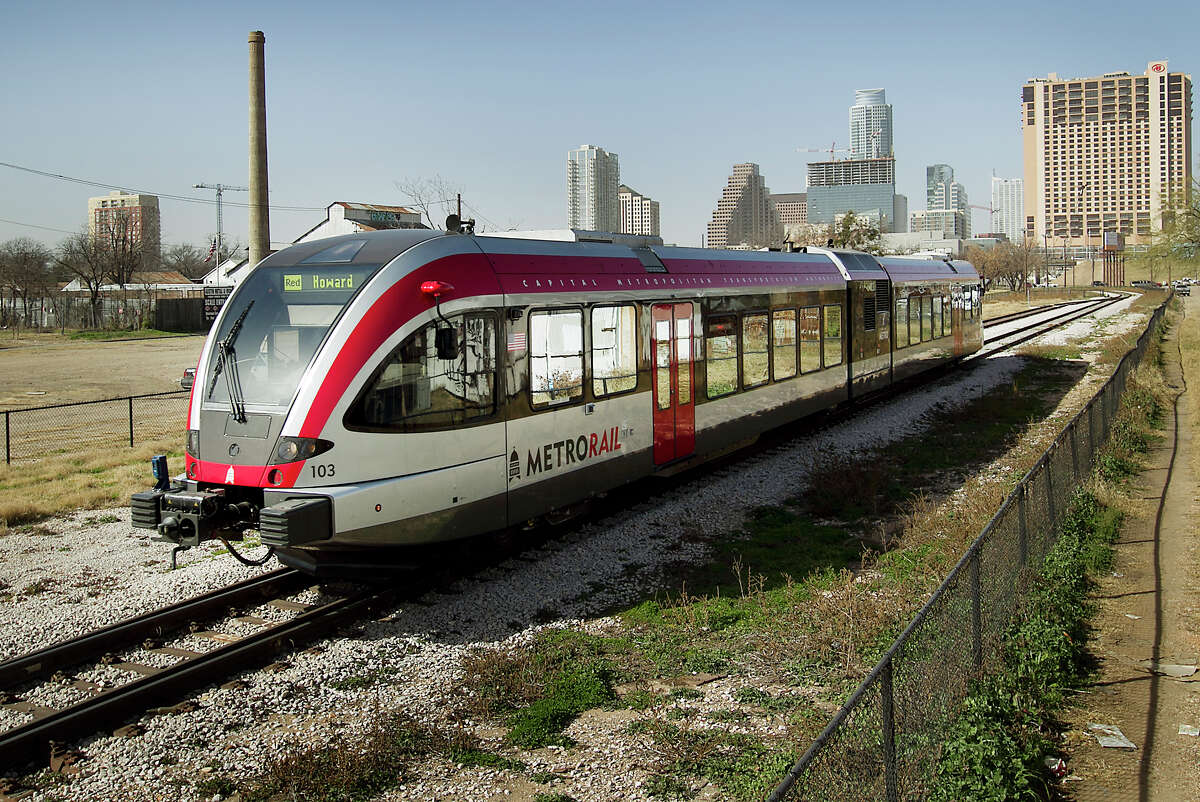
Austin's MetroRail train is seen from a view looking east towards downtown as the train starts its northbound journey.
Ralph Barrera/Austin American-Statesman
San Antonio Express-News
Greg Jefferson, Columnist
“I call it the 'R word,’ ” said San Antonio City Councilwoman Melissa Cabello Havrda, the new chair of the Alamo Area Metropolitan Planning Organization, which selects regional transportation projects to receive federal dollars. “It’s weird — everybody tenses up when you say it, like you’ve used a real curse word.”
That’s because talk of Austin-to-San Antonio rail service stirs up memories of how the rail district spent at least $25 million over 13 years without setting a single train car in motion. Most of that money came from taxpayers, and a lot of it went into the pockets of consultants.
“Over and over again, we’ve gotten burned on rail, and I think people are over it,” said Havrda, a potential 2025 mayoral candidate who heads up City Council’s transportation committee.
Nevertheless, she wants to talk unashamedly about Austin-to-San Antonio commuter rail — like in the old days of, say, 2015. And she’s not alone.
At a meeting of Austin- and San Antonio-area planning organizations this month in San Marcos, Havrda stood up and went for it. “I wanted to test the waters a little bit,” she told me. “I said I wanted to explore real options for rail.”
A representative of Travis County Judge Andy Brown was there and also talked about taking commuter trains seriously. That’s because her boss has taken a shine to rail.
“I’m looking at a passenger rail train, I see clear need for it and I look forward to discussing more when it gets a little farther down the track,” Brown said in a statement.
That fits in with Havrda’s belief that a growing number of people are itching to talk about it openly.
Obvious solution
That includes a handful who aren’t part of officialdom, such as 21-year-old Clay Anderson. He’s a San Antonio native and recent graduate of Columbia University in New York, where he studied urban planning. Anderson recently launched the advocacy group Restart Lone Start Rail District to gin up grassroots support for regional rail service. His online petition to pick up where the district left off had 452 signers as of Wednesday.
It’s not hard to understand the bubbles of interest.
The problem with treating regional rail as a taboo akin to cannibalism and devil worship is that it leaves transportation policymakers with no real way to unclog Interstate 35 — beyond making it wider.
As the populations of the San Antonio and Austin metro areas converge to form the nation’s next mega-region, on par with the Metroplex in North Texas, the stretch of I-35 between the two metros is increasingly congested and dangerous. Last year alone saw 73 crashes in which at least one person died on I-35 between Williamson and Bexar counties in 2022 alone, according to an analysis by Anderson's organization.
Commuter rail is an obvious way to unknot some of the traffic tie-ups.
Unlike the groan-inducing fantasy — peddled to local governments by Elon Musk's tunneling firm The Boring Co. — of building a network of tunnels for Teslas in Central Texas.
Of course, there’s more to regional passenger trains than improving roadway safety and the flow of goods, many of which are coming from or headed to Mexico.
It’s the familiar dream of Spurs fans, live-music lovers, academics, students and tech workers to be able to hop on trains and easily travel between the two cities, avoiding bottlenecked highway traffic. Such a service could tighten the two metro areas’ cultural and economic bonds. Right now, they’re pretty loose.
But dreams are one thing. Union Pacific Railroad is another.
2016 reality check
Created by the Texas Legislature and launched in 2003, the Lone Star Rail District explored several potential routes from San Antonio to Austin. But the only option that wouldn’t cost taxpayers an ungodly fortune was Union Pacific’s tracks between the two metros. And that wasn’t actually an option.
UP’s tracks cut through New Braunfels and San Marcos, a route that would have allowed Lone Star Rail to drop off and pick up commuters along the way without skirting the suburban cities. But the Nebraska-based rail giant rejected a rail-sharing agreement.
After UP made its position perfectly clear in early 2016, the Capital Area Metropolitan Planning Organization delivered the coup de grace, yanking its support for the rail district. It was decommissioned.
“If you’re UP, you know this is the fastest growing corridor in the United States — why on earth would you give up any capacity?” said Kevin Wolff, a former city councilman and Bexar County commissioner who now sits on the Alamo Area MPO.
I asked Union Pacific if Andy Brown had checked in to discuss jump-starting planning for commuter rail. The company doesn’t seem to have changed its thinking on a rail-sharing deal.
“Union Pacific has not been contacted by Judge Brown, and we remain focused on taking freight off the state’s already congested roads,” company spokeswoman Kristen South said in an email.
Of course, one option is to reconstitute the rail district to build its own tracks at taxpayer expense. But that would be a lot of expense. Wolff’s back-of-the-envelope estimate puts the cost of 50 miles of tracks at about $4 billion — and you’d obviously need more than 50 miles of rails. And this being Texas, one can easily imagine a spate of expensive legal fights over right-of-way.
“There’s no way to make it work that I can figure out,” Wolff said. “Where are you going to get the money? It just doesn’t exist in this state.”
Havrda said she’s under no illusions about the difficulties of developing commuter train service in Central Texas. For one thing, many Central Texans may support the idea of passenger trains connecting Austin and San Antonio, but that doesn’t mean they want to pick up the entire tab. A more likely approach, Havrda said, would be a public-private partnership.
'That’s a lot of work'
Bexar County Judge Peter Sakai is developing a working relationship with Brown, his Travis County counterpart and a fellow Democrat. But like many area politicians, Sakai seems wary of taking on the 1,001 challenges that pursuing commuter rail service in earnest would entail. He’s more interested in strengthening other economic ties with cities and counties across South Texas.
Sakai said in an interview that Brown did bring up passenger rail over dinner in Austin a couple of months ago. Brown’s enthusiasm at least made an impression. Last month, the Travis County judge attended Sakai’s State of the County speech at the Grand Hyatt in downtown San Antonio, along with top elected officials from Hidalgo and Medina counties. Sakai took a couple seconds to tell the audience of 450 that his guest from Austin “wants to connect our communities with a train.”
But with that, Sakai had disposed of the subject — at least until a reporter asked him about it after his speech.
Was commuter rail service to Austin a priority of his?
“No, that’s something Brown wants,” Sakai said. “Judge Brown wants to connect Austin to San Antonio, which I support. How we connect it — that’s a lot of work to discuss and a lot of work to do.”
Clearly, the R word still carries a lot of baggage.