
More than a quarter million people in San Antonio live below the poverty line.
Boy_Anupong/Getty Images
mySA
Catherine Wilson, mySanAntonio.com
San Antonio resident Gina Acord gets the bills every month. There's rent, utilities, and internet, but one unplanned expense can derail everything. There is a level of uncertainty in Acord's life that she can't afford when living paycheck to paycheck — always wondering if the next curve ball could be the thing to push her over the edge financially.
"It feels like you're always one disaster away from homelessness," Acord, a single mother working for a nonprofit, said.
Acord is just one of the many living in poverty in San Antonio. Some 259,231 people, or 17.6% of San Antonio's 1,472,909 residents, are impoverished, according to 2022 population estimates from the U.S. Census Bureau.
To break that down, a single adult in San Antonio making $13,000 or less annually is considered below the poverty line. The same goes for a single parent with one child making $18,000 a year or less, or a two parent household with three children on a combined income of $31,000 and below, according to statistics released by the City of San Antonio in 2022.
At a time when the cost of rent, goods, and services are undergoing massive inflation, residents are struggling to make ends meet on an income that hasn't kept up with the rising cost of living. According to livingcost.org, the average cost of living for a single person in San Antonio is $22,620 per year. For a family of four, it's $53,124 annually.
Typically, the biggest expense in a household, and a growing source of financial stress, is housing costs.
Rent in San Antonio
As of June, the average cost of rent for a one-bedroom apartment in San Antonio is $1,110, according to a market report from Zumper.com. However, when it's time to renew the rental agreement those rates can go up by hundreds, depending on the apartment and lease term. A price increase for a family already struggling to pay rent is a big ask, but an expensive relocation makes for a difficult decision..
"I don't know how rent is going to come down, and the rent increases that we hear from families, it's $400 or $500 from one lease to the next. They're forced to be more transient and more mobile," said Eric Cooper, the CEO and president of the San Antonio Food Bank. "There is a cost of transiency to your children, their relationships with friends, and the community."
With an inflexible budget, the apartments in Acord's price range are limited and the ones that are affordable are less than desirable.
"Three or four years ago I was evicted so [my son and I] ended up in a little tiny one bedroom apartment that was in one of these really old buildings, because it was the only thing I could afford and the only thing I could get into," Acord said. "People have no idea what kind of housing is out there, some of it is disgusting. This place ended up being roach and rat infested."
A general rule of thumb is that housing costs should amount to no more than a third of household income. However, that's rarely possible at the poverty line, and about 66%, or $880, of Acord's monthly income goes toward rent. In 2022, she took home $16,000.
As a result, she says one of the most difficult parts of living in poverty is not being able to provide everything she would want for her 14-year-old son.
"I thought I would be able to provide for him by now, and 11 years later I'm still struggling to provide that for him," Acord told MySA. "I had hoped to be able to buy my own home, so we could make our own place where we could feel stabilized and peaceful. I don't know if he's actually experienced — or if I've managed to give him — any sort of peace in a home."
Making ends meet in the Mission City
With the majority of income going toward rent in households similar to Acord's, it leaves little room to save money to cover unexpected, or even routine, expenses. Something as simple as getting a car repaired to get to and from work, or renewing the tags on your car, can land people under the poverty line in financial hot water.
Swinging some of those added costs requires a lot of creativity. During times when Acord needs a few extra dollars to keep the lights on or make rent, she's taken to doing things such as collecting clothing and furniture donations from people looking to get rid of them and then reselling them for profit.
When it comes to food, creativity comes in the form of letting coupons dictate what you buy, seeking out restaurants where one night a week kids eat free, and stretching food staples such as milk by watering it down, Cooper said.
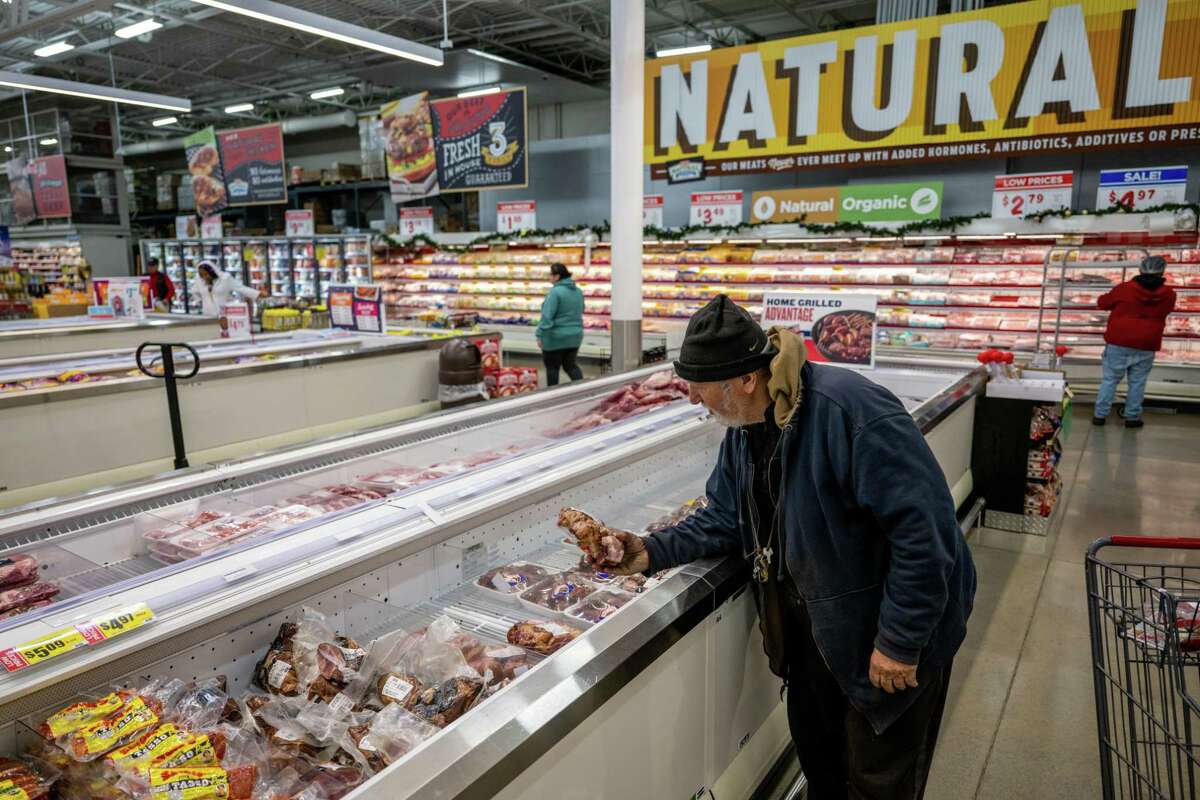
Angelou Liberta Coletta shops at an H-E-B grocery store in Houston in December 2022. Inflation has receded considerably from its peak, but many still struggle with poverty.
Brandon Bell, Staff / Getty Images
"There's the irony of rhetoric that the poor are lazy when sometimes the poor work way harder than the rest of us. They have to be more innovative to make ends meet. They have to be clever and they have to seek out more opportunities," he explained.
That creativity doesn't end at finances, it also applies to mental health care. Without resources to deal with trauma, Acord has sought free counseling from nonprofit programs, tried free acupuncture, and taken part in trauma yoga. But none were suitable substitutes for more traditional care, which is unaccessible due to her budget limitations.
"Carrying that trauma around from being evicted or living in a rat infested place builds up, and people don't seem to understand that being in poverty is traumatic," Acord said. "People don't understand how traumatic being poor is."
Perceptions of poverty in San Antonio
The reality is that poverty can strike anyone at any time, and is often spawned by major life changes such as sickness, divorce, and job loss, according to Cooper.
"I think sometimes people in poverty are just blamed for their situation," Cooper said. "'They should have made better choices that could have prevented this.' What I see is oftentimes it couldn't have been prevented, it's just how the cards were dealt."
Wendy Diestel and her partner enjoyed a comfortable lifestyle. Diestel is diagnosed with fibromyalgia, a chronic musculoskeletal disorder without a cure that results in diffuse pain, fatigue, and cognitive difficulties, among other associated issues, according to the Mayo Clinic.
They mostly lived on her partner's income while Diestel's social security disability check was used as padding. That all changed a few years ago after her partner, who was with her for 15 years, passed away.
"That was the end of me, so I fell into this major depression, and it really rocked my world," she said. "It wasn't so much losing her, but the security of it all, but the situation, and then having to fend for myself on just the [social security disability] check."
It took about four to five years for Diestel to find her footing. She now lives in low income housing, which she describes as being one of the nicer options in San Antonio, and tries to find ways to support herself by budgeting with what little she has.
One of the most difficult parts about coming to terms with her situation was the stigma around people living in poverty. Diestel said people like her are often misrepresented and treated differently than people who make more money.
"I think a lot of people think that, well, they just must be lazy, or maybe they're not as disabled as they're making it out to be because they just don't want to work. The perception is you're living off the fat of the land," she said. "I see how people treat people that may not be dressed as well ... All of this wasn't necessarily planned, and we don't really like it, but most of us are really good people."