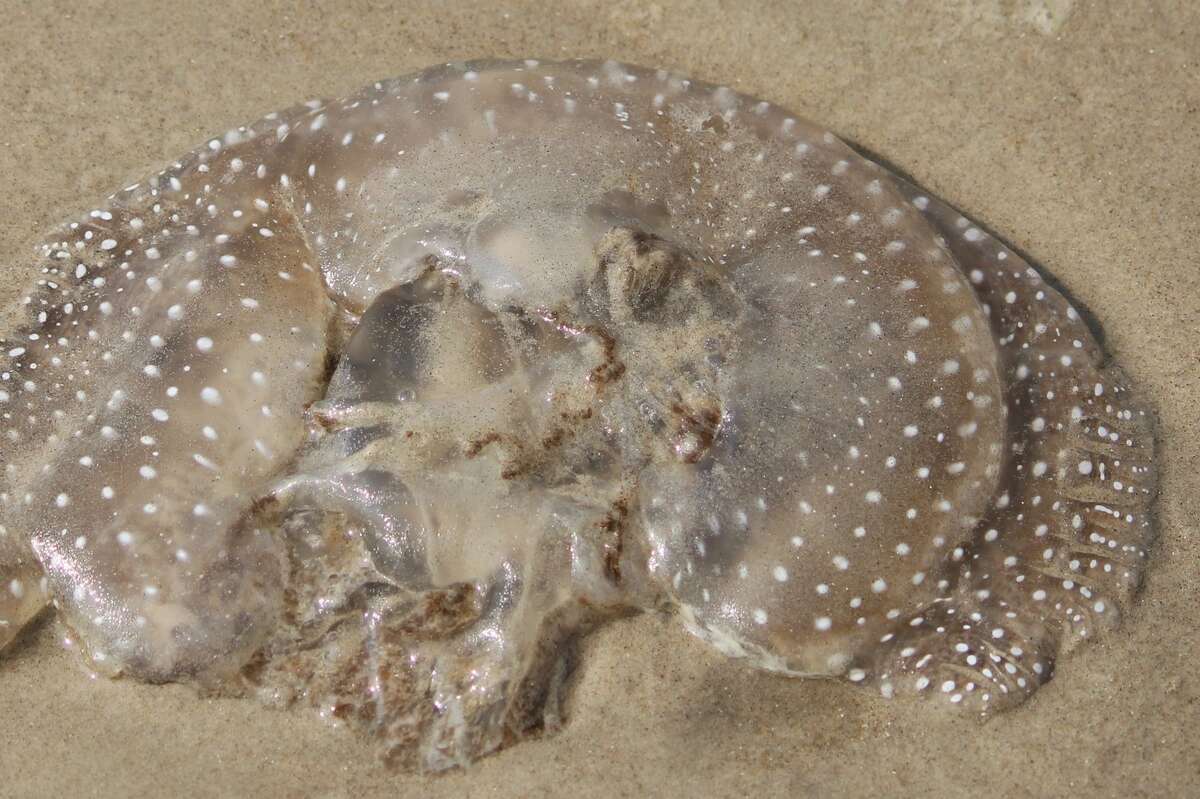
This invasive jellyfish washed ashore on Padre Island National Seashore.
Handout | Padre Island National Seashore
San Antonio Express-News
Shepard Price, San Antonio Express-News, Staff Writer
Aussie, Aussie, Aussie. Ow, ow, ow.
An invasive species of jellyfish, native to Australia, was spotted recently on Padre Island National Seashore. The Australian spotted jellyfish was found washed ashore along the national seashore's North Beach. The jellyfish is also known as the brown jellyfish or white-spotted jellyfish and is usually found in the western Pacific Ocean.
"Traveling in large groups, the Australian spotted jellyfish can be big, up to 20 inches across," National Park officials wrote. "But don't worry, they have a mild venom and are not considered a hazard to people. In fact, their venom is so weak they can't use it to stun prey."
Australian spotted jellyfish are filter feeders and eat microscopic organisms called zooplankton. The invasive species is found from the West Coast to the Gulf of Mexico to the Atlantic Coast near North Carolina. According to the Texas Invasive Species Institute, the brown jellyfish has become an issue in the Northern Gulf of Mexico near the Mississippi Sound due to its impact on zooplankton levels.
"It is highly possible that this jellyfish has started to occupy the region of the Gulf bordering Texas," Institute officials wrote.
Large numbers of the jellyfish can consume large quantities of zooplankton, park officials wrote, making it hard for local and native marine wildlife to find food. With the depletion of resources, white-spotted jellyfish are a "not-so-welcome" visitor.
The jellyfish is also impacting Gulf fisheries, according to TISI officials. White-spotted jellyfish eat larval fish, clog fishing nets, and compete with suspension-feeding fish and shrimp for food. The jellyfish can grow to the size of beach balls, so clogging nets in large numbers is not rare.