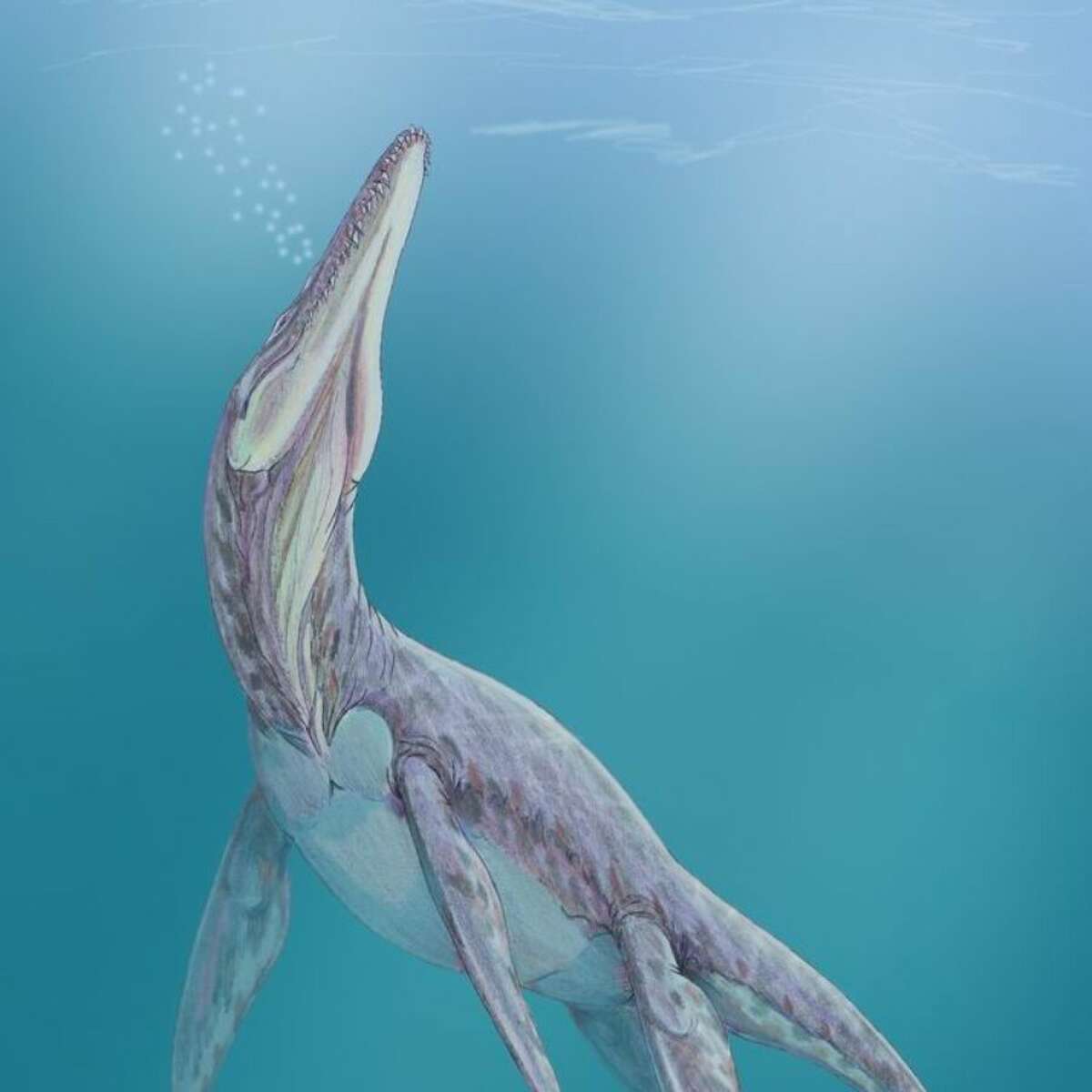
An artist’s interpretation depicts a Jurassic plesiosaur. Fossils from a plesiosaur discovered in West Texas are the only fossils from a Jurassic vertebrate found and described in the state.
Handout | University of Texas at Austin
San Antonio Express-News
Shepard Price, San Antonio Express-News, Staff Writer
The bone fragments are from the limbs and backbone of a plesiosaur, according to a news release last week. The marine reptile would have swum a shallow sea covering what is now northeastern Mexico and far western Texas about 150 million years ago.
Scientists found the bones in the Malone Mountains of West Texas over two fossil-hunting missions. Steve May, research associate at UT Austin's Jackson School of Geosciences Museum of Earth History, led the expeditions.
"There are Jurassic vertebrates out there," May said in a statement. "We found some of them, but there's more to be discovered that can tell us the story of what this part of Texas was like during the Jurassic."
Prior to this discovery, the only fossils found in Texas dated to the Jurassic came from marine invertebrates. Those include ammonites and snails. May said the fossils show proof that Jurassic bones can be found in Texas.
During the Jurassic era, giant dinosaurs roamed Earth's surface, leaving fossils behind as evidence. To find fossils from the era, however, Jurassic-aged rocks are necessary. Those rocks are a rare find in Texas due to its geological history, officials with UT said. Most of those rocks exist within 13 square miles of the Malone Mountains.
"You just don't want to believe that there are no Jurassic bones in Texas," May said in a statement.
Made up of large bone fragments, the plesiosaur fossils that May and other scientists found are weathered and broken up.
Today, the mountains stick out from a desert landscape. During the Jurassic, however, sediments were deposited just below sea level within miles of the shoreline.
Additional authors on the study included members of UT's Jackson School Museum of Earth History and researchers from Southern Methodist University.