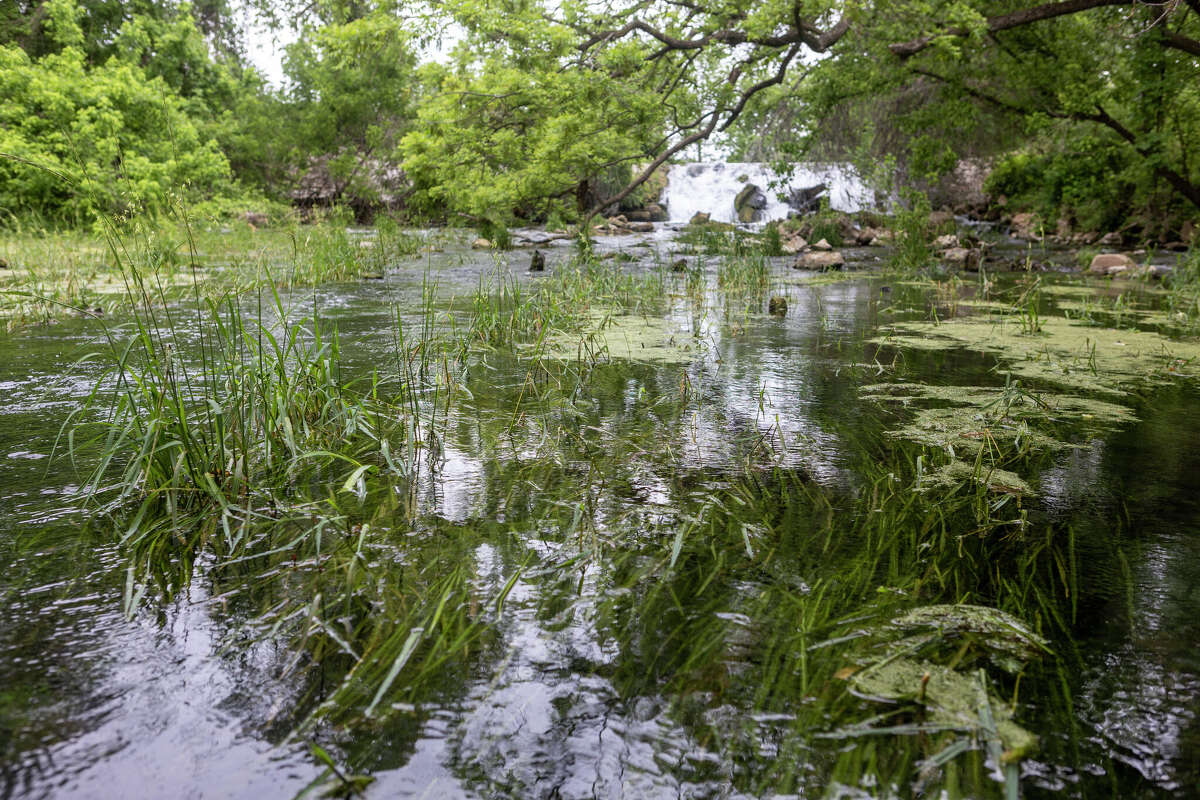
The San Marcos River flows just below the Spring Lake dam in San Marcos in this photo from April 26, 2022.
William Luther
San Antonio Express-News
Liz Teitz, Staff writer
San Marcos is trying to stop a developer from building a plant that could discharge 400,000 gallons per day of treated wastewater into area waterways, saying the city’s existing wastewater system should instead be used.
The dispute involves a planned 1,500-home development named Rattler Ridge, which is proposed for a site in the city’s extraterritorial jurisdiction, near where FM 1978 and Texas 123 intersect in Guadalupe County, east of Interstate 35.
The developer’s application with the Texas Commission on Environmental Quality seeks permission to build a facility that could discharge up to 400,000 gallons per day of treated wastewater into a series of tributaries and creeks leading to the Lower San Marcos River.
San Marcos has asked TCEQ officials to deny permission for the treatment plant, arguing that state policy requires using existing municipal wastewater facilities when that is an option.
“The state’s policy on regionalization seeks to prevent just such a type of application sought in this docket — small package plants which can be serviced by larger, professionally-run organizations, like the city,” attorney Arturo Rodriguez, who is representing the city, wrote in a motion last September.
San Marcos also raised concerns about the potential impact of the plant on water quality, as well as potential odor issues and the applicant’s lack of experience operating a wastewater plant.
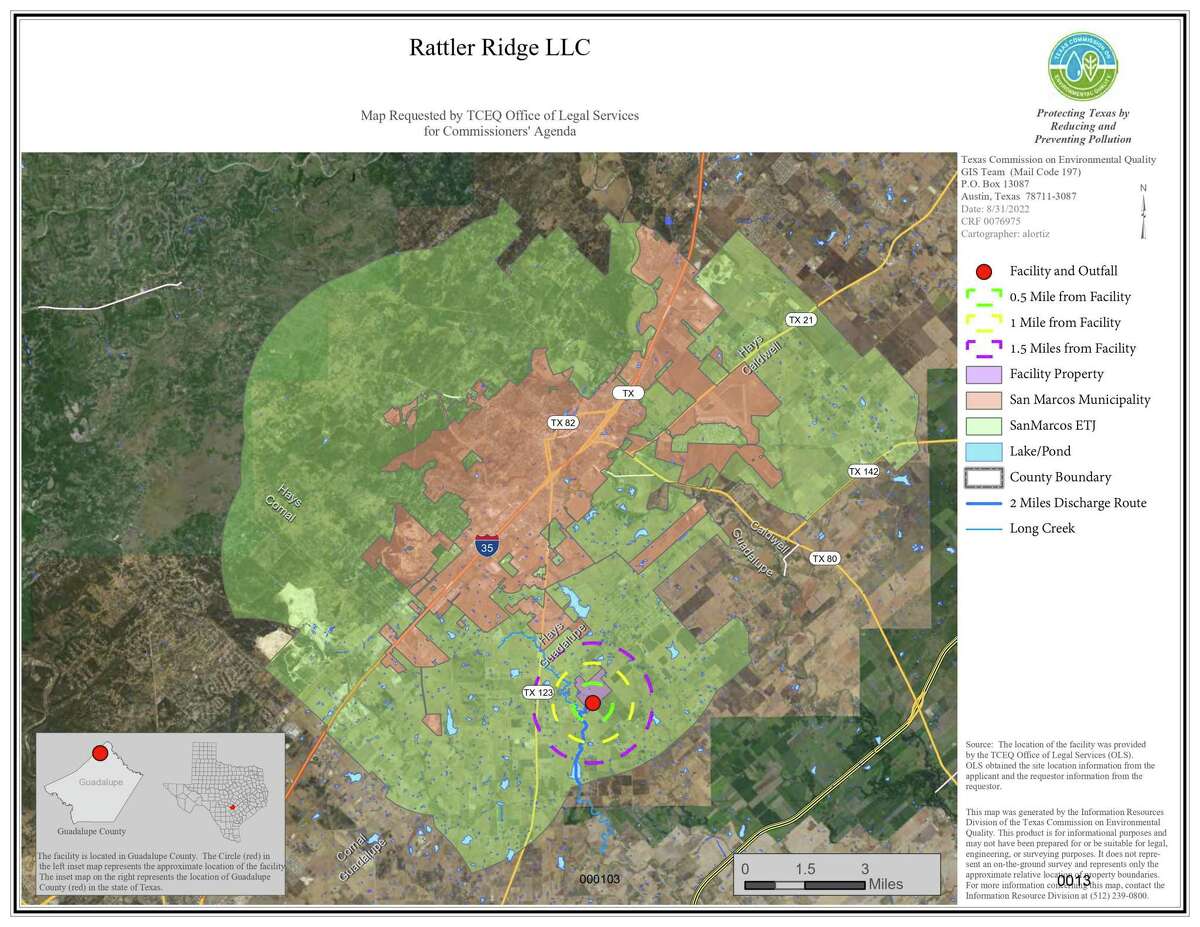
A map created by the Texas Commission on Environmental Quality shows the proposed location of the Rattler Ridge wastewater treatment facility near San Marcos. The city is opposing the developer's application, arguing that the municipal wastewater system should be used instead.
Texas Commission on Environmental Quality
After developer Clint Jones applied to TCEQ for the permit, the city requested a contested case hearing on the application. If the commission ultimately grants the permit, the city can request a rehearing, as it did when the commission previously approved a permit for another of Jones' projects, the Fleming Farms wastewater treatment plant.
If the plan were approved, the treated effluent would be discharged to an on-site pond, then an unnamed tributary, then Long Creek, to an unnamed reservoir, back to Long Creek, then York Creek and then to the Lower San Marcos River. An initial review “preliminarily determined that existing water quality issues will not be impaired by this permitting action,” according to a filing from TCEQ’s executive director.
Jones, the developer seeking the permit through an entity called Rattler Ridge LLC, told TCEQ that San Marcos “lacks sufficiently sized wastewater facilities in a geographic location near the Rattler Ridge subdivision to provide wastewater service by economically feasible means.”
The city’s treatment plant is about 4½ miles from the proposed development, Jones wrote in a TCEQ filing, but there are not sufficiently-sized collection lines close to the project.
A hearing on the application has been scheduled for September. However, since February, Jones and the city have been working toward a potential resolution.
“The applicant and the city of San Marcos have engaged in productive settlement discussions that could result in a settlement of this case,” David Tuckfield, the developer’s attorney, said in a motion. In May, he wrote that the developer “believes the parties are very close to an agreement.”
Jones told the Express-News the negotiations are related to wastewater treatment options for two proposed developments on property he owns. Those projects are Rattler Ridge, where 1,500 homes are planned north of FM 1978, and Fleming Farms, a 334-home subdivision planned nearby, south of FM 1978. Jones applied for and received a discharge permit for the smaller development in 2021, despite similar objections from the city. He has since acquired the Rattler Ridge property, which would require a much larger treatment plant.
“We’re still in discussions with the city,” Jones said.
Following the state policy of using existing wastewater infrastructure is not feasible in this situation, Jones said. He said he hasn’t been able to get an easement across private property between his proposed developments and the city’s treatment plant, and he said the city declined to use eminent domain authority to do so.
San Marcos said it couldn’t use eminent domain authority because there was no agreement in place with Jones' company, Regal LLC, to provide service for the Fleming Farms development, according to TCEQ filings.
“While the city engaged in informal attempts to secure an easement for Regal to connect, when it came time to use the power of eminent domain to secure the easement, Regal wanted the city to do this without benefit of an agreement to serve the property,” Rodriguez said. The city also said it couldn’t seek eminent domain while Regal was still actively seeking a discharge permit.
Jones said the negotiations currently underway include other developers in the area. He said he’d prefer to see a city-owned wastewater facility built that could serve the area, instead of multiple private plants.
“Instead of each project having separate individual plants, is there a way we can work out a deal with the city to combine all of our projects into one plant?” Jones said. “We’re hopeful that we get that worked out.”
The city declined to comment on the status of its negotiations with Jones and on whether a new city-owned facility is a possibility, but pointed to an ordinance which says San Marcos “discourages the use of sewer package treatment plants.”
“The city of San Marcos is always open to discussing solutions to meet wastewater discharge needs,” Director of Utilities Tyler Hjorth said in a written statement. “We have had discussions with stakeholders regarding this potential opportunity, but we are too early in the process to share any specific plans for a resolution at this time.”
The San Marcos City Council was scheduled to discuss Jones’ wastewater applications in executive session this week, according to its agenda.
In addition to the city’s objections, TCEQ received two letters opposing the proposed Rattler Ridge wastewater facility.
Garland Powers III, who owns property near the site, said the plant would discharge into his privately owned pond, which was built as a water source for livestock and wildlife. The overflow pipe for the pond is more than 30 years old and designed only to let water out in a flood, he wrote in a letter to TCEQ.
“It was not designed for treated water to be pushed down it constantly,” he said, and that use will eventually cause the pond to fail. He also said the wastewater would be a source and carrier of diseases, and suggested instead using the wastewater for irrigation.
Powers is a board member of the York Creek Improvement District, which also objected to the application.
“Some wisdom by governing bodies should be given to the immense detriment that these small plants and all the impervious cover being lost causes,” the district said. “If there is such a need for so many of these plants in very close proximity to one another, why isn’t there some movement among developers and the state government to construct one or two larger plants, so that they can be more easily monitored and inspected by appropriate agencies, county, city and state?”
The proposed developments would be east of I-35 and south of San Marcos High School, in what Jones called a “new growth corridor for the city of San Marcos.”
That’s in line with the city’s plans, Jones said, which identify it as the preferred location for growth, instead of the more environmentally-sensitive west side.
The 2013 “Vision San Marcos” comprehensive plan says the public indicated a preference for new development along I-35 and east side corridors, as “an alternative to development in the Edwards Aquifer recharge zone.”
For both of Jones' developments, once the wastewater plans are resolved, construction plans would need to be completed and final plat approval received by the city before beginning work on the neighborhoods' infrastructure, including streets and drainage.
If an agreement is reached by the end of the summer, infrastructure work could begin in 2024, Jones said. The lots would be sold to builders, who could potentially begin building homes in 2025.
Wastewater treatment facilities have increasingly become a flashpoint in the Hill Country, which has seen a boom in population growth and housing development.
In June, residents and environmental groups spoke against a proposed treatment facility in Comal County that would serve a planned 1,400-home development. That applicant seeks to eventually discharge up to 600,000 gallons per day into West Fork Dry Comal Creek, which ultimately runs into the Comal River.
Opponents have also objected to the Guajolote Ranch wastewater treatment plant proposed for a 2,900-home project in northwest Bexar County, south of Boerne. The treated effluent from that plant would flow into Helotes Creek.