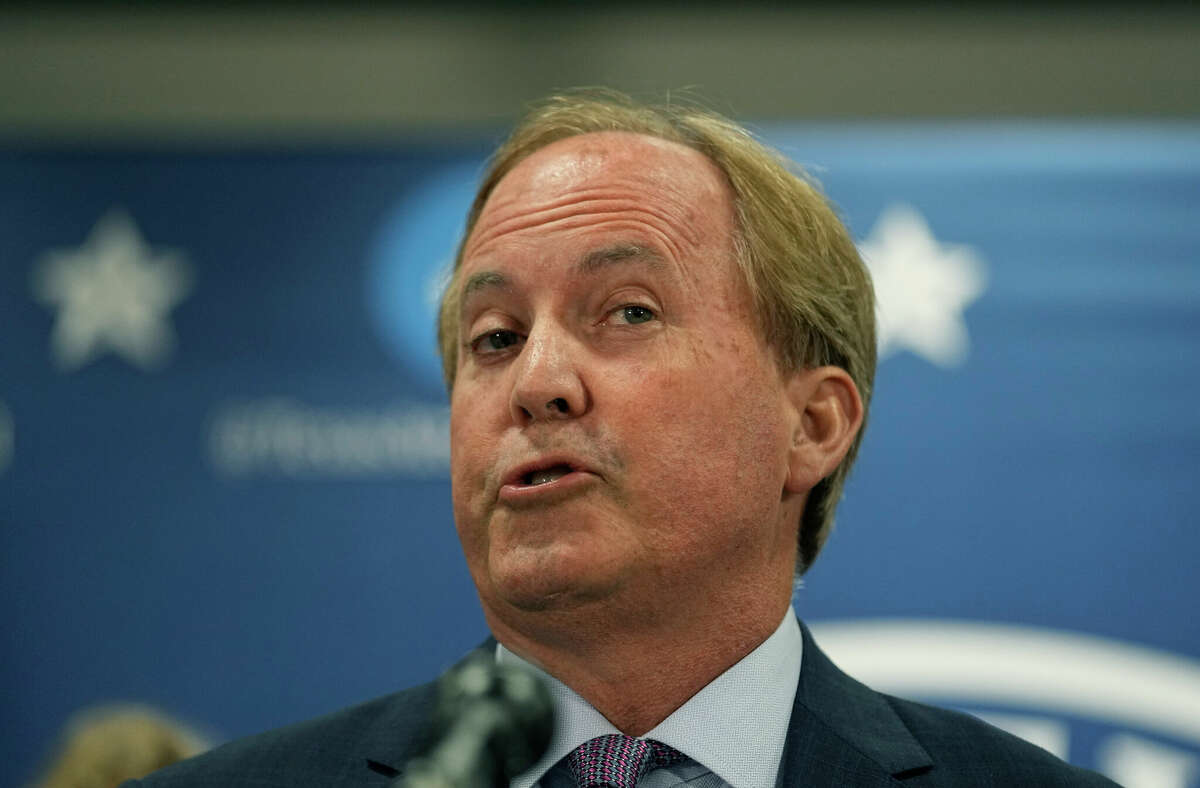
Texas Attorney General Ken Paxton makes a statement at his office in Austin on May 26, 2023, a day before the impeachment vote in the Texas House.
Eric Gay/Associated Press
Houston Chronicle
Nicole Hensley, Taylor Goldenstein, Staff
writers
A week before the 2022 Republican primary, Paxton met privately with Matthew Ocker, whom Paxton’s office had been prosecuting on charges the activist kicked and choked his disabled teenage daughter, court records show.
Paxton’s office acknowledged the meeting happened at a Gulf Coast hotel but said the attorney general didn’t know at the time that Ocker, 45, was facing criminal charges, according to an internal memo obtained by the Chronicle.
But other documents show that Ocker communicated for at least a month with one of Paxton’s closest advisers about his child abuse case before his face-to-face meeting with the state’s top lawyer. Ocker has pleaded not guilty in the case, which is now pending under a different prosecutor.
It’s not clear what the men discussed at the meeting, which Ocker attended without legal representation. But when his defense lawyer, Daniel Palmitier, learned about the extent of the meeting, he asked a judge to remove the child abuse case from Paxton’s jurisdiction, according to court documents. The judge indicated the private meeting with Paxton also concerned him.
Palmitier declined to discuss the details of the case. A spokesperson for the attorney general’s office did not respond to requests for comment.
The 2022 meeting raises concerns for Amanda Peters, a former prosecutor and professor at South Texas College of Law Houston, who reviewed documents referencing the meeting at the request of the Chronicle.
“The rules of ethics are clear. As soon as you know an opposing side has a lawyer, you are not to talk to him,” Peters said. “If it were me, as a prosecutor, I would walk out of the room."
Law professor Geoffrey Corn agrees Paxton’s behavior was problematic if he knew Ocker had a lawyer.
“It’s just bad lawyering,” said Corn, who teaches at Texas Tech University. He added he believes Paxton’s conduct with Ocker mirrors his willingness to “skirt the rules” in acts outlined in the impeachment charges.
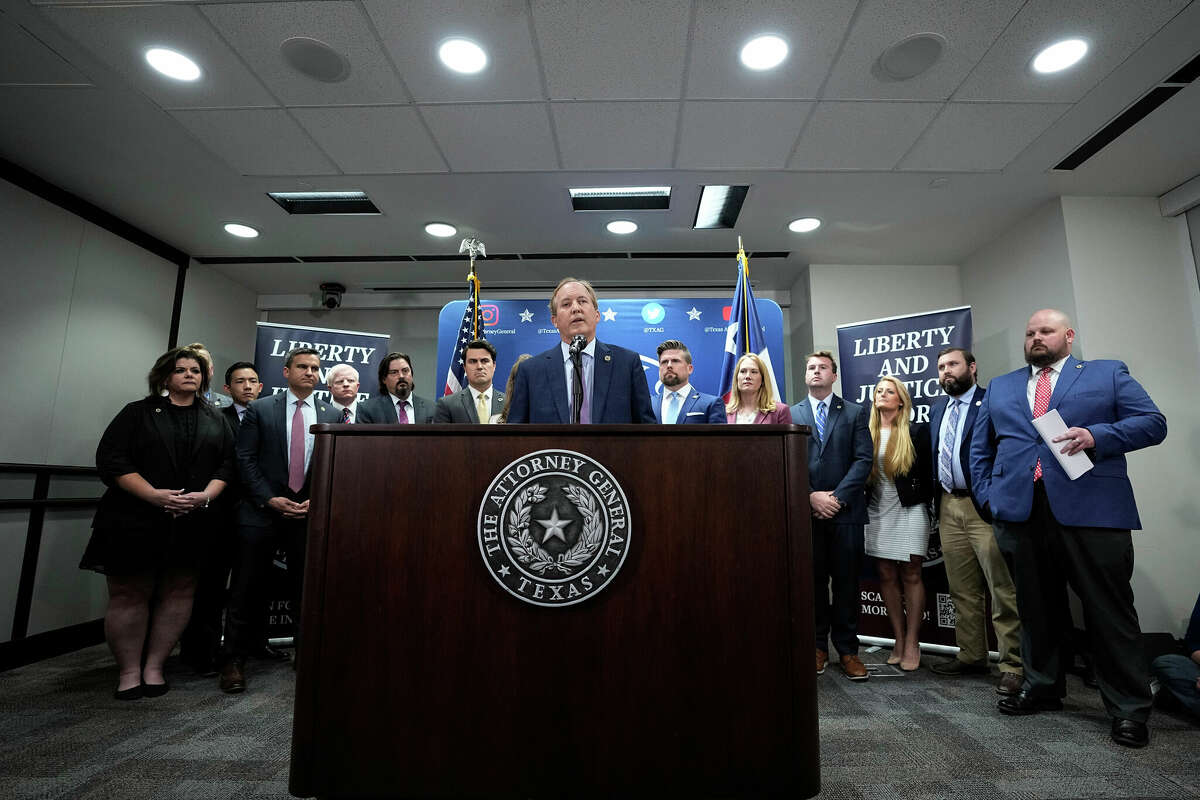
Attorney General Ken Paxton, center, makes a statement at his office about the impeachment proceedings launched against him in Austin on May 26, 2023. Among the people behind him at the podium, he is flanked, to the far left, by his adviser Michelle Smith, whom a Houston Chronicle investigation found played a role in setting up a meeting between him and a defendant whom his office was prosecuting.
Eric Gay/Associated Press
Both law professors said the hotel meet-up may have violated Texas disciplinary rules for attorneys, which prohibit lawyers from talking to other lawyers’ clients, unless the excluded attorney has explicitly consented. The records do not indicate if Paxton knew that Ocker had a lawyer, but both law professors said it would be unlikely for a criminal defendant to be unrepresented, and either way, Paxton should have asked.
Palmitier declined to say whether he submitted a misconduct complaint to the State Bar about Paxton.
A lawyer from the AG’s office said in court that Paxton often meets with voters, so he didn’t think the Ocker meeting should be viewed as a hindrance in his child abuse case.
Revelations of the private meeting come as Paxton prepares to defend himself against impeachment allegations that he accepted bribes from Nate Paul, his friend and campaign donor, and abused his office’s resources, launching a probe at Paul’s request into federal authorities who were investigating Paul. The FBI is also reportedly investigating the corruption allegations.
The meeting with Ocker marks another incident in which Paxton appears to have gone out of his way to address the complaints of a political supporter who felt he was being singled out by law enforcement.
Although Paxton, a third-term Republican, has been dogged by legal troubles for most of his tenure, he has continued to win over members of his party. An ally of former President Donald Trump, Paxton is perhaps best known for challenging the Obama and Biden administrations over border policy, health care access and environmental protections.
In addition to the impeachment, Paxton is awaiting trial on an eight-year-old felony securities fraud case that has been delayed repeatedly over procedural issues.
Paxton has denied the accusations in all these cases, saying they are politically motivated.
‘He can talk to me’
The man behind the meeting imbroglio is a conservative grassroots activist who served as president of the Hays Constitutional Republicans and a member of the Election Integrity Project of Hays County, which has raised concerns about voter fraud.
At the time of his arrest, Ocker sat on a Hays County school bond oversight committee, according to the Hays Free Press. He also ran an unsuccessful bid for county judge in Victoria County in 2010, the Victoria Advocate reported.
Ocker gave Paxton a $100 campaign contribution in 2016 and has donated nearly $6,000 to conservative campaigns over the last 20 years, according to state data.
The case that prompted Ocker to contact Paxton's office arose when the state child welfare agency reported Ocker had attacked his daughter during a visit at his Buda home, an affidavit shows. Hays County deputies arrested Ocker in February 2020 on charges of assault of a family member and injury to a child with disabilities.
His 16-year-old daughter told an investigator her father became angry with her after she spilled her apple juice. She dropped to the floor, and Ocker kicked her “five or six times,” she said. He then pulled her by her hair and choked her with both hands, according to the complaint.
The daughter told an investigator she “couldn’t really breathe” and “it felt like half my air was draining out of me,” the police affidavit said.
He had two prior criminal cases that were resolved through deferred adjudication, a form of probation, court records show.
The Hays County District Attorney recused himself from the child abuse case, saying Ocker believed he had unjustly targeted him, and asked the AG’s office to take over.
Ocker then began complaining to a top AG official raising similar concerns about Paxton’s prosecutors, according to copies of Facebook messages referenced in court, which the Chronicle obtained through an open records request.
In June 2021, he wrote to Michelle Smith, identified in court records as a senior adviser to Paxton, that “the AG’s office is totally out of control” and “Ken has lost my support.”
Smith, who worked as a campaign manager for Paxton and his wife, Angela, during her run for state senate, responded swiftly.
“Let me help,” she said.
Days later, she followed up saying she had asked people to “look into” Ocker’s situation.
Weeks of messaging ensued during which Ocker continued to disparage Paxton’s office.
Smith wrote back saying she had spoken with Brent Webster, Paxton’s first assistant, to answer a question about his case.
Ocker wrote at one point, “He (Paxton) can talk to me. He’s not prosecuting the case,” according to a court transcript.
Smith later helped coordinate Paxton’s Port Aransas schedule so that Ocker could meet with him between events, records show.
She texted Paxton’s executive assistant, Tommy Tran, and asked him to find a “quiet spot” for Ocker and Paxton to meet amid a day of campaigning at the Plantation Suites and Conference Center. She did not mention in the text that Ocker had a pending criminal case.
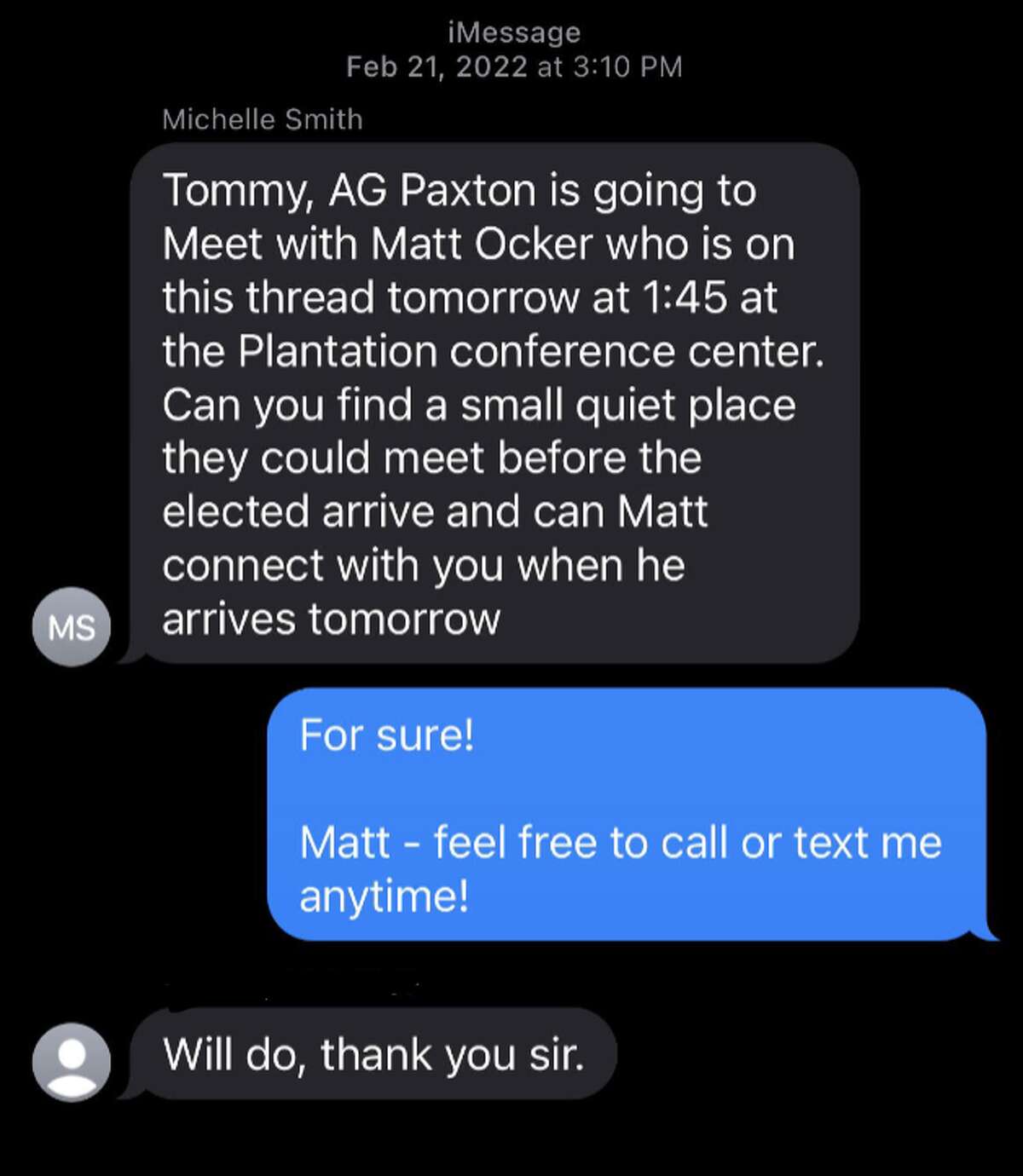
Michelle Smith, a senior adviser to the now-impeached Attorney General Ken Paxton, asks Paxton's executive assistant, Tommy Tran, if he can help coordinate a meeting between the official and a GOP activist whom the office was prosecuting. Hearst Newspapers obtained the message from the AG's office through an information request; profanities were redacted by Hearst Newspapers. Legal experts said the meeting may have violated Texas ethics rules.
Smith told the Chronicle she had no knowledge of Ocker’s case or the meeting between Paxton and Ocker.
Apart from his Texas grassroots activism, Smith said she did not know Ocker well. However, Facebook posts show Smith and Ocker commented back and forth, discussing politics, dog names and, in one case, she expressed interest in buying a pecan cutting board handcrafted by Ocker.
Poisoning his own case
Details about the Paxton-Ocker rendezvous emerged long afterward, in an April hearing.
Ocker’s lawyer told a Hays County judge that, unbeknownst to him, Paxton had met with his client, and the AG’s office had taken more than a year to share information from it, records show.
A Paxton staffer wrote in an internal memo that the meeting with Ocker had been impromptu and happened at Ocker’s request. Josh Reno, Paxton’s deputy attorney general for criminal justice, wrote that Paxton did not know he was going to be meeting with the defendant.
The meeting, which Tran and a person accompanying Ocker also attended, lasted five to 10 minutes, while Paxton’s security detail waited outside, Reno’s memo stated. The memo did not say what Paxton discussed with Ocker or whether he tried to end the conversation.
Ocker complained to Paxton that Webster, a high-ranking prosecutor, “had it out for him,” according to Reno’s memo. Webster had no direct involvement in the case and did not know Ocker, the memo said.
Reno believed Ocker’s plan all along was to poison his prosecution by Paxton’s office.
"My inquiry has led to the strong impression that Mr. Ocker was attempting to manipulate this meeting to circumvent the judicial process, his own defense counsel and ultimately, avoid his prosecution," he wrote.
It’s unclear whether Smith faced blowback for helping Ocker. But Palmitier told the judge he understood Smith was “threatened with her job” when co-workers learned about the meeting.
‘Slippery slope’
Palmitier asked the judge to bar the AG’s office from prosecuting Ocker’s case or dismiss the indictment altogether, saying that the hotel meeting violated his client’s “constitutional and due process rights,” court filings show.
James Haugh, the prosecutor for Ocker’s case, said the meeting with his boss did not constitute grounds for a recusal.
“The situation is akin to a random citizen asking for a meeting with an elected district attorney,” Haugh said. “And as a politician, you know, the attorney general meets with citizens and elected district attorneys meet with citizens about issues that they might want to discuss.”
Palmitier said Paxton asked Ocker to send his office information about the child abuse case. His client responded on his own, with “a 10-page email” detailing his defense, according to a transcript.
Prosecutors told the judge they couldn’t immediately confirm the email existed.
Hays County Judge Tanner Neidhardt acknowledged it was possible Ocker knew the face-to-face might delay or complicate his prosecution.
“You can't set up a meeting, request it, mislead that the AG's office isn't prosecuting, and then get some benefit by your deceit or fraud,” Neidhardt said, according to a transcript.
He also was concerned that Paxton’s office may have taken steps to arrange a meeting between Ocker and Paxton.
“Someone in the AG's office, at whatever level, gets a message from someone that says, ‘your office is prosecuting me and I want to talk to the AG’ and then they set it up,” the judge said. “It seems to me that someone from the AG's office should know that they're on a slippery slope.”
Neidhardt asked the lawyers to return for a follow-up hearing, to explain how the meeting was planned and the extent of Ocker’s contact with Paxton’s office.
At the next hearing, however, prosecutors did not answer the judge’s questions. Instead, they abruptly withdrew from the criminal case without explanation, court records show.
Ocker’s case returned to the newly elected, unconflicted, Hays County DA, where it is pending.
It would no longer create headaches for Paxton’s staff. Dropping the case effectively avoided the possibility of Paxton or his senior aides ever being called to testify about the meeting.
UPDATE: An earlier version of this story stated an incorrect age for Matthew Ocker. He is 45.