'Left with no choice': San Antonio likely to sue state over 'Death Star bill'
Published: Sun, 07/16/23
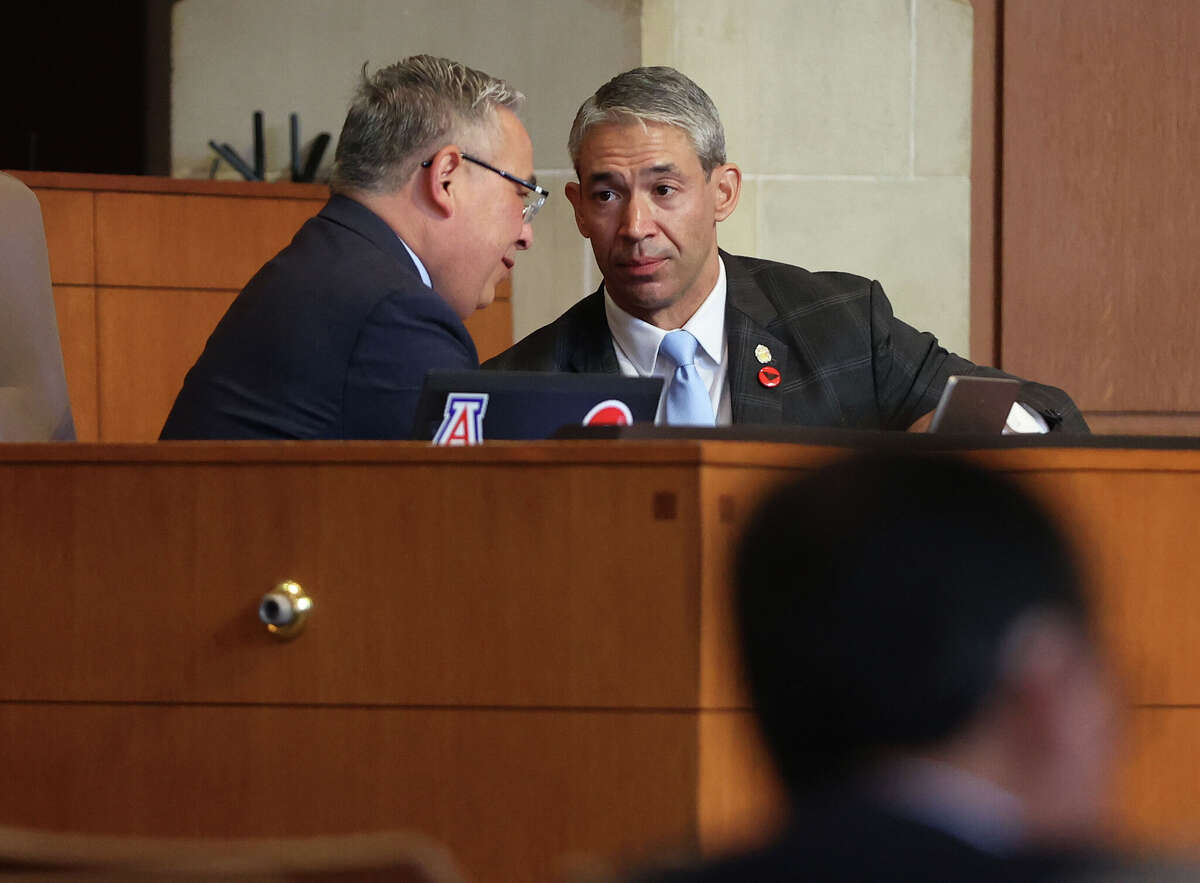
Mayor Ron Nirenberg (right) confers with City Attorney Andy Segovia as San Antonio City Council discusses Texas HB 2127 during session on Thursday, Mar. 23, 2023.
Kin Man Hui/Staff photographer
Megan Rodriguez
San Antonio city leaders are likely to soon sue the state of Texas over a new law that will limit local government authority.
City Attorney Andy Segovia said his office is reviewing its legal options, but City Council members are spoiling for a court fight over House Bill 2127.
The measure, which critics call the “Death Star bill,” puts a slew of local regulations in doubt and allows businesses and individuals to sue cities they believe have imposed new regulations in violation of the law.
“I think we’re going to be left with no choice but to file a lawsuit,” said District 8 Councilman Manny Peláez, an employment law attorney. The law, he added, “sows chaos” because cities don’t know what they can and cannot do anymore.
Peláez, District 9 Councilman John Courage and District 5 Councilwoman Teri Castillo are the staunchest advocates on council for challenging HB 2127.
“I’m willing to bet money that, at the end of the day, Andy Segovia is going to figure out a way for the city of San Antonio to get involved in this fight,” Peláez said.
“There’s a number of reasons that we should file suit,” Castillo said. “But ultimately, this is an unconstitutional and sweeping bill that does not allow city council to do what we were elected to do, which is protect the health and safety of our constituency, and everyday people of San Antonio.”
Last week, the city of Houston filed a lawsuit in Travis County District Court, arguing that HB 2127 violates the Texas constitution and is unenforceable. HB 2127 is set to take effect on Sept. 1, and Houston officials are seeking a temporary court ruling that would halt the new law as the case wends through the courts.
District 6 Councilwoman Melissa Cabello Havrda said she doesn’t like the idea of San Antonio suing the state, but that a lawsuit almost seems inevitable.
“We’re going to have to react,” Cabello Havrda said.
Yet she also noted that the city could wait to see how Houston’s lawsuit shakes out.
Segovia said his office is talking with its counterparts in other large Texas cities, including El Paso, Dallas, Houston and Austin, to discuss their options, and weighing whether San Antonio should join Houston’s lawsuit, file its own or not sue at all.
The City Council and Mayor Ron Nirenberg opposed HB 2127 as it moved through the legislature. Then-District 10 Councilman Clayton Perry was the only exception — and so is his successor, Marc Whyte.
“I wouldn’t want to see us wasting time and money on a legal fight when we need to be focusing on the issues important to our residents here, which they’ve clearly told us is crime and the homeless problem and economic development,” Whyte said. “That’s where our focus needs to be, not on fighting legal battles with respect to a bill that’s going to help businesses across the state.”
Whyte said fears of the law’s potential impact on cities have been overblown.
“I’ve asked my colleagues, 'What is it that this is not going to allow us to do that we need to do?' and I haven’t heard of an answer yet,” he said. “To me, this helps focus local government on the things we should be doing and not veering off into these areas that are covered by state or federal law.”
Segovia said the council met in closed-door executive session in late June to discuss their legal options.
‘Confusion and chaos’
HB 2127 limits cities' and counties' ability to craft new regulations. New rules can be no more restrictive than what’s “expressly authorized” in state codes covering business, labor, property and other areas.
Currently, as long as state law doesn’t tell the city that it can’t do something, the City Council can move forward with regulations. The new law flips that approach; the city will have to get permission from the Legislature to adopt new rules.
Houston’s lawsuit echoes what critics have said for months — that the measure undoes more than a century of law giving cities “home-rule” authority. And it uses “vague language so indefinite, awkward, and opaque that it fails to notify Texas cities which of their laws they may enforce,” the lawsuit states.
Supporters say the law will give companies regulatory consistency across the state, saving businesses from dealing with different rules from city to city. And it will ensure local officials don’t overstep the powers granted to them by the Legislature.
Segovia disagrees.
“This notion that 2127 is going to create consistency is way off the mark,” he said. “If anything, it’s going to add confusion and chaos statewide.”
He cited one provision in the law: “Unless expressly authorized by another statute, a municipality or county may not adopt, enforce, or maintain an ordinance, order, or rule regulating conduct in a field of regulation that is occupied by a provision of this code.”
“Nobody can tell me what that means,” Segovia said. “What is ‘an ordinance in a field of regulation occupied a provision of these codes? ’ That’s classic legalese that really nobody can define in any clear manner.”
Instead of trying to identify city ordinances that are unenforceable under HB 2127, Segovia said San Antonio will leave everything on the books for now. Only if someone sues under the new law will the city check the regulation — the target of the complaint — against the new state law.
“If I hired 20 attorneys to look at all our ordinances and come up with a list of those that were nullified under 2127, I’d come up with 20 different lists,” Segovia explained. “It’s that vague and ambiguous.”
“We still consider ourselves a home-rule city,” Segovia added. “And until somebody tells us different, we’re going to continue to act as a home-rule city.”
But the new law has already changed how council members have handled a proposed ordinance that would mandate water breaks for construction workers city-wide. A council committee earlier this month narrowed the focus to only companies that contract with the city, to avoid possibly running afoul of HB 2127. The council will vote on an ordinance in August.
Segovia, however, said that HB 2127 wasn’t the only reason for scaling back the water break regulation. Concerns over how to enforce it and questions about the construction industry’s support also played into the Planning and Community Development Committee’s 4-0 vote.
Taking action
It’s hard to know how quickly Houston’s lawsuit, and similar litigation that’s expected to be filed soon, will be resolved. St. Mary’s University law professor Al Kauffman said Houston’s suit could make it all the way to the Texas Supreme Court by year’s end — or it could take a few years.
He said Houston’s case will be stronger if several other cities, large and small, get involved, either by joining the lawsuit or filing their own.
The basis of Houston’s lawsuit is that home-rule cities were established by the Texas Constitution, not the Texas Legislature. So doing away with home-rule cities — which critics say is essentially what HB 2127 does — requires an amendment to the Texas Constitution, not a bill.
‘Cities in jeopardy’
HB 2127 opens the door for just about anyone to file a lawsuit against a city if they think an ordinance conflicts with state law. It doesn’t have to directly affect the person suing because they can argue that it “threatened” to deny their rights.
That’s unusual, Kauffman said, since people are generally limited to bringing lawsuits when there’s an effort to enforce a rule against them.
“That is going to be very broad and would encourage a great number of lawsuits, and, to be honest, put the cities in jeopardy on anything they pass now or any statute on the books that someone feels could threaten their rights,” he said.
But under the new law, people would need to give the city a 90 day notice before they file suit. During that time, Segovia said, the city attorneys, council and the city manager will decide if the ordinance in question should be repealed or amended, or if the city should defend it in court.