Soaring population, higher chances of drought will impact water supplies in Central Texas
Published: Sun, 07/16/23
Soaring population, higher chances of drought will impact water supplies in Central Texas
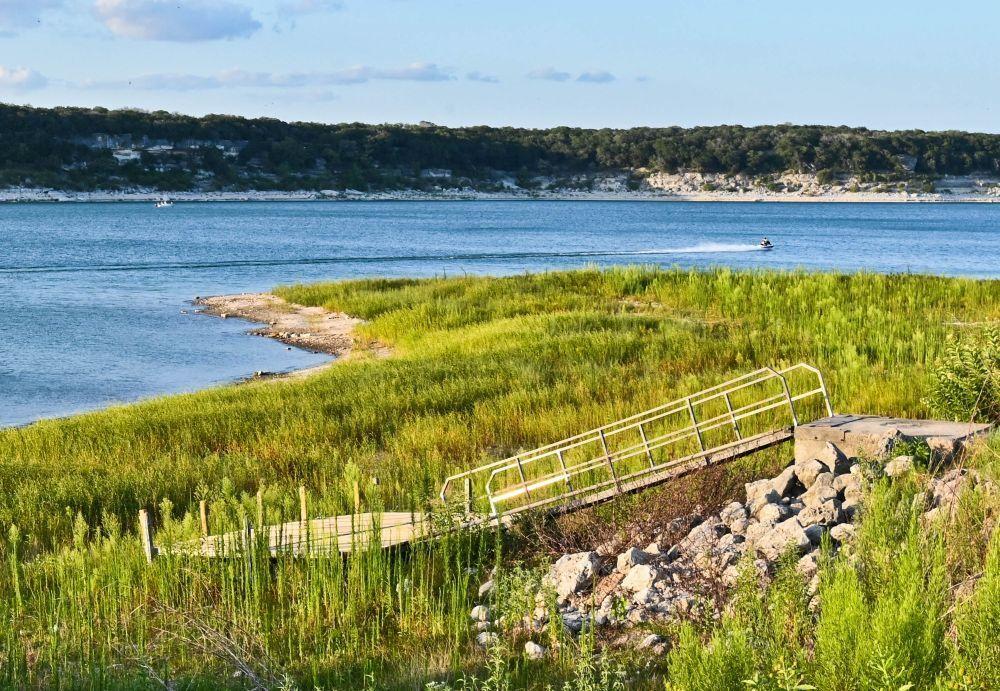
An out-of-water boat dock near The Sportsman Club at Lake Belton doesn’t deter anglers from fishing for trophy bass. Both Lake Belton and Stillhouse Hollow are more than 14 feet below normal levels.
Nan Dickson/Special to the Telegram
Editor’s note: This is one in an occasional series about water in Texas.
Killeen Daily Herald
By DAVID STONE | Special to the Telegram
July 15, 2023
Massive increases in population and continued drought could add stress to a thinning Texas water supply and force exploration of alternate sources of creating and storing drinking water.
According to the U.S. Census Bureau, Texas’ population hit 30 million last year and is expected to top 54 million by 2050 as newcomers continue to flock into the state. Texas, Arizona and Florida lead the nation in population growth, and Bell County is smack-dab in the middle of a booming Central Texas.
In 2010, the Census Bureau reported that Bell County had a population of 310,235. That number soared to 370,647 by 2020, and just three years later an additional 18,000 residents call Bell County home.
Charley Ayers, director of industry and educational partnerships for Workforce Solutions of Central Texas, said there are 55,000 more people in Bell, Lampasas and Coryell counties than there were just five years ago. Even more staggering: “We’re expecting another 58,000 people to move into the three-county area in the next five years,” he said.
Higher population numbers mean an increased need in drinking water, more showers and baths, more clothes to wash, more lawns to water and more cars to wash. In short — more people means more demand for Texas’ dwindling water supplies.
According to 2022 Texas State Water Plan numbers for Bell County, water needs are expected to increase from 1.22 billion gallons per year to 10.3 billion gallons by 2070.
While population growth has had a detrimental effect on available water, some experts say the bigger culprit has been ongoing drought associated with climate change.
According to Jay Banner, director of the University of Texas Environmental Science Institute, the number of 100-degree days in Central Texas could triple by the end of the century.
“Texas is known for extreme weather,” Banner said. “We have extreme rains, extreme drought and extreme heat, and a warming climate is going to increase those extremes.
“We could see a future of megadroughts — droughts that are at least 10 years in length,” he said. “Some western U.S. states have been in drought since 2000. In Central Texas, summers like the one we have now are becoming more common.
“One of the models we use to forecast drought is a count of days with high temperatures of at least 100 degrees. Over the past 10 years, Central Texas has averaged 40 100-degree days every year. But, unless we reduce greenhouse gas emissions, we are going to see up to 80 additional 100-degree days a year by the end of the century. That could mean 120 days of triple-digit heat — about a third of our year.
“Right now, the heat is expected in June, July, August and early September,” Banner said. “Where will the additional 80 days fit in? We could very well see 100-degree temperatures from April through October.”
Banner pointed out that people already struggle to pay summer electricity bills, and costs associated with running air conditioning will increase because of the extended heat.
“The cost of paying bills isn’t the only thing that will be affected,” he said. “There is going to be a significant increase in heat-related illnesses and quality of life will be curtailed because people won’t be going outside as often.”
On the other side of predictions, the development of an El Nino weather pattern may affect Texas differently. El Nino conditions typically lead to wetter, snowier conditions in Texas and cooler maximum temperatures during the winter, the National Weather Service said. Sometimes El Nino brings more rain in the Eastern Pacific Ocean that brings more moisture, including some flooding, to Texas.
Banner said the state and Texas counties and cities are preparing for the future to ensure a safe and secure water supply.
“As a state, we are exploring alternative sources of water such as desalination,” he said. “That’s where salt is removed from sea water. A water storage option being considered is Aquifer Storage and Recovery, the process of injecting water into the ground for storage and later recovering that water for use.”
According to Bell County Judge David Blackburn and Temple City Manager Brynn Myers, a coalition has been formed to study the needs and possible locations for Aquifer Storage and Recovery facilities in Bell County.
The coalition consists of the county, the cities of Temple and Rogers, the Brazos River Authority, Bell County Water Control and Improvement District No. 1, the Central Texas Water Supply Corp., Fort Cavazos and the Clearwater Underground Water Conservation District.
The coalition has identified 14 sites in the county suitable for an Aquifer Storage and Recovery facility, including locations on Fort Cavazos and in Temple, near Oscar, near Holland, at Patterson Crossing and at multiple locations near Rogers.